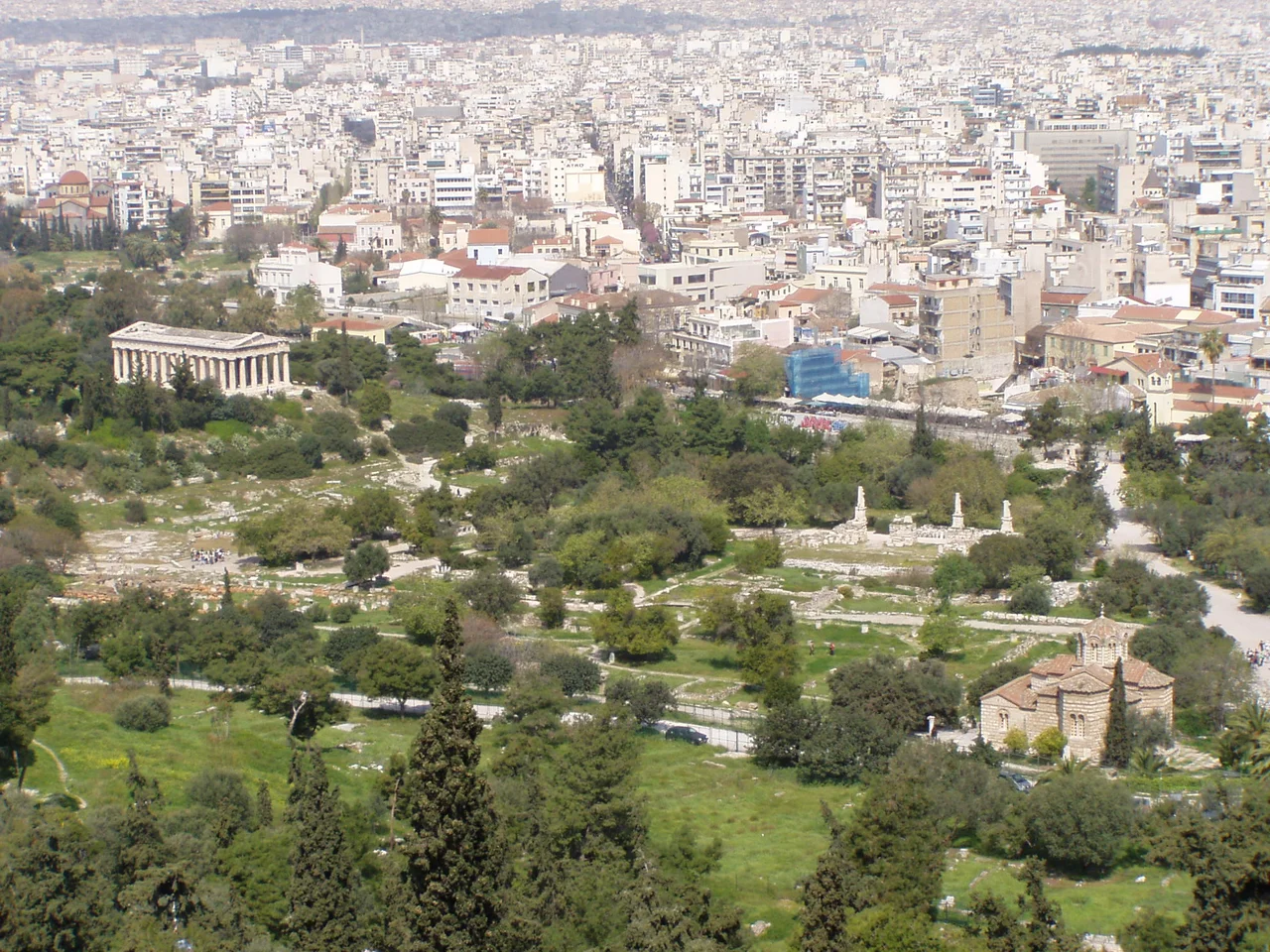

Synagogue in the Agora of Athens
In the summer of 1977, excavators digging near the heart of the Ancient Agora of Athens turned up a fragment of Pentelic marble, once part of a curved frieze above a doorway or niche. Carved into it were two unmistakable images: a seven-branched menorah and a lulav, the palm branch of the Jewish festival of Sukkot. A few meters away stood the Metroon, an old temple to a mother goddess. The fragment raised a quiet, tantalizing question that archaeologists are still careful not to answer too firmly. Was there once a synagogue here, in the civic center of pagan Athens?
A Community in the City
Jews had lived in Athens for a long time before that marble was carved. Written evidence places a Jewish community in the city from the second century BC, and a community of that age almost certainly maintained a place to gather and pray. These were not visitors but residents, part of the fabric of a Mediterranean world in which Greek-speaking Jewish communities reached from Alexandria to Asia Minor. The Agora was the beating center of Athens, a place of law courts, commerce, and public life. To worship at its edge was to be woven into the everyday rhythm of the city, not pushed to its margins.
The Fragment and the Theory
The case for a synagogue rests on careful inference rather than a standing building. Homer Thompson, who directed the Agora excavations, and the scholar A. Thomas Kraabel proposed that part of the Metroon may have been converted into a synagogue. The timing fits a wounded city. In 267 CE the Germanic Heruli sacked Athens, and in the aftermath buildings were repaired, repurposed, and rebuilt from the rubble. Kraabel suggested that a northern room of the old temple, shaped much like a Christian basilica, could have served the congregation. The marble fragment, found in a layer dating to the late fourth or early fifth century, points to a building put up in that long, uncertain recovery.
The Pauline Question
There is an older thread tangled into this story. The Acts of the Apostles describes the apostle Paul in Athens, reasoning "in the synagogue and in the Agora" with whoever happened to be there. For centuries that line has invited readers to picture a specific building. But the proposed Agora synagogue dates from after 267 CE, generations later than Paul, so it cannot be the one he visited. In 1941 the scholar William A. McDonald argued the point from the text itself: if Acts distinguishes the synagogue from the Agora, the synagogue Paul knew likely stood somewhere else in the city. The marble menorah and the famous verse, tempting as it is to join them, belong to different chapters.
What a Carving Carries
What we have is fragile and incomplete: one piece of marble, two carved symbols, and a community known mostly from a handful of references. The proposed synagogue, if it existed, did not last long. Tradition holds that the Visigoth king Alaric, who swept through Greece in the 390s CE, may have damaged it. Yet that single frieze fragment does real work. It testifies that Jewish life persisted in Athens deep into late antiquity, and that a menorah was carved with confidence in marble quarried from Mount Pentelicus, the same stone that built the Parthenon. The people who worshiped here left almost nothing behind. This one stone insists that they were here at all.
From the Air
The proposed synagogue site lies in the Ancient Agora of Athens near the Metroon, around 37.975°N, 23.722°E, just northwest of the Acropolis. Athens International Airport (LGAV) is about 30 km east. From above, the green expanse of the excavated Agora sits below the Acropolis rock and beside the reconstructed Stoa of Attalos, the clearest landmark in the area. Best viewed at low altitude on a clear day, when the open archaeological ground stands out against the surrounding city.
Nearby Stories
- Great Sand Beach 5 km away
- Battle of Delium 7.7 km away
- Tower of Aliartos 9 km away
- HMHS Britannic 10 km away
- Saronic Gulf 15 km away
- Sousaki Volcano 17 km away
- Sanctuary of Apollo Maleatas 24 km away
- Skyros 66 km away