
Syntagma Square
The square is named for a demand. On the night of 3 September 1843, soldiers led by Dimitrios Kallergis gathered before the Royal Palace and refused to leave until King Otto granted Greece a constitution. The Bavarian-born king appeared at his window with Queen Amalia, looked down on the crowd, and gave in. From that night the open ground outside his palace took the name it still carries: Plateia Syntagmatos, Constitution Square. Nearly two centuries later, Greeks still come here when they want their government to listen.
A King and His Window
Otto of Greece was seventeen when the great powers handed him a throne, a teenager from Bavaria ruling a country he had never seen. He moved the capital from Nafplio to Athens in 1834, and laid out two grand squares for his new city. This one, on the eastern edge of town, was first called simply Palace Square, named for the neoclassical building rising along its northern side between 1836 and 1843. But Otto governed through Bavarian officials and without a constitution, and the veterans of Greece's war for independence had not fought the Ottomans to be ruled by foreign bureaucrats. When they came for him in September 1843, the king's grand square became the stage for his humbling. The palace that gave the square its first name now houses the Greek Parliament, and the word for the people's victory replaced the word for the king's residence.
The Guard at the Tomb
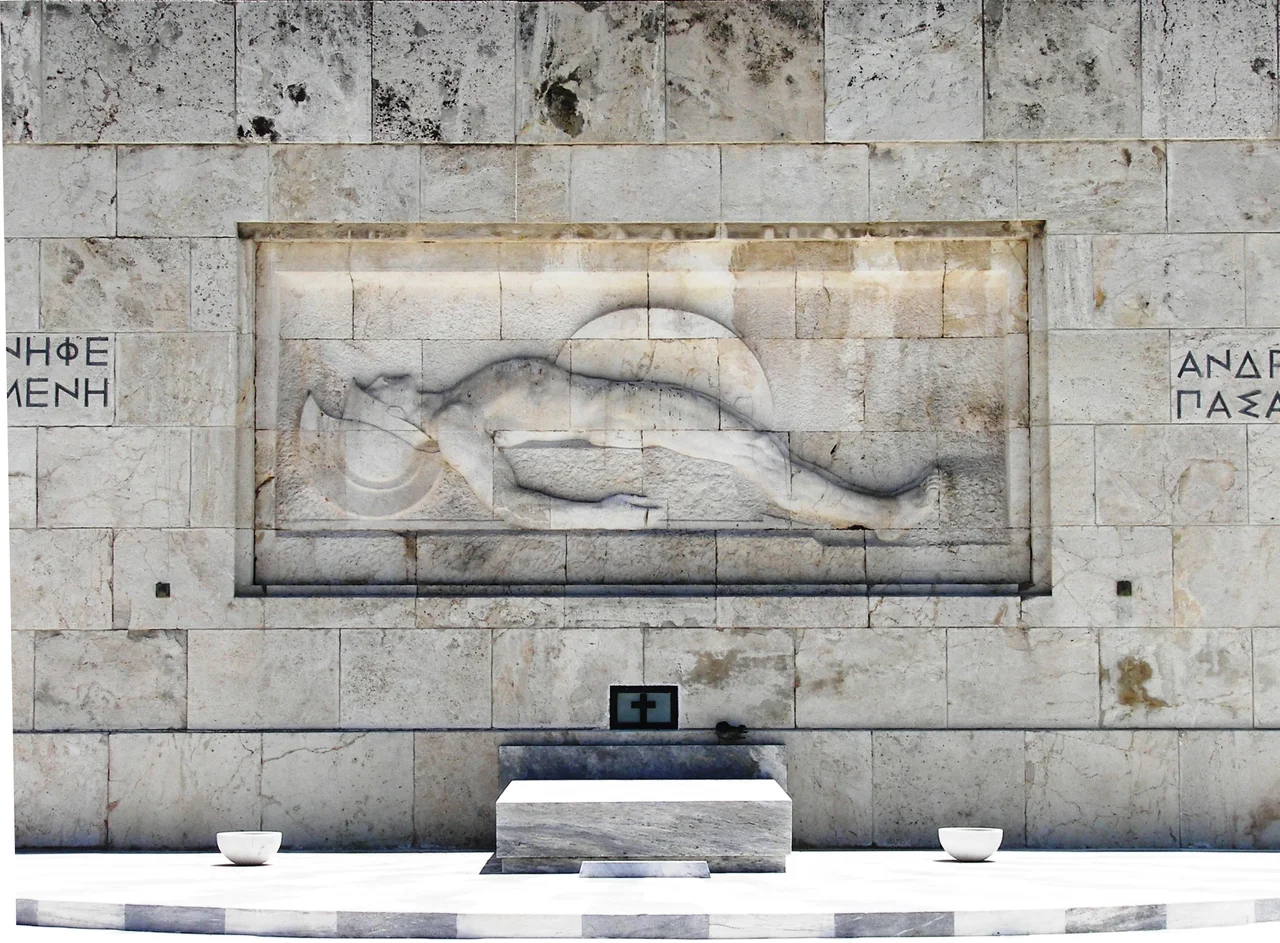
Across Amalias Avenue, on the marble forecourt of Parliament, stands the Tomb of the Unknown Soldier, watched day and night by the Evzones of the Presidential Guard. Every hour they perform the changing of the guard, a slow, deliberate ceremony of impossibly high kicks and frozen poses, the soldiers in pleated white kilts and shoes tipped with black pompoms. On Sundays the full ritual unfolds: an army band, and most of the 120 Evzones marching together at eleven in the morning. The movements look almost unnatural, each step held at the edge of motion. It is choreography as memorial, devotion performed in slow motion before the grave of a soldier no one can name.
Where the City Gathers
Climb the broad marble steps on the square's eastern side and you stand above one of the busiest crossroads in Greece. Beneath your feet, Metro lines 2 and 3 meet at Syntagma station, while the tram reaches its northern terminus and buses fan out toward the suburbs, the coast, and the airport. The steps surface between a pair of cafes, and the old mid-19th-century fountain still plays at the center. Shade trees fill the green margins to the north and south. This is the heart of Athens not by accident of geography but by design, the place where movement, commerce, and politics all converge on a single patch of marble and water.
The Sound of Crowds
What began with soldiers demanding a constitution never really ended. Between 2010 and 2012, as Greece reeled through its government debt crisis, the square filled again with tens of thousands of people, this time protesting austerity rather than autocracy. The setting carries its own argument: stand in Syntagma and you face the Parliament directly, the people on one side of the avenue and their representatives on the other, separated only by the tomb of a fallen soldier. That symmetry is the point. A square named for a promise wrung from a reluctant king remains the place where Greeks come to remind those in power who granted them their authority in the first place.
An Ancient Neighborhood
For all its modern role, Syntagma sits within easy walking distance of antiquity. The Acropolis, the Ancient Agora, Hadrian's Library, and the Tower of the Winds lie a short stroll west and south, while the old quarters of Plaka and Monastiraki spill toward them through narrow lanes. Even the square itself holds a fragment of deep time: a stretch of the Peisistratian aqueduct, built in the 6th century BCE to carry water to the ancient city, is displayed where commuters now pass. Medieval churches dot the surrounding streets. In Athens the centuries do not take turns. They share the same few blocks.
From the Air
Syntagma Square sits at 37.9756 N, 23.7347 E in central Athens, roughly 33 km west of Athens International Airport (LGAV / ATH). From the air it reads as a green-fringed rectangle directly west of the long, columned facade of the Hellenic Parliament and the broad National Gardens. The Acropolis rises about a kilometer to the southwest as the clearest landmark. Best viewed at low altitude on a clear day; the dense urban grid of central Athens makes the open square and palace forecourt stand out.
Nearby Stories
- Great Sand Beach 5 km away
- Battle of Delium 7.7 km away
- Tower of Aliartos 9 km away
- HMHS Britannic 10 km away
- Saronic Gulf 15 km away
- Sousaki Volcano 17 km away
- Sanctuary of Apollo Maleatas 24 km away
- Skyros 66 km away