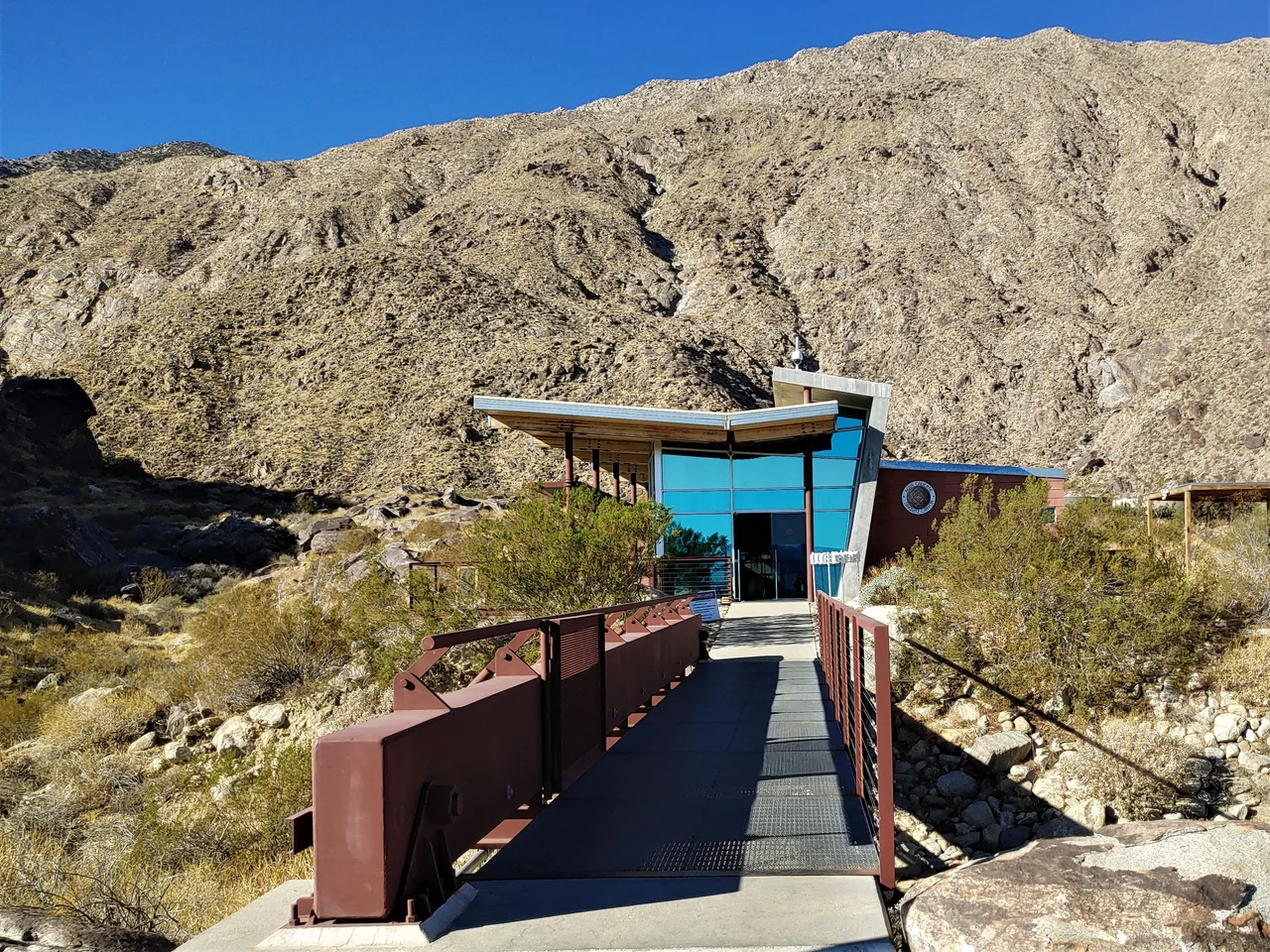

Tahquitz Canyon
There is a spirit in Tahquitz Canyon. The Cahuilla people call him Tahquitz — sometimes nukatam, which means shaman — and he was created by Mukat, the creator, in the beginning. He was the first shaman. He became corrupt, began stealing the souls of those who ventured too far into the canyon at night, and was cast out. He reveals himself as a green ball of light moving across the sky — what others might call a meteor — and when he passes through the earth, it shakes. The canyon that carries his name has been inhabited for over 5,000 years. The spirit and the place are inseparable.
Water in the Desert
Tahquitz Canyon cuts into the base of the San Jacinto Mountains above Palm Springs, carrying an intermittent stream that feeds Tahquitz Falls — a 60-foot cascade that is among the more dramatic water features in the Coachella Valley's mountain edge. The Cahuilla people who lived in and around the canyon for thousands of years developed irrigation ditches that predate any outsider settlement in the region. These ditches directed water from the canyon stream to agricultural areas below — evidence of sophisticated land and water management that was operational long before Spanish missionaries or American settlers arrived to impose different systems. The water that made life possible in the canyon is the same water that made the canyon spiritually significant.
Frank Capra's Lost Horizon
In 1937, director Frank Capra used Tahquitz Falls as a filming location for Lost Horizon, his adaptation of James Hilton's novel about Shangri-La — a hidden Himalayan utopia. The falls' dramatic height and lush desert canyon setting stood in convincingly for the mythical mountain paradise. It was not the last time the canyon would serve as a proxy for somewhere imagined rather than real; the landscape has a quality of controlled drama, narrow enough to feel enclosed and tall enough to feel otherworldly, that serves cinematic purposes. Capra himself became a regular presence in the region, often working on scripts at the La Quinta Resort a few miles away.
The Desert Plays
Between 1921 and 1930, writer Mary Hunter Austin and designer Garnet Holme used the mountains around Tahquitz Canyon as the setting for the Desert Plays — outdoor theatrical productions that drew on Indigenous stories, desert landscape, and an early twentieth-century impulse to connect performance with place. The productions took place in natural amphitheaters formed by the canyon's terrain, using the mountain backdrop and desert light as scenic elements that no constructed theater could replicate. The Desert Plays represented an unusual moment of cultural attention to the canyon's Indigenous significance during a period when most American cultural production ignored or erased Native American history.
From the Air
Tahquitz Canyon is located at the base of the San Jacinto Mountains directly above Palm Springs at approximately 33.50°N, 116.31°W. The canyon mouth is visible from the air as a dark notch in the mountain face immediately south and west of the Palm Springs urban area. Tahquitz Falls, at the canyon's upper reach, is not easily visible from altitude. Palm Springs International Airport (KPSP) is approximately 3 miles north-northeast of the canyon mouth. When flying approaches to KPSP from the south, the canyon mouth and the steep mountain face above are prominent terrain features — the San Jacinto peak rises to 10,804 feet just a few miles beyond, requiring careful altitude awareness on southern approaches.
Nearby Stories
- Borrego Valley Groundwater Basin 6.7 km away
- Chocolate Mountains 7.8 km away
- Imperial Valley Geothermal Project 7.9 km away
- Coachella Valley National Wildlife Refuge 13 km away
- Kumeyaay 15 km away
- Coxcomb Mountains 18 km away
- Cabazon Dinosaurs 20 km away
- Mountain Fire (2013) 24 km away