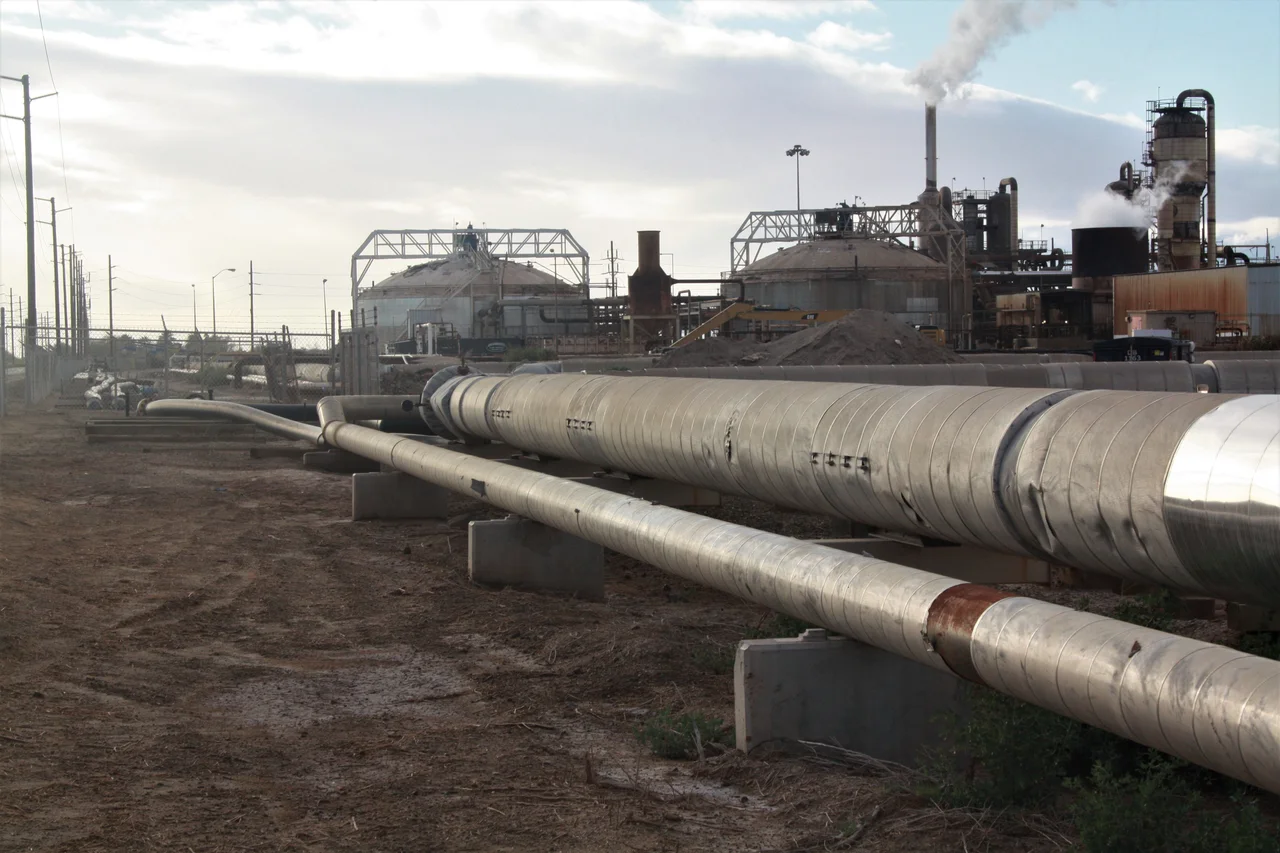

Imperial Valley Geothermal Project
Beneath the flat agricultural fields of Imperial County, at depths between one and three kilometers, superheated brine circulates through fractured rock at temperatures approaching 400 degrees Celsius. This is the Salton Sea Geothermal Field, and the eleven power stations that tap it represent the second largest geothermal resource in the United States, surpassed only by The Geysers in Northern California. Together they generate roughly 403 megawatts of electricity from heat that would otherwise remain unused underground. But the power generation is increasingly the secondary story. What the brine contains — lithium, rubidium, cesium, bromine, and other minerals — may matter far more to the coming decades than the electricity.
Heat from the Rift
The Imperial Valley's geothermal abundance is a direct consequence of its tectonic setting. The region sits at the northern end of the Gulf of California extensional zone, where the East Pacific Rise — a spreading ridge that opened the Gulf of California — meets the San Andreas Fault system. As the crust stretches and thins, magma rises closer to the surface, elevating the geothermal gradient to levels far above the continental average. Rainwater percolating downward heats to extreme temperatures, dissolving minerals from surrounding rocks and concentrating them into the dense, salty brine that geothermal operators pump to the surface. Once the heat has been extracted to drive turbines, the cooled brine has traditionally been reinjected into the ground — a closed-loop process that avoids surface disposal of the mineral-laden fluid. That reinjection step is now the subject of intense interest, because the fluid being sent back underground contains something extraordinarily valuable.
The Lithium in the Brine
The brine of the Salton Sea Geothermal Field contains lithium at a concentration of approximately 202 parts per million — more than five times the concentration found in the Dead Sea and substantially higher than most lithium brine deposits currently mined commercially. The California Energy Commission has estimated that the field could potentially yield 600,000 metric tons of lithium carbonate per year from a total reserve of 3.4 million tonnes. To put that in perspective, the United States currently imports the vast majority of its lithium from South America and Australia. A domestic source of this scale, co-located with existing geothermal infrastructure and capable of producing electricity and battery materials simultaneously, represents a genuinely unusual opportunity.
The Electric Vehicle Connection
In 2021, General Motors announced a strategic partnership with Controlled Thermal Resources, an Australian company developing a combined geothermal power and lithium extraction facility at the Hell's Kitchen site within the geothermal field. The agreement was designed to secure a domestic supply of battery-grade lithium for GM's Ultium battery platform, which underpins the company's electric vehicle transition. The process CTR is developing extracts lithium from geothermal brine as a byproduct of power generation — using the same fluid that drives turbines to produce lithium hydroxide and lithium carbonate through a closed-loop chemical process. Berkshire Hathaway Energy, which already operates ten geothermal plants in the area through its BHE Renewables division, has separately planned a lithium carbonate pilot plant. The Imperial Valley is positioned, if the technology performs as hoped, to become a critical node in American battery supply chains.
Potential and Patience
Geothermal projects operate on long timelines. The technology for extracting battery-grade lithium from geothermal brine at commercial scale is proven in principle but not yet demonstrated at the volumes the projections assume. The 2,950 megawatt total potential of the Salton Sea Geothermal Field — of which only 403 megawatts is currently developed — suggests decades of additional buildout before the resource is fully utilized. Environmental reviews, water rights, transmission infrastructure, and the inherent capital intensity of geothermal development all impose constraints on the timeline. What is clear is that the valley floor, which looks from altitude like nothing more than a grid of irrigated fields, sits atop one of the most energetically and mineralogically extraordinary geological formations in North America.
From the Air
The Imperial Valley Geothermal Project facilities are scattered across the area around 33.163°N, 115.617°W, south and southeast of the Salton Sea. From altitude, the geothermal plants are visible as industrial clusters with cooling towers amid the agricultural fields. The Salton Sea is visible to the north. Imperial County Airport (IPL) is approximately 8 miles south near El Centro.
Nearby Stories
- 1915 Imperial Valley Earthquakes 8 km away
- Coyote Mountains 8.5 km away
- Ocotillo Wells, California 11 km away
- Chocolate Mountains 12 km away
- Whitewater River 13 km away
- Old Plank Road 20 km away
- Felicity, California 47 km away
- Poston War Relocation Center 84 km away