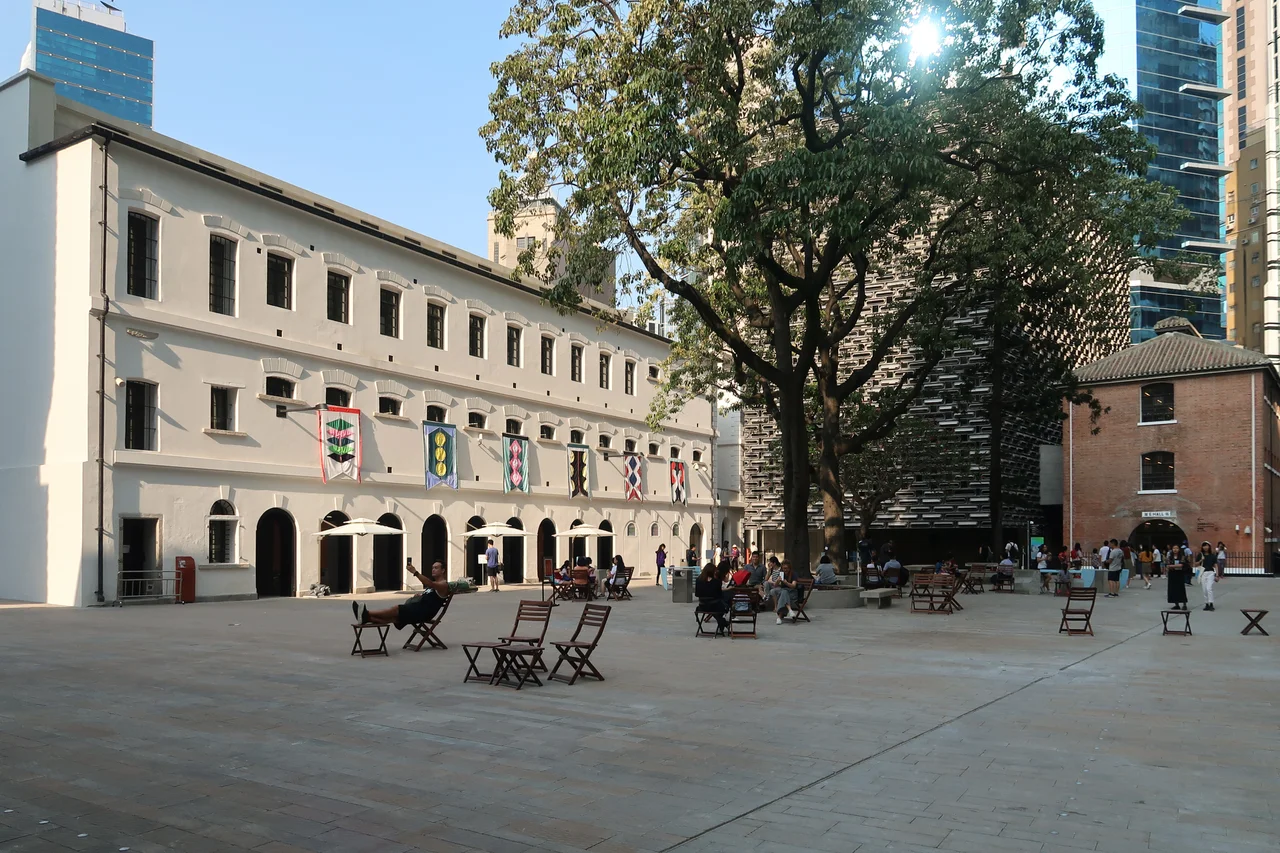

Tai Kwun
The cells of Victoria Prison once held Hong Kong's accused. Today, the same brick walls shelter exhibitions, bars, and performance spaces. When the gate swings open on what is now Tai Kwun, visitors cross a threshold between eras — from colonial authority into something harder to categorize: a living museum that still feels inhabited, still charged with the weight of what happened here.
Cop Shop to Cultural Hub
Three institutions share the walled compound on Hollywood Road: the Former Central Police Station, the Former Central Magistracy, and Victoria Prison. Together, their 16 historic buildings trace the arc of colonial justice from arrest to sentencing to incarceration. Construction began in 1841, not long after British forces first planted a flag on Hong Kong Island, and the complex grew piecemeal through 1925 as the colony expanded and its enforcement needs grew with it. Most of Hong Kong's colonial architecture didn't survive the development boom that followed the 1997 handover. This compound did — partly through luck, partly through obstinacy, and partly because a prison in active use is hard to demolish. Victoria Prison closed in 2006, finally ending over a century and a half of continuous operation.
A Billion-Dollar Bet on the Past
Preserving old bricks in a city that tears down and rebuilds faster than almost anywhere on Earth requires both money and political will. In 2008, the Hong Kong Government and the Hong Kong Jockey Club formed an unlikely partnership to rescue the compound. The cost eventually reached HK$1.8 billion, making it one of the most expensive heritage revitalisation projects ever undertaken in the territory. The project wasn't smooth. A wall and roof collapse in 2016 halted work and triggered prosecution of a subcontractor whose actions were found to have structurally undermined a brick pier. When Tai Kwun finally opened in phases beginning 29 May 2018, it did so with both restored heritage buildings and two newly constructed additions — their contemporary design deliberately drawing from the compound's historic brickwork, echoing without copying.
The Parade Ground in a Different Light
The former parade ground at the heart of the compound is now a public gathering space, open to the city that once entered only under duress. Galleries, studios, restaurants, and a boutique hotel fill the surrounding blocks. The inaugural exhibition, "100 Faces of Tai Kwun," introduced the place to the public on opening day — a fitting beginning, emphasizing the human stories that accumulated here across generations. Time magazine included Tai Kwun in its "World's Greatest Places 2018" list. The following year, UNESCO awarded the project its Asia-Pacific Award of Excellence for Cultural Heritage Conservation. These honours recognize something the designers understood from the start: the goal wasn't to erase the compound's difficult past, but to keep it visible while making room for something new to grow alongside it.
What the Walls Remember
Walking through Tai Kwun, the architecture resists nostalgia. The brickwork is clean and the ironwork restored, but the proportions of the old prison blocks haven't changed — the narrow windows, the long corridors, the sense of enclosure. B Hall, the surviving prison cell block, is perhaps the most striking reminder of what this place was. The stone floors, the barred doors, the shallow cells: the building doesn't hide what it was designed for. There is something meaningful about the fact that Hong Kong chose to preserve this rather than erase it. In a city under significant political pressure, the decision to keep these walls standing — and to fill them with art — is an act that invites multiple readings.
From the Air
Tai Kwun sits at 22.2813°N, 114.1540°E in Central, Hong Kong Island, tucked between Hollywood Road and Old Bailey Street on the northern slope rising toward Victoria Peak. Approaching from the southwest at 2,000 feet, you can trace the dense grid of Central's towers giving way to the compound's comparatively low brick profile. VHHH (Hong Kong International Airport) is approximately 30 km to the northwest on reclaimed land at Chek Lap Kok. On clear days, the distinctive ridge of Victoria Peak (552 m) provides an unmistakable navigational landmark directly south.
Nearby Stories
- Lok Ma Chau Loop 2.3 km away
- Portas do Cerco 2.3 km away
- Kweilin Incident 17 km away
- Wanshan Archipelago Campaign 34 km away
- Nanxiong Formation 115 km away
- Battle of Nanpeng Island 148 km away
- Heyuan 169 km away
- Cape Maobitou 632 km away