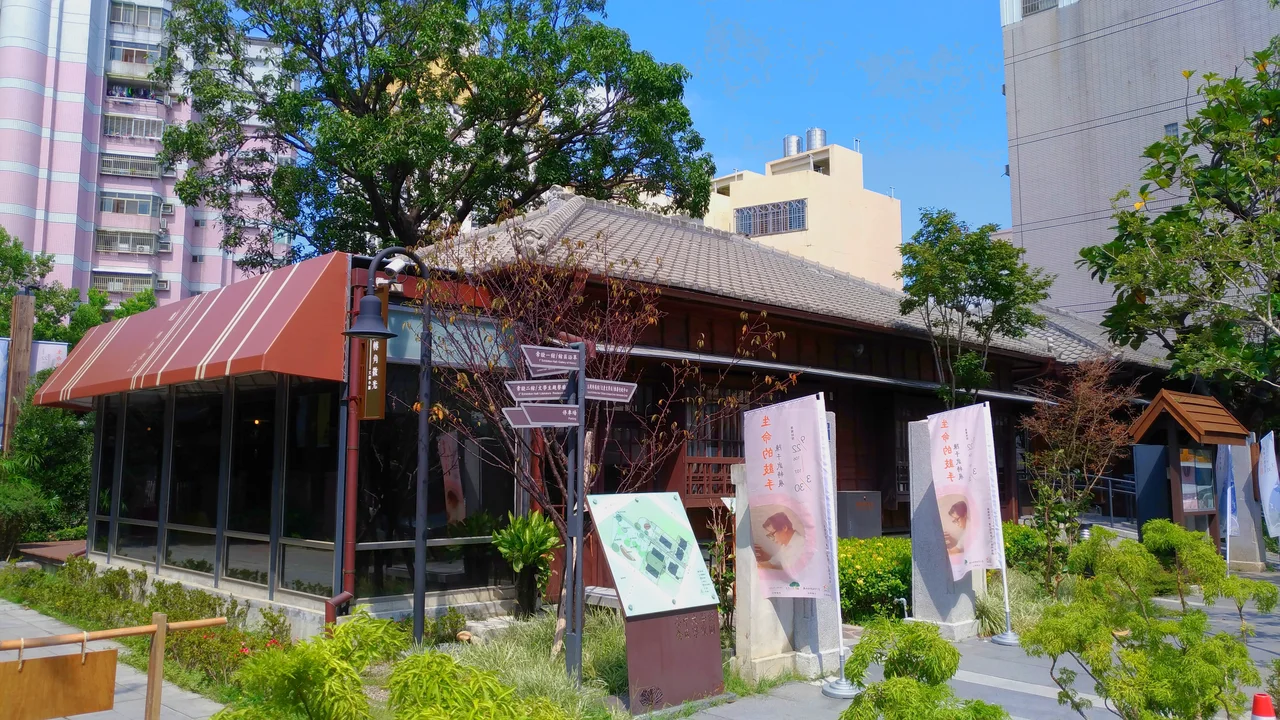

Taichung Literature Museum
In 1934, police officers assigned to Taiwan's colonial administration moved into a new dormitory complex in Taichung's West District. The buildings were functional and orderly, built in the Japanese residential style of the era — low-pitched roofs, wooden interiors, disciplined geometry. Nobody who lived there would have predicted that eighty years later, the same rooms would host poetry readings, children's story hours, and exhibitions celebrating the writers who defined modern Taiwanese literature. Yet that is what happened. The Taichung Literature Museum opened fully on August 26, 2016, and the transformation — from police dormitory to literary sanctuary — turns out to be a quietly perfect metaphor for what literature does.
Buildings That Outlasted Their First Purpose
The complex was constructed in 1934 during Japan's administration of Taiwan, as residential quarters for police officers stationed in Taichung. For the next seven decades the buildings served institutional purposes, aging through the postwar transition to Republic of China governance without particular distinction. By 2009, they had acquired a new kind of value: the Cultural Affairs Bureau of the Taichung City Government designated them as historical buildings, recognizing their architectural and historical character. Renovation began in April 2010. The museum's exterior and park opened to the public in April 2015; the full interior followed on August 26, 2016. The process of making a literature museum out of a police dormitory required both physical restoration and imaginative transformation — and both succeeded.
Six Buildings, One Park, Many Rooms for Writing
The campus consists of six individual structures and a literature park that links them. Each building has been assigned a distinct function. One houses the permanent exhibition, tracing the arc of Taichung's literary history and the broader story of Taiwanese literature through the twentieth century and beyond. Another is dedicated to themed exhibitions that rotate through — artist retrospectives, genre explorations, regional literary traditions. A third building is given over entirely to children's literature: smaller scale, bright and welcoming, designed to make the youngest visitors feel that books were built for them. Workshops and lectures fill another building. A themed eatery occupies one wing, where reading and eating happen in comfortable proximity. The administration office keeps the whole operation running from the last. Between the buildings, the literature park provides a green and shaded space where visitors can sit with a book or simply be outdoors in an urban neighborhood that rarely offers this kind of breathing room.
Literature as a Form of Resistance and Identity
To understand why Taichung — and Taiwan more broadly — would dedicate a campus to literary culture requires some history. Taiwan's twentieth century was defined by successive administrations that controlled not only what people did but what they wrote and read. Japanese colonial censorship shaped literature during the colonial period. After 1945, decades of martial law under the Kuomintang brought new restrictions, new required languages, and new categories of forbidden expression. Taiwanese writers navigated all of this — some compromising, some circling around the rules, some writing things that circulated only in private. The literature that emerged from these pressures is richer and stranger for having been shaped by them. A museum dedicated to this tradition is not a neutral cultural institution. It is a declaration that those words mattered.
A Place in the West District
The museum occupies a quiet corner of Taichung's West District, a neighborhood that has accumulated layers of colonial and postwar architecture without losing the residential scale that makes it walkable and human. The campus sits at roughly 24.140°N, 120.673°E — close to Taichung's historic core but set back from the busier commercial streets. Mornings on the park grounds have a particular quality: the old wooden buildings, the filtered light through established trees, the sense of time moving at a different pace than the city just outside the gate. If you come looking for the poetry of a place rather than just the facts of it, this is a good place to start.
From the Air
The Taichung Literature Museum is located at approximately 24.140°N, 120.673°E in Taichung's West District. The campus of six wooden Japanese-era buildings with a central garden park is best appreciated at low altitude, around 1,500 to 3,000 feet, where the contrast between the museum's green grounds and the surrounding dense urban fabric becomes visible. The nearest major airport is RCMQ (Taichung International Airport / Ching Chuang Kang), approximately 10 nautical miles north-northwest. Taichung Station is roughly 1 kilometer to the southeast and provides useful orientation when flying over the city center.
Nearby Stories
- Taroko National Park 4.5 km away
- Jiji, Nantou 9 km away
- Miaoli Ceramics Museum 9.2 km away
- Smangus 17 km away
- Taixi, Yunlin 23 km away
- Lintianshan Forestry Culture Park 24 km away
- Taiwan Strait 52 km away
- China Airlines Flight 611 60 km away