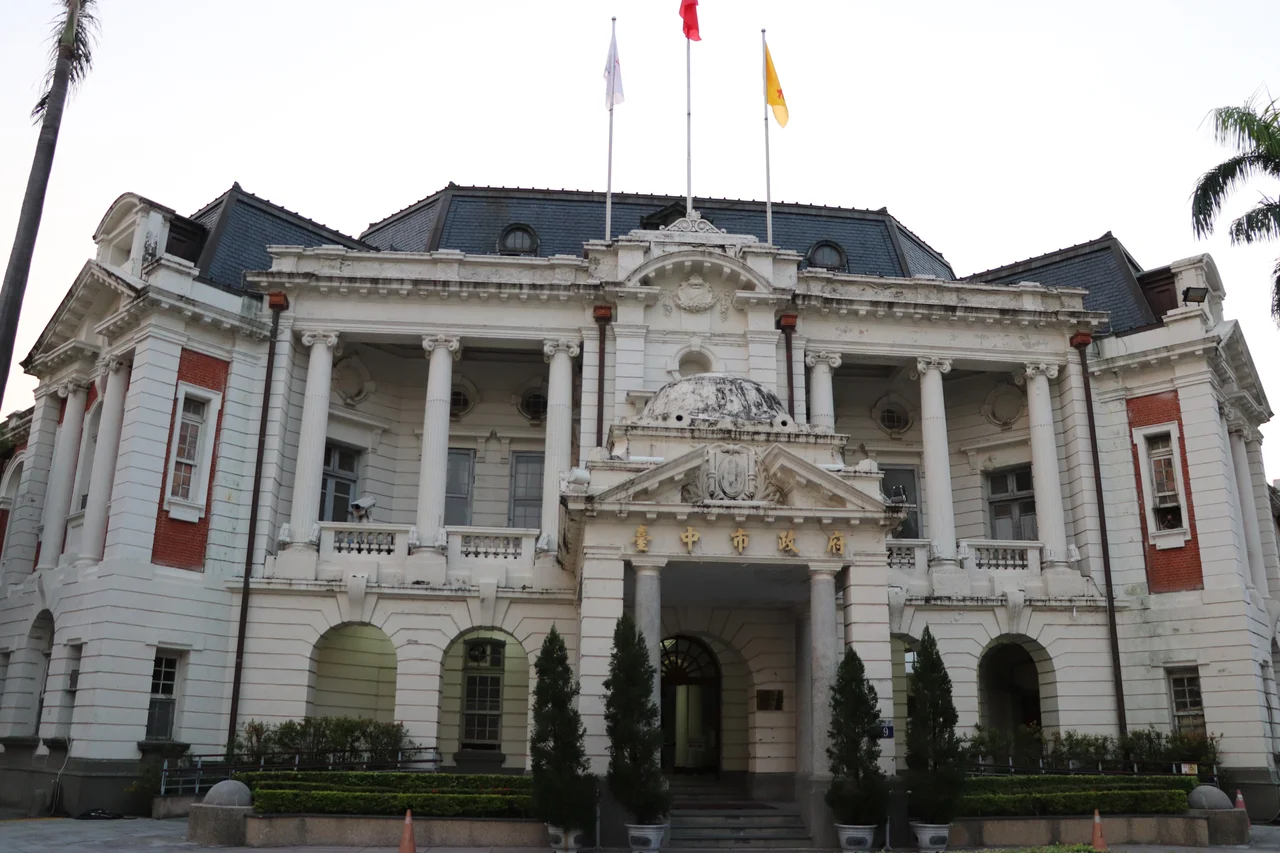

Taichung Prefectural Hall
The building arrived in pieces, across two decades. What began in 1913 as a prefecture hall for the Japanese administration of Taichū went through four successive expansions before reaching its final form in 1934. By then it had taken on the character it still carries: a Baroque-style structure with a mansard roof and a corner entrance flanked by two symmetrical wings, as imposing as any government building of its era in Taiwan. It was designed to project authority. Over the following century, it would hold that quality long after the authority that built it was gone.
Built to Govern, Built to Last
The Japanese who built the Taichū Prefectural Hall in 1913 were in the business of permanence. Colonial architecture was a statement: we are here, we are organized, we are modern. The building's Baroque style — borrowed from European civic tradition, applied to a subtropical Taiwanese city — communicated ambition. The mansard roof, the corner placement with the main entrance at the building's diagonal axis, the wings extending from either side: all of it follows a formal grammar of institutional power. The last of four expansions was completed in 1934, giving the building the scale it needed to match Taichū's growing status as a major Japanese colonial city. Few structures from that era survived intact. This one did.
From Prefecture to Bureaucracy to Heritage
After 1945, when Japanese rule ended and the Republic of China took control of Taiwan, the hall shifted roles without changing its walls. It became the office of the Environmental Protection Bureau of the Taichung City Government — useful space in a city that needed administrative buildings, even old ones. Its institutional continuity was almost mundane: a Japanese prefecture hall, now a Taiwanese government office. Heritage recognition came slowly. The building was designated a historic building in 2002, then elevated to a city-designated historic building in 2006. In November 2017, the Bureau of Cultural Affairs pushed for national-level recognition. The formal application followed in April 2018, and in January 2019, the Taichung Prefectural Hall was officially designated a national historic monument.
A Future in Dispute
What to do with a century-old government building in the middle of a modern city? In 2018, plans emerged to transform the hall into the Taichung Prefectural Hall Park, a cultural project overseen by the National Taiwan Museum of Fine Arts with an estimated cost of NT$1.05 billion. An additional NT$1.2 billion was set aside for an archive devoted to local art history and photography. It was an ambitious reimagining — and it lasted less than two years. In February 2020, Mayor Lu Shiow-yen announced that her administration was withdrawing from the agreement with the museum. The hall would not become an art museum branch. What it would become was left unresolved, but the building endured the controversy as it had endured everything else: still standing, still grand, still waiting.
Light Festival and Living City
Whatever its administrative fate, the building has not waited passively. It has been incorporated into the annual Taichung Light Festival, organized by the Cultural Affairs Bureau, when projections and installations transform its Baroque facade into a canvas for light art. The effect is startling — colonial architecture meeting digital spectacle, the building's formal geometry suddenly alive with colour and motion. Seminars and civic events have found a home inside its halls. The Taichung Prefectural Hall sits within walking distance west of Taichung Station on the Taiwan Railway, which means it is close enough to the city's main transit hub to be genuinely accessible. A century after it was built to house Japanese prefecture administration, it is still, in its way, at the centre of things.
From the Air
The Taichung Prefectural Hall stands at 24.139°N, 120.678°E in the West District of central Taichung, a short distance west of Taichung Station. From the air at 2,000–4,000 feet, its Baroque roofline and corner configuration are distinguishable among the lower surrounding buildings of the historic city core. The nearest major airport is Taichung International Airport (RCMQ), approximately 8 km to the west. The building is most easily identified from a westward approach following the rail corridor through central Taichung.
Nearby Stories
- Taroko National Park 4.5 km away
- Jiji, Nantou 9 km away
- Miaoli Ceramics Museum 9.2 km away
- Smangus 17 km away
- Taixi, Yunlin 23 km away
- Lintianshan Forestry Culture Park 24 km away
- Taiwan Strait 52 km away
- China Airlines Flight 611 60 km away