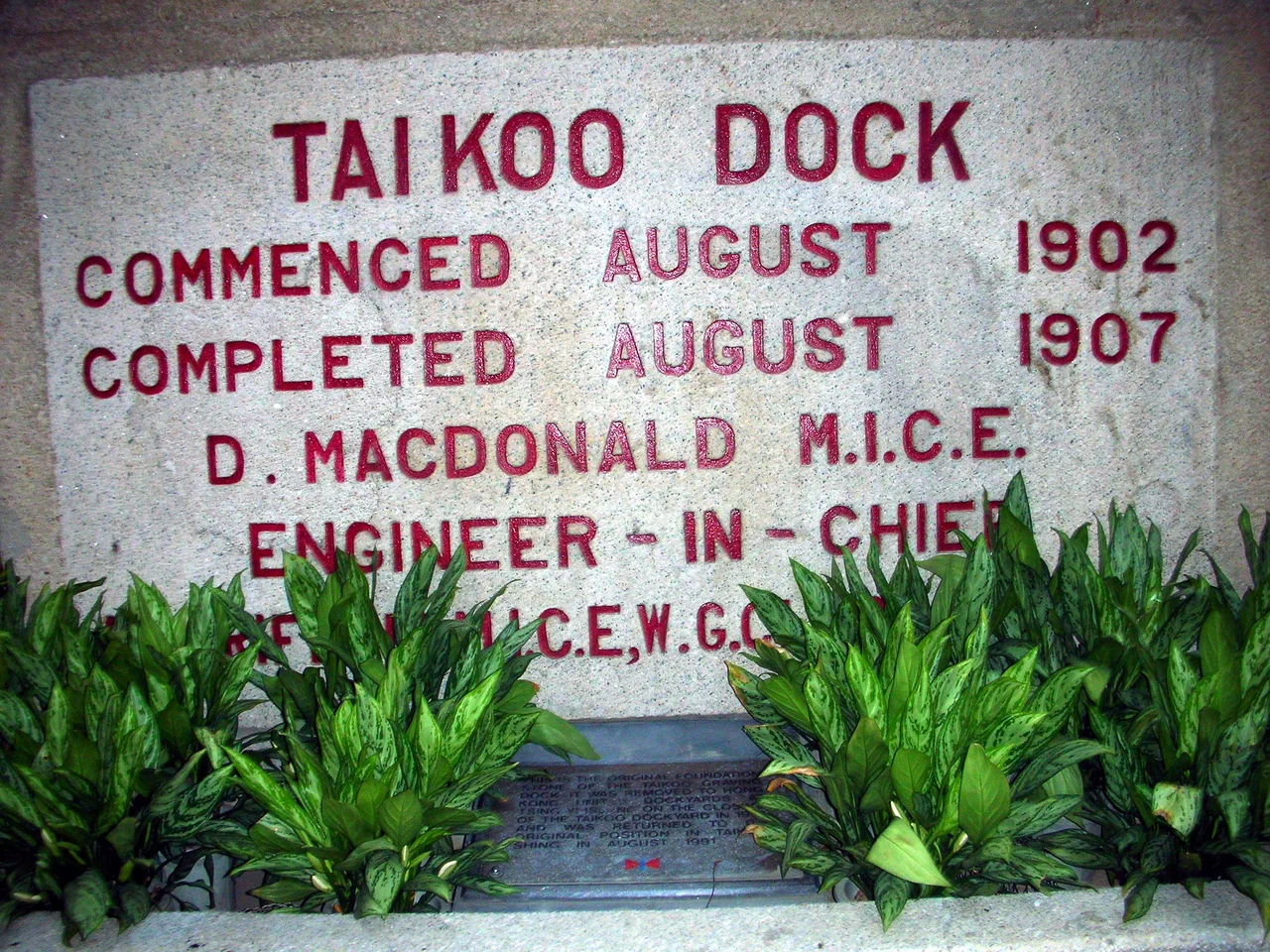

Taikoo Dockyard
John Samuel Swire said no. Several times, in the late nineteenth century, someone within John Swire and Sons proposed that the family firm should build its own dockyard in Hong Kong to service the China Navigation Company's growing fleet. Swire — the elder, the patriarch — kept blocking it as uneconomic and too far outside the firm's trading interests. He died in 1898. The dockyard was begun in 1900.
Sugar Land and Surplus Space
The opportunity came from an accident of geography. When John Swire and Sons established the Taikoo Sugar Refinery at Quarry Bay in the 1880s, the site proved larger than the refinery needed. The surplus land sat on the harbourfront. The case for a dockyard — made repeatedly and repeatedly rebuffed — became obvious once you looked at a map: the land was there, the ships were there, the need was certainly there. After Swire's death, the firm registered the Taikoo Dockyard and Engineering Company in Britain, appointed Butterfield and Swire as Eastern Managers, and brought in Scotts Shipbuilding and Engineering Company as technical advisers. Work began in 1900 or 1901 at what was then still a relatively undeveloped stretch of Hong Kong Island's northern shore. What the firm built there over the next seven decades would reshape both the waterfront and the city.
Slow Profit, Long Patience
The Taikoo Dockyard's financial history was a lesson in industrial patience. The first ship for the China Navigation Company came off the ways by 1910 — nearly a decade into operations. But profit waited another six years. It was sixteen years before the working account showed a surplus, and twenty before the firm declared a dividend. Meanwhile, the dockyard's chief competitor, the Hong Kong and Whampoa Dock Company, made the early years difficult, responding to Taikoo's arrival with what the records describe as "considerable hostility." The two firms eventually reached a working agreement in 1913, dividing Hong Kong's considerable repair and shipbuilding trade between them. Together, Taikoo and Whampoa would build some of the largest vessels that ever slid down the ways in the British Empire outside the home islands.
Ships That Went to War
The ships Taikoo launched carried names from the rivers and provinces of China — Wuchang, Anhui, Wusueh — and lives that went far beyond the Pearl River trade. The Wuchang, built in 1914 as a Yangtze passenger steamer, was converted into a submarine depot ship and used in the evacuation of Singapore in 1942. The Autolycus, a 5,806-ton steamer completed in 1917 for the Ocean Steam Ship Company, was the largest vessel ever built in a British territory outside the United Kingdom at the time of its launch. The Breconshire, a 10,000-ton passenger-cargo liner built in 1939 for the Glen Line, was the largest ship built by any Hong Kong dockyard to that date. One vessel built in 1933, later captured by the Imperial Japanese Army, changed hands several times after the war and finally sank with the loss of 88 lives during Typhoon Rose in 1971.
The Harbour Before Reclamation
The Taikoo Dockyard predates the reclamation of Victoria Harbour in its current form. Old maps show the original shoreline at Quarry Bay cutting much further south than today's waterfront, with the dockyard slips extending directly into water that is now dry land — or, more precisely, the foundations of Taikoo Shing, one of Hong Kong's largest private housing estates. The MTR Tai Koo station sits over what was once the centre of the dockyard basin. Taikoo Place, the commercial office development, covers another substantial section. Walking from the MTR exit to Cityplaza shopping mall today, you cross ground that was once covered in steel, smoke, and the sound of riveting hammers. Almost nothing above ground gives any indication of it.
Into Hong Kong United Dockyards
The Taikoo Dockyard eventually merged with the Whampoa Dockyard — the competitor it had reached a truce with in 1913 — to form the Hongkong United Dockyards. The merged operation moved to the west coast of Tsing Yi Island, in the New Territories, where deep water and space allowed for modern container-era ship repair. The Quarry Bay site was cleared and developed from the 1970s onward, its industrial character replaced entirely. The transformation from working dockyard to residential and commercial district is one of the cleanest breaks in Hong Kong's urban history: a site that built warships and river steamers for seventy years left so little physical trace that only the name Taikoo — still on the MTR station, the shopping mall, the housing estate, the office towers — survives to mark it.
From the Air
The former Taikoo Dockyard site is located at approximately 22.286°N, 114.217°E in the Quarry Bay district on the northern shore of Hong Kong Island. Today the site is occupied by Taikoo Shing residential estate, Taikoo Place offices, and Cityplaza mall. From the air, the area is identifiable by the dense residential towers of Taikoo Shing directly north of the country park hills. Victoria Harbour is immediately to the north, with Kowloon visible across the water. Nearest airport: Hong Kong International Airport (VHHH), approximately 33 km to the northwest on Lantau Island. The former Kai Tak runway site — itself reclaimed — is approximately 5 km to the northwest across the harbour. At 2,000–4,000 feet, the transition from harbour waterfront to Quarry Bay commercial district to the green hillside of Tai Tam Country Park directly to the south is clearly visible.
Nearby Stories
- Lok Ma Chau Loop 2.3 km away
- Portas do Cerco 2.3 km away
- Kweilin Incident 17 km away
- Wanshan Archipelago Campaign 34 km away
- Nanxiong Formation 115 km away
- Battle of Nanpeng Island 148 km away
- Heyuan 169 km away
- Cape Maobitou 632 km away