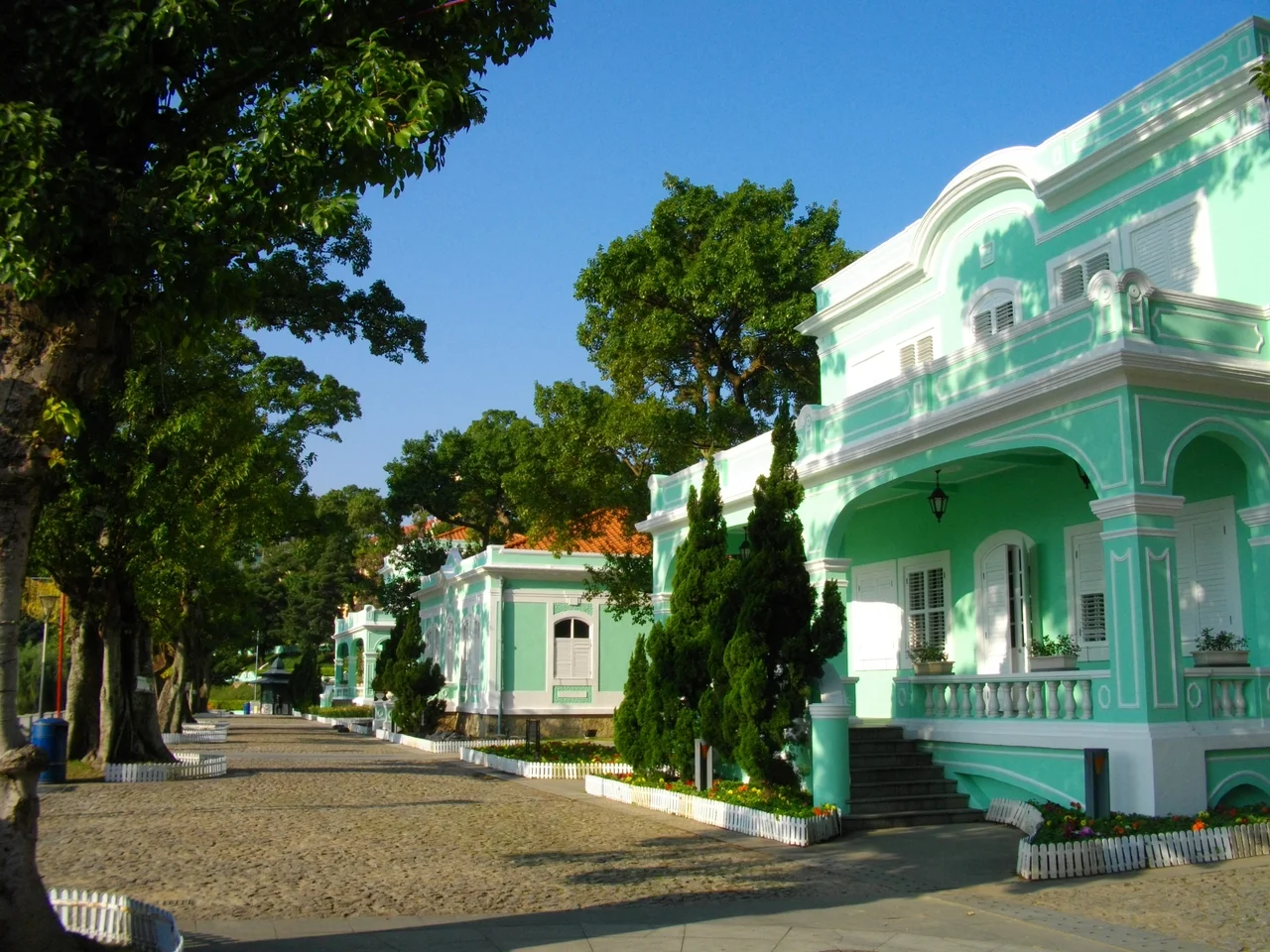

Taipa Houses–Museum
The five houses were built in 1921 to face the sea. That was their defining characteristic: a row of pale colonial villas on Taipa's waterfront, oriented toward the channel between the island and Coloane, built for well-off Portuguese families who wanted a view with their verandas. The sea is gone now. Land reclamation between Taipa and Coloane through the twentieth century created what became Cotai — the mega-resort strip — and what had been open water is today a small remnant wetland. The houses still stand, their facades looking out over a changed world, and since December 1999 they have functioned as the Taipa Houses–Museum, a preserved record of the domestic culture that once animated them.
A Particular Kind of Colonial Afternoon
Four of the five houses are museum spaces, arranged to recreate the interior life of prosperous Portuguese families in Macau during the first half of the twentieth century. The rooms are furnished and dressed: dining tables set for formal meals, parlors arranged for receiving guests, bedrooms with period furniture, kitchens equipped with the tools of their era. The effect is less like a conventional museum — objects in cases, labeled and distanced — and more like walking through a household where the family has recently stepped out. The restoration aimed specifically at the domestic, the everyday, and the intimate. These were private homes before they became public exhibits, and that origin is still legible in the scale of the rooms and the particular details the curators chose to preserve and display.
The Architecture of a Distant Portugal
The houses are built in the Portuguese colonial style that gives Taipa's old village much of its visual character: stucco facades painted in soft colors, shuttered windows, covered verandas, a formal symmetry suited to the tropics. The style traveled from Lisbon and Oporto through Goa and Malacca to Macau, adapting at each stop to local climate and local materials while retaining a recognizable visual vocabulary. In Taipa, the houses represent one of the cleaner surviving examples of that vocabulary — well maintained, restored with care, and concentrated in a way that makes the streetscape legible as a coherent environment rather than isolated remnants. The last of the five houses was restored in 1999, the year the museum opened on December 5.
The Sea That Disappeared
Understanding the Taipa Houses means understanding what Cotai has done to the landscape around them. For decades, the strip of water between Taipa and Coloane was a working waterway — part of the maritime geography of the Pearl River delta, visible from the verandas of houses built expressly to command the view. Land reclamation, which has been reshaping Macau's coastline incrementally since the nineteenth century, intensified dramatically in the 1990s and 2000s as the casino economy required space for resort development. The water between the islands became land. The houses, which once looked out over open water from the southern edge of Taipa, now look out over a wetland that is itself a remnant of the channel that no longer exists. It is a small, visible record of a much larger transformation.
Lusofonia and Living Use
The fifth house in the complex does not function as a museum gallery. It serves as an event venue, keeping the site actively in use for community and cultural purposes rather than purely curatorial ones. Each autumn, the Cultural Affairs Bureau of Macau organizes the Lusofonia Festival in the open space surrounding the houses — a celebration of the Portuguese-speaking world that draws participants from across the network of former Portuguese territories. The museum is administered by the Cultural Affairs Bureau and forms part of Macau's effort to preserve the material and cultural heritage of its colonial period, a heritage that sits alongside and intertwines with the Chinese cultural tradition that also runs deep in Taipa's history. Together the houses serve as a place where that coexistence is made visible and inhabitable.
From the Air
The Taipa Houses–Museum sits at approximately 22.15°N, 113.56°E on the southern edge of Taipa's old village, facing what was once the Cotai waterway and is now reclaimed land. From the air, the old village of Taipa is visible as a compact cluster of low-rise Portuguese colonial architecture south of the Cotai development strip, which is characterized by large resort complexes and wide boulevards. Recommended viewing altitude: 2,000–4,000 ft for a clear view of the contrast between old Taipa village and the Cotai development. The Macau International Airport (VMMC) is approximately 3 km to the northeast on the eastern coast of Taipa Island. The Governador Nobre de Carvalho Bridge connecting Taipa to the Macau Peninsula is visible to the north. VHHH (Hong Kong International) is approximately 50 km to the northeast.
Nearby Stories
- Tai Tau Chau (Southern District) 0.7 km away
- Lai Chi Wo 3 km away
- Wanshan Archipelago Campaign 3.2 km away
- Pearl River Delta 3.7 km away
- Battle of Yamen 13 km away
- Jiangmen 15 km away
- Hong Kong 12 32 km away
- Battle of Nanpeng Island 114 km away