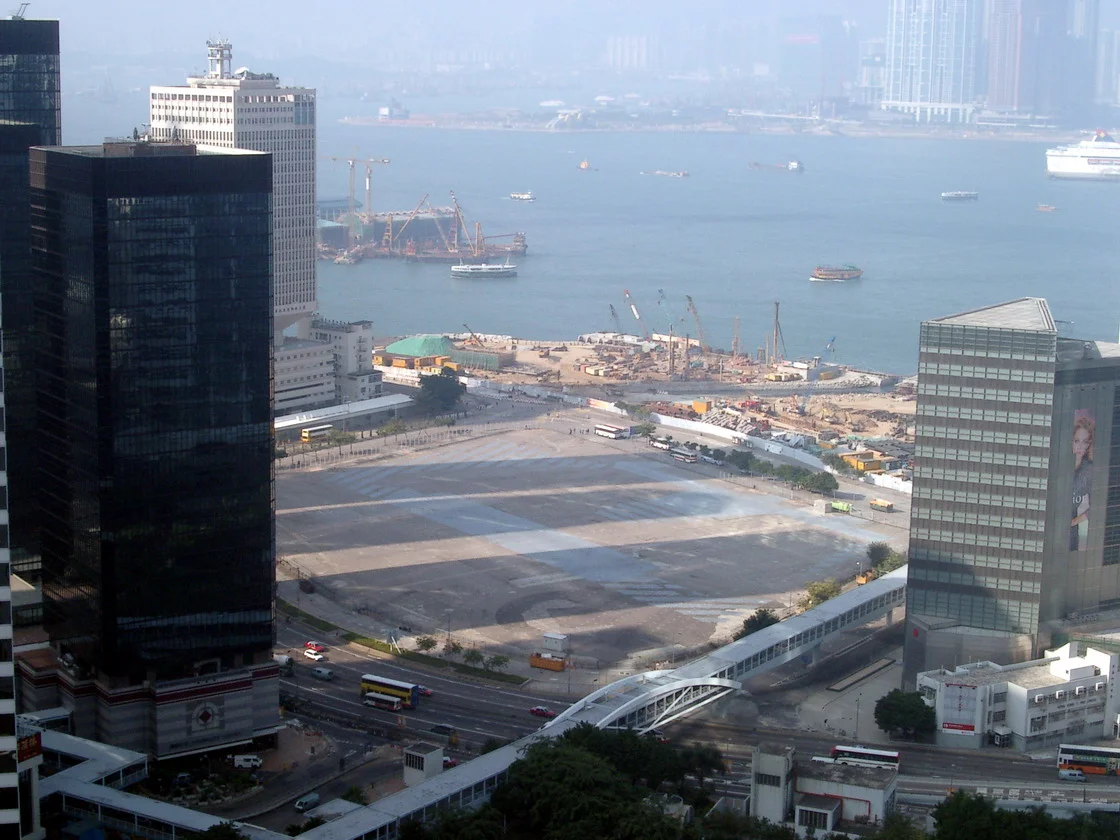

Tamar, Hong Kong
A ship named HMS Tamar arrived in Hong Kong in 1897, found a berth off the Naval Dockyard, and in British naval tradition became the nominal depot ship of the local garrison — meaning every officer and rating ashore came technically under her authority. The ship stayed through the colonial decades and was still there when the Japanese occupation began in December 1941. By then she had already given her name to the naval base that would long outlast her. Today "Tamar" denotes the administrative heart of Hong Kong: the Central Government Complex, the Legislative Council, Tamar Park, and four and a half hectares of the most contested real estate in Asia.
The Most Expensive Empty Land in Hong Kong
For years, the Tamar site was valued at $24.3 billion Hong Kong dollars on the open market — roughly $9,000 per square foot. It sat on the Admiralty harbourfront, flanked to the east by the Hong Kong Convention and Exhibition Centre, to the southwest by Garden Road, and to the south by the concentrated financial district of Pacific Place. Almost every significant building in Hong Kong Island's commercial core was visible from it. When the British garrison vacated the Prince of Wales Building and the broader naval base ahead of the 1997 handover, the question of what to do with the land consumed years of debate, planning exhibitions, and public controversy. Developers saw the obvious potential. Planners saw a once-in-a-generation opportunity to create public waterfront open space. The government eventually decided it needed the site for itself.
SARS, Harbourland, and a Concert That Failed
The Tamar site spent several years as an improvised public venue before the government made up its mind. The Hong Kong International Film Festival used it. Cirque du Soleil performed Saltimbanco there. The site hosted a funfair in 2005 and 2006. In 2003, when the SARS epidemic devastated Hong Kong's economy and morale, the government organised a large-scale concert called Harbour Fest to signal recovery — and chose Tamar as the venue. The event became a public relations disaster, widely condemned as poorly organised and wasteful. Westlife performed there on 25 October 2003. The WTO Ministerial Conference of 2005 produced another chapter: protesters proposed using Tamar as a demonstration site; the government refused and used it instead as a vehicle-processing checkpoint, screening over a thousand vehicles a day against the convention centre across the road.
Building the New Government
The contract for the Central Government Complex was signed on 28 January 2008; construction began in mid-February and finished in 2011, employing 3,000 workers. The project cost $5.2 billion Hong Kong dollars and reserved two hectares of the 4.2-hectare site as Tamar Park — public open space on the harbourfront. The government bureaux moved from various locations scattered across the island into a unified complex. The Legislative Council chamber was redesigned, abandoning the traditional British parliamentary layout of opposing benches in favour of a tiered semicircle with the speaker at the centre — an arrangement resembling the Congress Hall of the Great Hall of the People in Beijing, a choice that did not pass without comment. A flag-raising ceremony on the morning of 1 August 2011 marked the first offices opening.
The Word "Tamar" and What It Carries
In Hong Kong's political vocabulary, "Tamar" functions the way "Whitehall" does in Britain or "the Kremlin" in Russia: a metonym, a shorthand for government authority itself. When protesters said they were marching on Tamar, they meant the administration, not the geography. When critics called decisions "a Tamar move," they were invoking institutional power. This linguistic weight accumulated gradually, transferring from the naval base to the government complex through the shared fact of occupation. The height limit imposed on the new government buildings — 130 to 180 metres above principal datum — was set to preserve harbour views for the hotel and office towers behind the site: Island Shangri-La, the Conrad, Pacific Place. Even the building heights were negotiated around visibility.
The Park at the Edge of Power
Tamar Park, the two-hectare public green space carved out of the development plan, runs along the waterfront between the government buildings and Victoria Harbour. It is one of the rare points on Hong Kong Island's central harbourfront where a person can stand on grass, look north across the water to Kowloon, and be nowhere near a ferry pier, a hotel lobby, or a shopping mall entrance. Critics from the Hong Kong Institute of Planners argued that the Tamar site's location — bridging culture, finance, and tourism — made it unsuited to serve purely as a government precinct. The park was the compromise, a strip of public claim on a site the public lost. On clear days, the view from the lawn takes in the entire sweep of the harbour, from the Western Harbour Crossing to the Hung Hom Peninsula.
From the Air
Tamar is located at approximately 22.281°N, 114.166°E in the Admiralty district on the northern shore of Hong Kong Island, directly on Victoria Harbour. From the air, the Central Government Complex is identifiable as a cluster of modern government buildings immediately east of Central's skyscrapers, with Tamar Park's green strip running along the waterfront. The Hong Kong Convention and Exhibition Centre's distinctive curved roof is visible to the east. Nearest airport: Hong Kong International Airport (VHHH), approximately 28 km to the northwest on Lantau Island. The harbour approach from the northwest provides a clear view of the entire Admiralty and Central waterfront. At 1,500–3,000 feet on a clear day, the legislative council building, the government tower, and the park's green waterfront strip are distinguishable in the dense urban fabric.
Nearby Stories
- Lok Ma Chau Loop 2.3 km away
- Portas do Cerco 2.3 km away
- Kweilin Incident 17 km away
- Wanshan Archipelago Campaign 34 km away
- Nanxiong Formation 115 km away
- Battle of Nanpeng Island 148 km away
- Heyuan 169 km away
- Cape Maobitou 632 km away