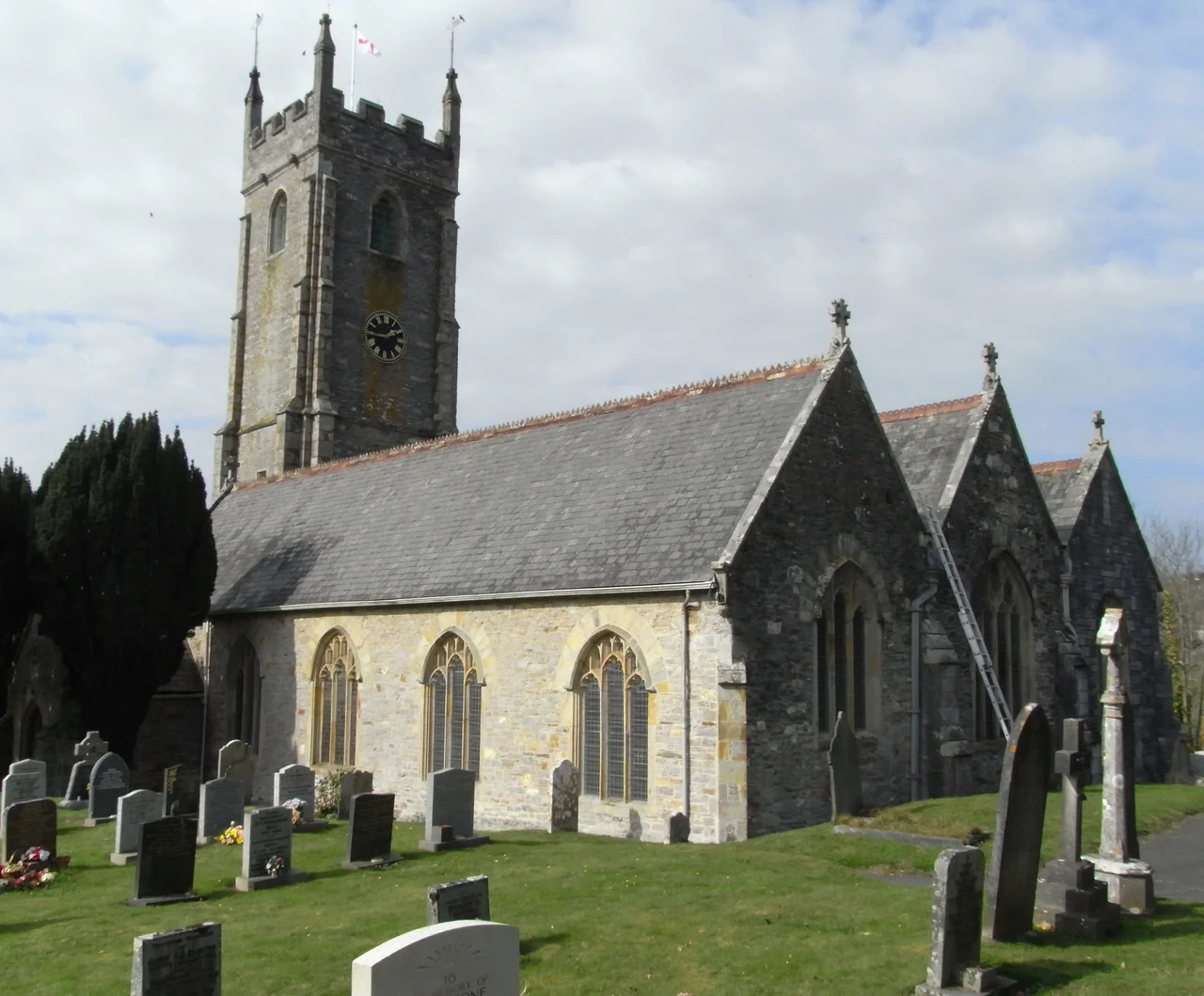

Tamerton Foliot
Just outside the churchyard wall of St Mary's, in the village of Tamerton Foliot, an ancient hollow oak still stands. It is called the Copleston Oak, and it has been called the Fatal Oak. According to the Devon biographer John Prince, writing around 1700, this is where John IV Copleston, lord of the manor, stabbed his godson to death after a dispute. The tree is now older than the event it remembers, but the story has outlived the family. By the time John V Copleston died childless in 1632, the great Devon name was extinguished. Locals had a phrase for it: the curse of the oak.
Where Two Rivers Meet
Tamerton Foliot sits in a green valley on the northern edge of Plymouth, near where the Tamar and the Tavy come together. A small stream runs through the village and broadens almost immediately into a tidal creek, threading past a bridge beneath the Tamar Valley Line railway. Walk two miles down a quiet road and you reach Tamerton Foliot's old railway station, opened in 1897, now a private home on the edge of a wooded riverside nature reserve. The village has about 2,300 people, three pubs, a Methodist chapel that closed in 2008, and St Mary's Anglican church, which traces back to the twelfth century on the foundations of something even older, possibly a chapel of the obscure Saxon saint Indract. Its 78-foot Perpendicular tower went up around 1440. A peal of six bells still rings.
The Name Behind the Place
Most English villages take their second name from a Norman family who once owned them. Tamerton Foliot is no exception, and the family in question had unusually grand credentials. John Foliot was a half-brother of William the Conqueror, granted large stretches of Devon for service in the conquest of 1066. Sometime between 1135 and 1154 a Foliot kinsman named Sampson built the original Warleigh House on the east bank of the Tavy, and from then on the manor of Tamerton bore the family's name. Drive through Plymouth's Southway estate today and you will pass streets called Bampfield and Copleston. These are not random naming choices. They are the surnames of the families who held this manor for nearly nine hundred years, set down in tarmac as the city expanded into its old country fringes.
The Fatal Oak
John IV Copleston was the sort of Tudor gentleman whose monument the village still keeps. His tomb stands in the north wall of the chancel at St Mary's, erected by his widow Susanna in 1617, inscribed in Latin praising him as a man of true virtue and noble descent. He died at Warleigh on 9 November 1608, having reached his 59th year. But the inscription does not mention what John Prince, writing a century later, recorded as the family's central tragedy. According to Prince, John IV killed his own godson, possibly an illegitimate son of his own, outside the church under the oak that still bears the family name. Prince called it the most unfortunate occurrence in the place, and believed it hastened the extinction of the Copleston line. When John V died in 1632 aged only twenty-three, leaving no male heir, the manor passed through his sisters to the Bampfylde and Elford families. The Coplestons were finished. The oak still stands.
From Manor to Suburb
In 1741 Sir Richard Bampfylde sold Tamerton Foliot to Walter Radcliffe, ending the Copleston-Bampfylde line of inheritance. The Radcliffes still resided at Warleigh in 1822. Warleigh House itself, the Tudor manor on the Tavy that once belonged to the Foliots, the Gorges, the Bonvilles, the Coplestons, the Bampfyldes, and finally the Radcliffes, became a Bed and Breakfast by 2012. The Civil War briefly turned the village into a garrison: Prince Maurice, brother of Prince Rupert, made it one of his quarters during the siege of Plymouth in October 1643, until he caught camp fever in mid-November and withdrew. In 1951 Tamerton Foliot lost its independent civil parish status and was absorbed into Plymouth. Today it is the city's northern edge, residential, quiet, still feeling like a village. In November 2012 the area flooded after torrential rain made parts of it impassable, a reminder that this is still a place where two rivers meet and the water knows the old paths better than the streets do.
From the Air
Tamerton Foliot lies at 50.43 N, 4.16 W, on the north edge of Plymouth where the Tamar and Tavy estuaries converge. From cruising altitude the village is hidden in wooded valley folds, but the broader confluence of the two rivers is a striking shape from above, with the Tamar Bridge and Brunel's Royal Albert Bridge visible to the south. Nearest active airfield is Exeter (EGTE) about 35 nm to the northeast; Newquay Cornwall (EGHQ) is roughly 40 nm to the west. Best low-level viewing is 1,500 to 2,500 feet AGL with low westerly sun lighting the wooded creeks.
Nearby Stories
- Davidstow Circuit 3.7 km away
- Golden Hind 3.9 km away
- Powderham Castle 4.4 km away
- Fowey Lifeboat Station 5.1 km away
- Okehampton Castle 12 km away
- Battle of Plymouth (1652) 19 km away
- Goonhilly Satellite Earth Station 44 km away
- German Submarine U-672 73 km away