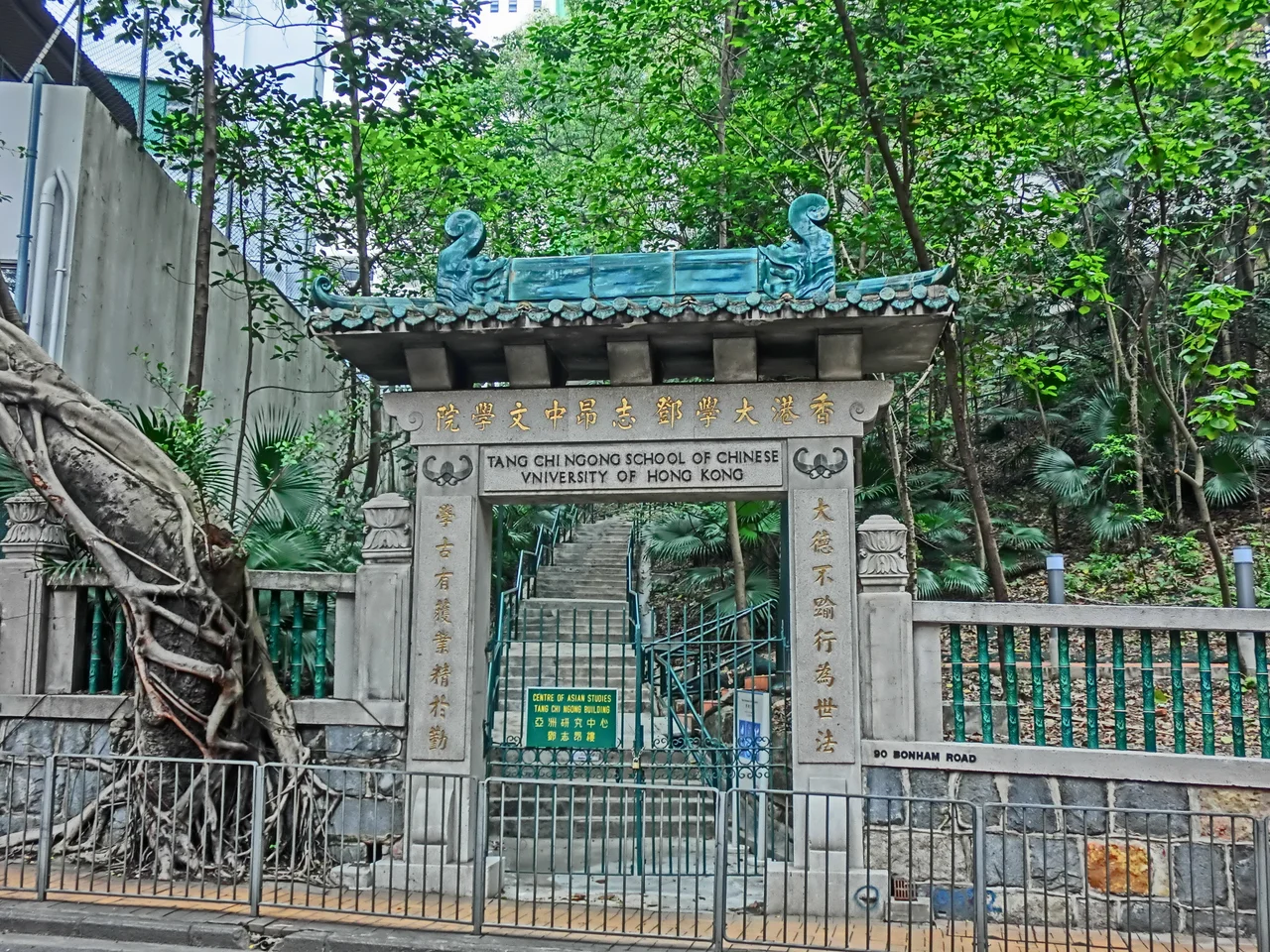

Tang Chi Ngong Building
Look closely at the stone arch that marks the entrance to this building on the University of Hong Kong campus, and you will find an anomaly: the word carved into the facade reads "VNIVERSITY," not "UNIVERSITY." The V is not a typo. It is a deliberate echo of ancient Roman stonecutting, a practice common for Latin inscriptions in the 1920s and 1930s, when the letter U had not yet fully displaced the V in formal carved script. That single letter makes the Tang Chi Ngong Building unlike any other structure on campus — a three-storey monument to Chinese scholarship that opened in 1931 and has been quietly accumulating history ever since.
A Father's Gift, A Son's Legacy
The building exists because of Tang Chi-ngong, a wealthy merchant who donated the funds to construct it in the late 1920s. Construction began in 1929, and the completed building was named in his honor. Tang Chi-ngong was the father of Sir Tang Shiu-kin, who would himself become one of Hong Kong's most celebrated philanthropists. The donation was motivated by an idea that had been gaining traction in inter-war Hong Kong: the University needed a proper home for the study of Chinese language and literature. Until then, Chinese studies had no dedicated facility. Tang Chi-ngong's gift changed that. On 28 September 1931, Governor Sir William Peel formally opened the building, lending the occasion the weight of colonial officialdom. Further donations followed over subsequent decades, deepening the endowment for Chinese instruction and cementing the Tang family's connection to one of Hong Kong's most important institutions.
The V That Outlasted Empires
The architecture speaks in a register somewhere between colonial confidence and classical restraint. The building is Neo-classical in style — flat-roofed, three storeys, its exterior surfaced with Shanghai plaster, a material common in early-twentieth-century Hong Kong construction. The paifang, or traditional Chinese stone arch, at the Bonham Road entrance gives the structure a dual identity: a Western architectural vocabulary wrapped around a gateway borrowed from China's own ceremonial tradition. Then there is that V. The word "VNIVERSITY" appears not once but three times — on the stone arch, on the main facade, and on the foundation tablet — insisting on a Latinate authenticity that the building's designers clearly felt mattered. The exterior was declared a monument in 1995, ensuring that the V, along with everything surrounding it, would remain protected.
Changing Rooms, Constant Name
What happens inside a building matters as much as what's carved on its walls, and the Tang Chi Ngong Building has seen its interior purposes shift considerably over the decades. Its original mission — housing the study of Chinese — gave way in the 1970s to other university needs as HKU's campus expanded and departments reorganized. The Centre of Asian Studies moved in and called the building home for decades, until relocating in 2012. Today the building houses the Jao Tsung-I Petite Ecole, named for the eminent Hong Kong-based scholar Jao Tsung-I, whose research ranged across Chinese literature, art, history, and calligraphy. Through all these changes, one thing never wavered: the name. The building has always been, and remains, the Tang Chi Ngong Building. In a city that tears down the old with uncommon speed, that constancy is its own kind of monument.
On the Western Edge of the Island
The University of Hong Kong occupies a hillside above Pok Fu Lam on Hong Kong Island's western shore, removed from the bustle of Central and the harbour district. The campus climbs steeply, and the Tang Chi Ngong Building sits on an artificial platform — a common engineering solution on this rugged terrain — near Pok Fu Lam Road. Looking out from the campus, the South China Sea is not far below. The surrounding neighborhood is residential and quieter than much of Hong Kong, shaded by mature trees that line the mid-levels streets. For a building whose purpose has always been scholarship and learning, the setting suits it: elevated, a little apart from the noise, facing west.
From the Air
The Tang Chi Ngong Building sits at approximately 22.284°N, 114.140°E on the University of Hong Kong campus, on Hong Kong Island's western side near Pok Fu Lam Road. Approaching from the west at 2,000–3,000 feet, the HKU campus is visible climbing the hillside above Pok Fu Lam. The nearest major airport is Hong Kong International Airport (VHHH), located on Lantau Island roughly 20 km to the west-northwest. Kai Tak's former runway site lies across the harbour to the northeast. Low cloud frequently clings to the mid-levels in humid weather, so clear-day conditions offer the best views of the university's compact, steeply terraced campus layout.
Nearby Stories
- Lok Ma Chau Loop 2.3 km away
- Portas do Cerco 2.3 km away
- Kweilin Incident 17 km away
- Wanshan Archipelago Campaign 34 km away
- Nanxiong Formation 115 km away
- Battle of Nanpeng Island 148 km away
- Heyuan 169 km away
- Cape Maobitou 632 km away