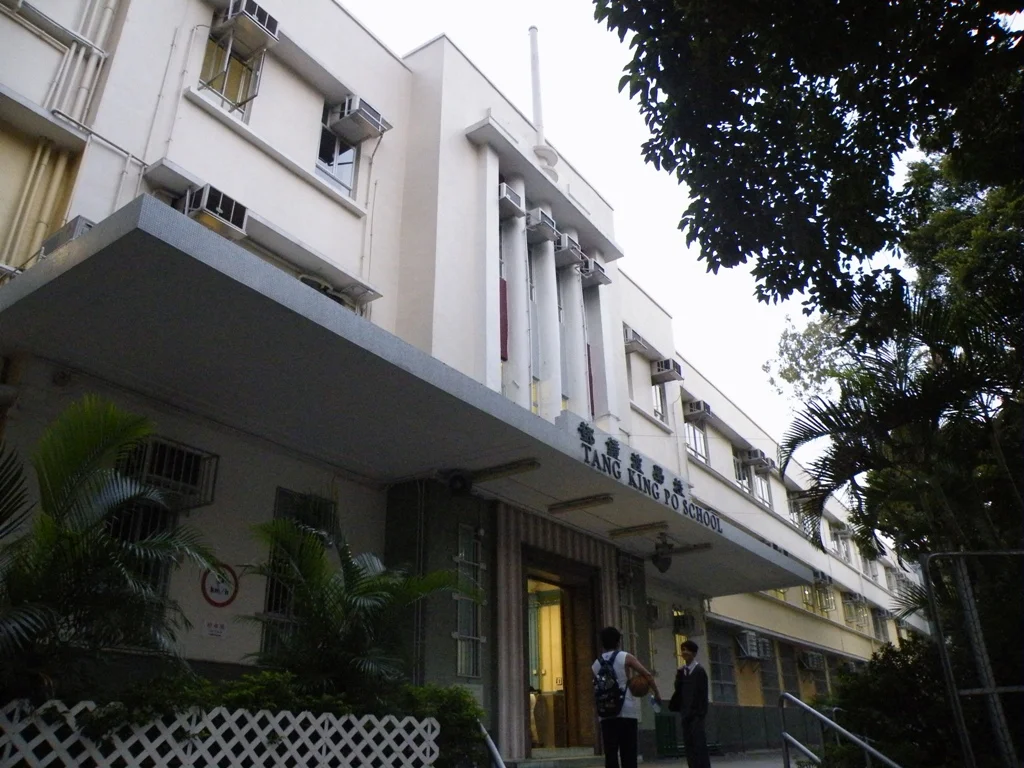

Tang King Po School
In 1952, a businessman named Tang King Po made a donation that would change the educational landscape of Ma Tau Wai. He gave the funds to the Salesians — a Catholic religious order founded in 19th-century Italy specifically to serve poor and working-class youth — to build a school in Kowloon City District. What opened the following year was not a school designed for Hong Kong's elite. It was a place built for boys who needed practical skills and a path forward, with classes in clothes-making, printing, and shoemaking waiting for them on their first day.
The Salesians and Their Mission
The Salesians of Don Bosco are the second-largest religious order in the Catholic Church, founded in 1859 by Italian priest John Bosco with the explicit goal of educating young people who had fallen through the cracks of the Industrial Revolution — migrant youth, child workers, boys from the streets of Turin. Their method, which Bosco called the Preventive System, rested on reason, religion, and loving kindness rather than punishment and rigid discipline. By the time the Salesians arrived in Hong Kong in the twentieth century, that tradition had been carried across dozens of countries. Tang King Po's donation gave them resources; the Salesians brought a century of hard-won understanding about what it meant to educate a boy who had few other options. Governor Alexander Grantham officially opened the school on 23 July 1953, marking it as part of the colony's educational infrastructure from its first day.
Trades First, Then Everything Else
The original curriculum was deliberately vocational. Three tracks greeted the school's first students: the clothes industry, the printing industry, and the shoe industry. This was not a concession or a lesser education — it was the Salesian philosophy made concrete. Boys needed skills they could use, and the school was built to give them exactly that. Over the following decades, as Hong Kong's economy transformed and the territory's secondary education system evolved, Tang King Po School expanded far beyond those original trade classes. By the 2014–2015 academic year it was running 31 classes across a full academic program. The vocational origins gave way to a school where Form 7 graduates — the equivalent of senior secondary completers — went on to tertiary education at a rate above 70 percent. What began as a trades school became a launching pad.
Numbers That Tell a Story
Hong Kong secondary schools live and die by examination results, and Tang King Po School has earned a solid standing. All Form 3 students have historically passed the Junior Secondary Education Assessment, with a 100 percent allocation rate to Form 4. Roughly 75 percent of Form 5 students passed the Hong Kong Certificate of Education Examination. In the 2005–2006 school year, Form 3 students outperformed the territory-wide average in English by a measurable margin, exceeded the average in Chinese by two percentage points, and posted a 98 percent compliance rate in mathematics. These numbers matter not as abstract statistics but as evidence of what happens when a school takes seriously its responsibility to every student it admits — not only the strongest ones.
A School and a Parish
The campus in Ma Tau Wai is more than a school building. Because the Salesians are a religious order, the site also functions as a parish — a physical community with roots that extend beyond the academic calendar. The nearby Mary Help of Christians Church in Kowloon is part of this same Salesian presence in the district. Seventy-five teachers serve a student body at a ratio of roughly one to eighteen. Almost all the faculty hold formal teaching credentials, with nearly a third holding master's degrees or higher. For a school founded on a donation from a single businessman and the labor of a religious order, the staffing reflects an institution that has grown into something durable and purposeful. The streets of Ma Tau Wai, dense and residential, surround the campus on all sides — a reminder that this school has always drawn from the neighborhood around it.
From the Air
Tang King Po School is located at approximately 22.320°N, 114.185°E in the Ma Tau Wai area of Kowloon City District. From the air at 3,000–4,000 feet, the densely packed residential streets of Kowloon stretch in every direction. The former Kai Tak Airport runway, now redeveloped, lies roughly 1.5 km to the east — pilots once made their famous curved approach over these very rooftops. Hong Kong International Airport (VHHH) is about 25 km to the west on Lantau Island. The Kowloon waterfront and Victoria Harbour are visible just a few kilometers to the south.
Nearby Stories
- Lok Ma Chau Loop 2.3 km away
- Portas do Cerco 2.3 km away
- Kweilin Incident 17 km away
- Wanshan Archipelago Campaign 34 km away
- Nanxiong Formation 115 km away
- Battle of Nanpeng Island 148 km away
- Heyuan 169 km away
- Cape Maobitou 632 km away