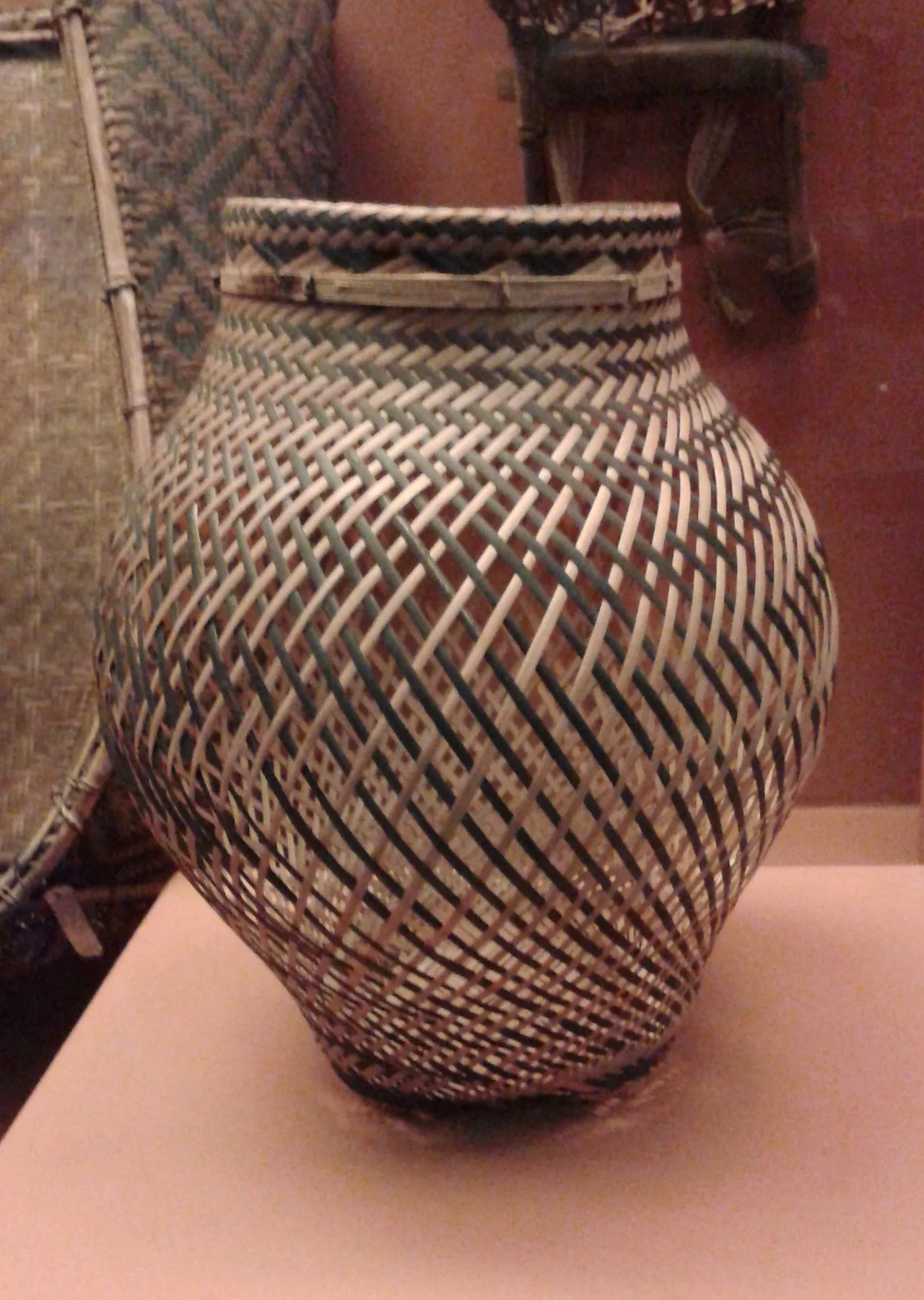

Tariana people
In their own language, the Tariana call themselves bipó diroá masí - the children of the blood of the thunder. The other peoples of the Uaupés River accept the name. It comes from an origin story set at the Uapuí waterfall on the upper Aiari River, where the Tariana say their ancestors emerged and began the journey that took them to the rivers where they live now. Six hundred years ago, potters were firing ceramic vessels the shards of which archaeologists still turn up in the Jurupari region. Those six centuries are the sliver of Tariana history that can be dated. The rest is much longer and has never stopped.
The River That Speaks Many Languages
The Tariana live along the Uaupés River - called the Vaupés in Colombia - which forms part of the border between northwestern Brazil and southeastern Colombia. They number roughly 2,684 in Brazil according to a 2014 health service count, with an additional 205 in Colombia as of 2010. Most live in the middle and upper reaches of the river, concentrated in and around the village of Iauaretê, which held about 1,300 Tariana in 2004 and spreads through the old neighborhoods of São Miguel, Don Bosco, Santa Maria, and São Pedro. Others live in Campo Alto, Itaiaçu, Miriti, Japurá, Aracapá, and Sabiá. The river society here is extraordinarily multilingual: the Tariana language belongs to the Arawakan family and is closely related to Baniwa, but most Tariana also speak Tucano, which serves as the common language of the whole Uaupés. By 1996 there were no speakers of Tariana left in Colombia, and only about 100 in Brazil. The reason, the Tariana themselves explain, is historical: their men traditionally married Wanano and Tucano women, and children grew up speaking their mothers' languages.
Exogamy and the Architecture of Marriage
Tariana society is patrilineal, exogamous, and patrilocal - lineage passes through the father, marriage is required to be with someone from a different ethnic group, and the wife moves to her husband's community. Tariana women typically marry Tucano or Piratapuyo men. This is the system anthropologists call the Vaupés linguistic exogamy network: a regional rule that one must marry outside one's language group, which guarantees every household speaks at least two languages and every child grows up bilingual from birth. The Tariana social order also inherits internal status: leaders, specialists in the intricate dances and feather ornaments, shamans, and others. Their ancestors, according to their own stories, halted at specific places on their great journey, and the rank among the different sibs - the descent-group subdivisions of the Tariana whole - was settled at those stopping places.
Epidemics and Missions
The upper Rio Negro region was devastated by smallpox in 1740 and by measles in 1749 and 1763. Franciscan missionaries arrived and found the town of Ipanoré filled with Tariana. In the mid-nineteenth century the newly formed Province of Amazonas began what it called a program of civilization and catechization. A Capuchin friar baptized 700 people and built chapels in 24 villages along the Uaupés and Içana rivers. The traders the Tariana called regatões moved along the river exploiting indigenous labor without pay; some Tariana were taken to work in Manaus; children were placed in orphanages. In 1857 a military force attacked several Tariana villages. Prophetic movements arose in the second half of the nineteenth century, offering to liquidate debts and absolve sins. In 1883 the Tariana expelled three Franciscan missionaries who had displayed a mask of Jurupari on the church pulpit - a serious violation, since the mask belongs to male initiation rites that women are forbidden to see.
The Salesians at Iauaretê
In the first decades of the twentieth century the Salesians of Don Bosco established missions along the Uaupés and effectively became the local representatives of the Brazilian state. When the German-Brazilian ethnologist Curt Nimuendajú visited in 1927, he found Iauaretê had become the main Tariana center, with 479 people living along a two-kilometer stretch of the river. He noted that the missionaries were intolerant of Tariana tradition. The first mission boarding school opened in May 1930 with three resident missionaries and 15 students. By the late 1930s the mission had housing for 250 Indigenous students. By 1950 it was the largest Salesian establishment in the entire Rio Negro region, with a staff of 40, most of them alumni of the boarding schools themselves. The missionaries required that in order to receive sacraments or participate in trade, families give up their ceremonial objects and move out of the traditional malocas - the great communal longhouses - into individual houses clustered around the chapel. Over time, they did. The boarding schools closed in 1988.
Choosing an Indigenous Territory
In the late 1980s, under the military-led Calha Norte Project, the Brazilian government proposed converting Tariana lands into an Indigenous Colony - a status that would have granted the residents education, health care, and economic support, but opened their territory to miners and loggers. At a meeting in Taracuá in June 1988 the Uaupés and Tiquié peoples were told they could be declared acculturated and accept colony status. The Tariana of Iauaretê initially accepted; Tariana communities downstream were skeptical, correctly predicting that the promised benefits would not arrive and the extractive industries would. A mosaic of colonies and national forests was officially created in 1987-88. The promises did fail. Demoralized by the broken terms, the Tariana and neighboring peoples organized their own movement for autonomy. In the mid-1990s the federal government recognized over 11 million hectares - more than 27 million acres - as Indigenous Territories across the region. The Alto Rio Negro, Médio Rio Negro I and II, Balaio, and Cué-Cué/Marabitanas territories together now protect Tariana land. They are self-governing. They are, by any fair reading, what the Tariana chose after being offered something else.
From the Air
The main Tariana concentration at Iauaretê sits near 0.61°N, 69.19°W at the confluence of the Uaupés and Papurí rivers on the Brazil-Colombia border. São Gabriel da Cachoeira (SKFC/BGR) is the nearest airport at 150 km east; Iauaretê itself has a small airstrip opened in 1958. Dense tropical rainforest covers the region; the rivers are the primary visible landmarks from cruising altitude. Visibility is often limited by afternoon convective buildups. Respect the sovereignty of demarcated Indigenous Territories - these are not public lands.
Nearby Stories
- Great Depression in Latin America 58 km away
- Sao Gabriel da Cachoeira 172 km away
- Operation Jaque 314 km away
- Solimoes-Japura Moist Forests 367 km away
- Tonantins 386 km away
- La Macarena 543 km away
- Orinoco Basin 603 km away