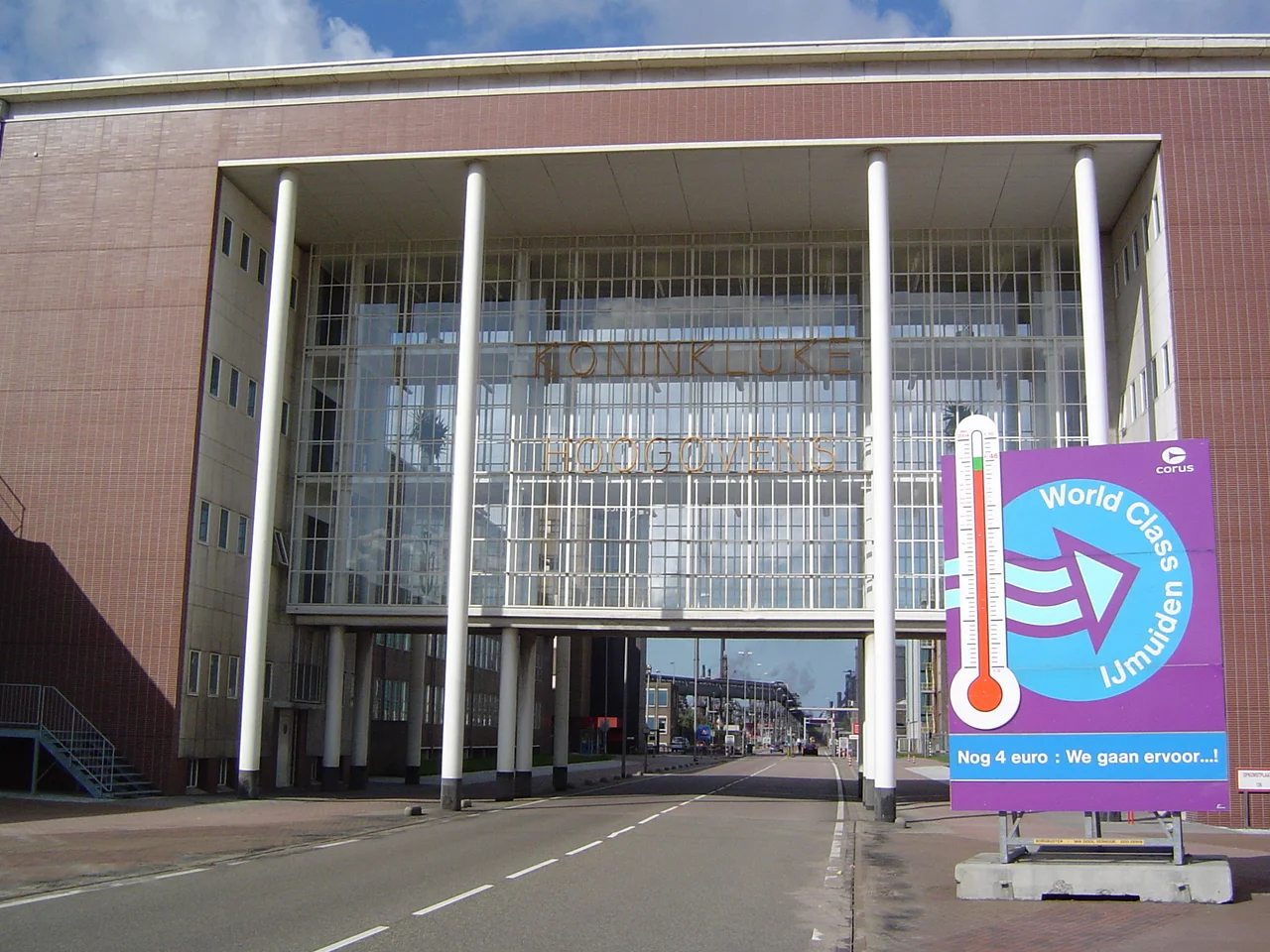

Tata Steel Netherlands
From the dunes of Wijk aan Zee, the cooling stacks are the first thing you see. They rise from the flat coast like a city of geometry - blast furnaces, coke batteries, gantries, conveyors - exhaling steam that can be visible from forty kilometers away on a still morning. The plant has stood at the mouth of the North Sea Canal in IJmuiden since 1918, longer than most of the Dutch state's modern institutions. It built the steel that rebuilt the country after the war. It still employs roughly nine thousand people. And in the villages downwind, parents have been asking for years why their children keep getting sick.
From Hoogovens to Tata
The plant began life as Koninklijke Nederlandsche Hoogovens, a Dutch national project to keep the country's steel supply on Dutch soil. By the 1930s it had moved from raw iron into full steelmaking with open-hearth furnaces, and by the late 1990s, when it employed 23,000 people and produced 8 million tonnes of steel a year, it was one of the largest industrial concerns in the Netherlands. The 1999 merger with British Steel created Corus, and in 2007 the Indian conglomerate Tata bought the whole company. After the European business split in 2021, IJmuiden became Tata Steel Netherlands - a Dutch institution wearing an Indian corporate name, still rolling the same hot bands of steel that have been the plant's signature for half a century.
The People Behind the Furnaces
Steelmaking is hot, dangerous, and unforgiving, and the people who do it have always come from somewhere. After the war, the plant recruited workers from Italy, Spain, Turkey, Yugoslavia, and Morocco, sometimes housing them in floating hotels moored alongside the canal. Many of their grandchildren still live in the IJmond villages of Wijk aan Zee, Beverwijk, and Velsen-Noord. The plant has been generous to those communities in good years - a 9.19 percent profit-sharing bonus to roughly eight thousand workers in 2014-15, sports clubs, an industrial heritage foundation, a chess tournament that bears the company's name and has attracted world champions to a North Holland coastal town since 1938. The Tata Steel Chess Tournament still happens every January. Magnus Carlsen has played in it more times than he can count.
The Air They Share
And then there is the other story, the one the steelworks would rather not be famous for. For most of the plant's history, the dust and gas that drift off the coke ovens and sinter plants were treated as part of the price of having a steel industry. By the early 2020s, that bargain had stopped being acceptable. Investigations by Dutch public health authorities and journalists documented elevated levels of cancers and lung disease in the villages around the plant, traced to lead, polycyclic aromatic hydrocarbons, and fine particulate matter from the works. Children playing in their own yards were measured with lead in their blood. The Dutch parliament held hearings. Activist groups organized lawsuits. The company has announced plans to phase out one blast furnace and switch toward direct-reduction steelmaking with hydrogen - cleaner in principle, expensive in practice. The argument over how fast that transition should happen, and who should pay for it, has become one of the defining industrial-policy fights of the Dutch decade.
Why It Is Still Here
The case for keeping the plant is not subtle. Tata Steel Netherlands accounts for a meaningful share of the country's steel output and employs many thousands more in suppliers and contractors. Closing it would shift the emissions and the cancer risks somewhere else, probably to a country with looser standards, and would gut the IJmond economy. The case for closing it is also not subtle. The people who breathe its exhaust did not sign up for the trade, and many of them are the children and grandchildren of the workers the plant brought to the coast in the first place. The plant sits, in other words, exactly where Dutch climate and industrial policy collides with itself - between the country the Netherlands wants to build and the one it has.
Seeing the Place
The works occupy roughly 750 hectares between the dunes and the canal - a landscape so flat and so industrial that it feels imported. On a clear day, from the right approach into Schiphol, you can pick out the orange flare of the blast-furnace stoves before you see the canal itself. From the ground, the best vantage is the dune crest above Wijk aan Zee, where a North Sea breeze separates the village's beachfront cafes from the steel city a few hundred meters away. People surf there. Children build sandcastles. The cooling towers steam in the background. It is one of the strangest skylines in northern Europe, and it is not changing soon.
From the Air
Coordinates 52.478N, 4.592E, occupying the south bank of the North Sea Canal where it meets the North Sea at IJmuiden. Approximately 18 km west-northwest of Amsterdam Schiphol (EHAM); IJmuiden's harbor mouth and locks are unmistakable from the air, and the steel plant is the largest industrial footprint on the entire Dutch coast. Visible from cruising altitude in clear weather as a brown-and-gray rectangle against the green polder; on cold still mornings the steam plumes from the blast furnaces can extend tens of kilometers downwind. Approach paths into and out of Schiphol from the west routinely overfly the site.
Nearby Stories
- Battle of Camperdown 2.1 km away
- Randstad 6.4 km away
- Oostvaardersplassen 6.7 km away
- Luchterduinen Offshore Wind Farm 7 km away
- HMS Prince George (1895) 7.2 km away
- Amersfoort 9.6 km away
- Ockenburg 16 km away
- Stavoren 18 km away