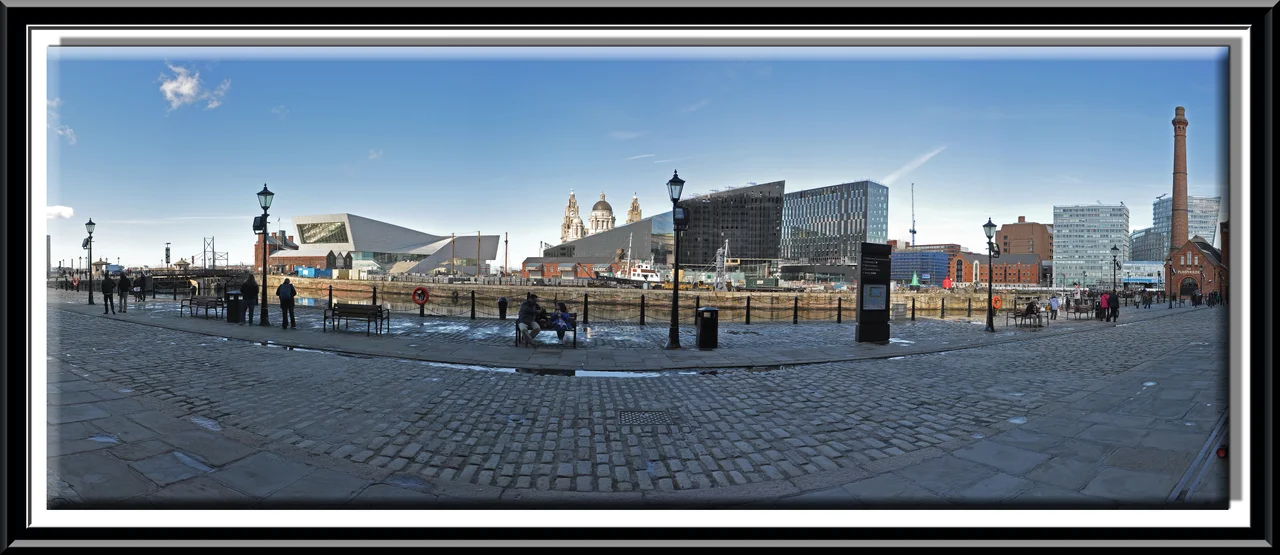

Tate Liverpool
When the Royal Albert Dock opened in 1846, it was the world's first non-combustible warehouse complex - constructed entirely from cast iron, brick, and stone with no structural timber, immune to the fires that periodically devastated the city's older docks. For more than a century these vaulted warehouses stored cotton, tobacco, brandy, and tea. By the 1970s they stored nothing. The docks were silting, the trade had moved, the warehouses were empty. The Merseyside Development Corporation needed a flagship project to make the case that this enormous derelict complex could become something else, and in May 1988 they had one: Prince Charles cut the ribbon on Tate Liverpool, the national modern art collection's first home outside London, occupying the southern range of warehouse number two.
James Stirling Inside the Warehouse
The Tate Gallery commissioned the architect James Stirling to convert one of the dock warehouses into exhibition space. Stirling was at the height of his international career, fresh from the Neue Staatsgalerie in Stuttgart, and his Liverpool brief was unusual. He had to insert contemporary museum-grade galleries - with their requirements for environmental control, lighting, security - inside a Grade I listed nineteenth-century structure whose interior was a forest of cast-iron columns supporting brick groin vaults. Stirling treated the warehouse with respect. He left the iron columns visible. He kept the brick vaults exposed where structurally feasible. He painted the original cast iron in vivid orange - now Tate Liverpool's signature colour - and introduced a contrasting white sequence of clean modern galleries within. The result is unmistakably a converted dock warehouse but also unmistakably a contemporary art museum. The conversion opened on 24 May 1988 with Prince Charles cutting the ribbon and BBC Two broadcasting the ceremony live.
The Tate Goes North
Until 1988 the national Tate Collection - Britain's official collection of British art from 1500 to the present, plus international modern art - was concentrated in London. The Tate Gallery on Millbank had been the public face since 1897. The St Ives outpost in Cornwall would not open until 1993. The new Tate Modern would not open until 2000. Tate Liverpool was the very first dispersion of the national collection beyond Westminster, an answer to longstanding northern complaints that British art ought not to live exclusively in the capital. The gallery rotates highlights from the national holdings - paintings by Turner and Stubbs and Lowry, sculptures by Hepworth and Moore, contemporary work by Hockney and Hirst - alongside an ambitious programme of temporary exhibitions. Major shows on Mondrian, Picasso, Tracey Emin, and Roy Lichtenstein have all been mounted in the dockside galleries since 1988.
The Turner Prize Comes North
In 2007 Tate Liverpool hosted the Turner Prize awards ceremony - the first time Britain's most controversial contemporary art prize had been judged outside London since its founding in 1984. The four shortlisted artists exhibited at Tate Liverpool, the prize was decided there, and the ceremony was broadcast live to the country with Mark Wallinger taking the £25,000 prize. It happened again in 2022, when the Turner Prize returned to Tate Liverpool and the winner Veronica Ryan - the British-Caribbean sculptor whose Hackney public commission of giant bronze fruit had become a London landmark - received the award. The Liverpool Biennial, the largest contemporary visual arts festival in Britain, has used Tate Liverpool as a hub since its founding in 1999. Light Night Liverpool, the annual September festival of free arts events, transforms the gallery's facade with projection mappings. The Eurovision Song Contest in 2023 - hosted in Liverpool on behalf of Ukraine - filled the Albert Dock complex with broadcast operations, with Tate Liverpool playing host to celebrations and exhibition openings.
Peter Blake at the Cafe
In 2007 the gallery refurbished its public foyer, with architects Arca redesigning the entrance and signage to handle growing visitor numbers, and the artist Peter Blake - one of the founding figures of British Pop Art, who designed the Sgt Pepper's Lonely Hearts Club Band album cover - collaborated with Liverpool-based Architectural Emporium on a new cafe design. Blake's signature is the dazzle camouflage pattern adapted from First World War naval painting, with bold black-and-white geometry across the cafe interior and a wooden welcome desk with an undulating orange fascia that links to Stirling's original colour scheme. A colour-changing wall provides backdrop. The whole experience pulls the visitor from the dark stone vaults of the warehouse into something brighter and more deliberately contemporary, before letting them into the gallery proper.
Closed for 2027
Tate Liverpool closed in October 2023 for a £29.7 million refurbishment - the most thorough overhaul since the gallery opened. The galleries themselves are being upgraded with better climate control and lighting. New social spaces are being created. The original two-year timeline was extended in February 2025 when Tate announced the works would now finish in spring 2027. During the closure the gallery has been operating from a temporary home at RIBA North in Mann Island - across the dock from the original site, in the lower-built area between the Liver Building and Albert Dock. Pop-up exhibitions, talks, and education programmes have continued there. When the doors reopen in 2027, Tate Liverpool will be approaching its fortieth anniversary. The warehouse it occupies will be approaching its 181st. The cast-iron columns Stirling painted orange will still hold up the brick vaults. The Tate Collection will still rotate through its galleries. The dock that the city wrote off in the 1970s will still be the cultural heart of Liverpool's waterfront.
From the Air
Tate Liverpool sits inside the Royal Albert Dock complex at 53.401°N, 2.994°W on the Liverpool waterfront, immediately south of the Pier Head and the Liver Building. Best viewed at 2,000-4,000 ft. Liverpool John Lennon Airport (EGGP) is 5 nm south-southeast. Look for the distinctive red-brick warehouses arranged around a rectangular dock basin just south of the Three Graces. Tate Liverpool occupies one section of the southern warehouse range; the rest of the complex contains the Merseyside Maritime Museum, the International Slavery Museum, and the Beatles Story.
Nearby Stories
- RAF Wrexham 3.3 km away
- Birkdale Palace Hotel 3.7 km away
- Turton Tower 4.1 km away
- Tatton Park 5.6 km away
- Abergele Rail Disaster 9.6 km away
- Diglake Colliery Disaster 13 km away
- Ysbyty Ifan 16 km away
- Celtic Array 62 km away