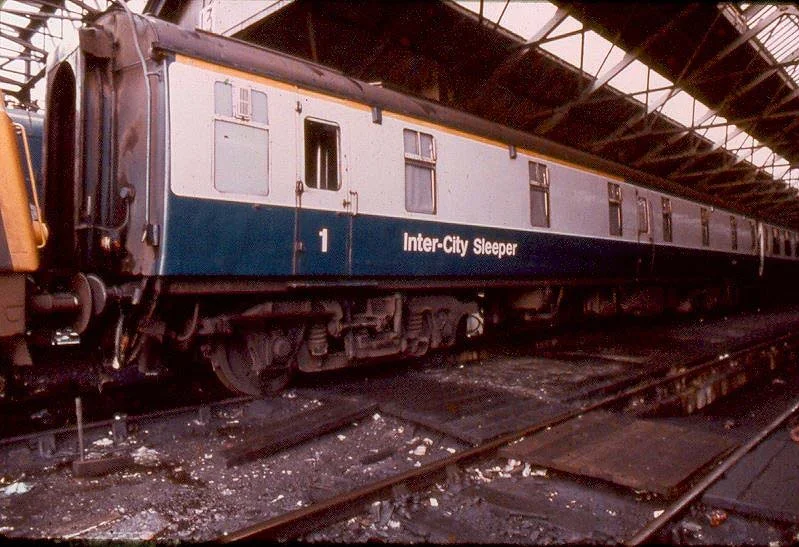

Taunton Sleeping Car Fire
The 22:30 sleeping-car express from Penzance to London Paddington was a familiar service for West Country travellers - retirees heading home, business people, holidaymakers, parents with sleeping children. On the night of 5-6 July 1978, the train was hauled by a Class 47 diesel locomotive and stopped at Plymouth to pick up two extra sleeping cars so that earlier passengers could go to bed without waiting up for the main service. One of those cars was W2437, a 1960-built Mark 1 sleeping coach. In its vestibule, against an electric heater installed two years earlier, sacks of dirty bedlinen had been stacked. Sometime in the small hours, near Taunton, the heater overheated. Twelve passengers never woke up.
An Engineering Compromise
W2437 had been built in 1960, when British steam locomotives still hauled most of the country's passenger services. Steam engines produced steam, and steam heated the carriages - a simple, elegant arrangement. By the 1970s steam was gone, replaced by diesels fitted with auxiliary boilers to keep the old steam-heated coaches usable. The boilers were unreliable and expensive to maintain. So British Rail decided to convert the coaching stock to electric train heating (ETH), drawing power from the locomotive. W2437 was converted in 1976. An electric heater was installed in the vestibule. The steam-heating capability was kept for now. It was assumed that nothing would be placed against the heater, and so no warning notices were fixed to it. This was the first link in the chain of failures that led to twelve deaths.
Where the Dirty Linen Went
The main store for bed linen on the Plymouth service was at Old Oak Common depot near Paddington. Used bedding from the Plymouth portion had, until 1977, been carried in the train's guards van. That year the guards van was removed from the consist as a cost-saving measure. Used linen had to go somewhere. The somewhere chosen was the vestibule of W2437, stacked in plastic bags. Plastic bags against the electric heater. No one along the chain had connected the dots. The conversion engineers had assumed the vestibules would stay clear. The depot staff had needed somewhere to put the laundry. The conductors had stacked the bags where they fit. The heater had no warning sign. By the time the train left Plymouth on the night of 5 July 1978, the plastic bags were touching the heater element, and the train was about to head into the long night run up through Somerset.
The Fire and the Locked Doors
The fire started in the early hours of 6 July near Taunton. The plastic melted, the linen ignited, and dense smoke poured through the vestibule and into the sleeping compartments. Most of the twelve dead died not of burns but of smoke inhalation - asphyxiated in their bunks before the train could be stopped. Fifteen others survived but were injured. What made the death toll worse was what David Penhaligon, the Liberal MP for Truro, told the House of Commons in the immediate aftermath. Penhaligon used the West Country sleeper regularly. He stated that 'all the doors' between the carriages had been locked, and that all the external doors except one were locked too. He claimed the windows that were supposed to open often did not work. Passengers had been trapped, by design and by neglect, in coaches filling with smoke.
A Hundred and Eleven Years
In the same Commons debate, another West Country MP - Robin Maxwell-Hyslop, Conservative member for Tiverton - made the observation that should have been quoted in every railway boardroom in the country. Maxwell-Hyslop pointed out that 111 years earlier, an inspector reporting on the Abergele rail disaster of 1868 (which contemporaries called the Irish Mail crash) had explicitly warned that locking doors at the ends of sleeping cars could cause passenger deaths. The warning had been on the record since the reign of Queen Victoria. 'Should we not have learned by now?' Maxwell-Hyslop asked. The answer in the silence that followed was the twelve dead at Taunton, the fifteen injured, the families now waiting for telegrams that had already arrived.
What the Mark 3s Inherited
The Taunton fire happened at a fortunate moment in industrial timing. The new Mark 3 sleeping cars were still at the design stage when the bodies were brought out of W2437. British Rail's response, when the inquiry reports came in, was thorough in the way that disasters force institutions to be thorough. The Mark 3 sleepers were fitted with sophisticated fire-warning systems, fire-retardant materials throughout, multilingual warning placards on heaters and electrical equipment, and revised emergency procedures including clearer routes to exits. Subsequent fire-safety regulations across British rolling stock derive partly from the Taunton inquiry. Today's passengers travel in carriages whose design assumes that any combustible material could in principle catch fire, and that any door could in principle be needed as an escape - a baseline of safety that the twelve dead at Taunton helped to establish.
Twelve Names in the Vale of Taunton
The Vale of Taunton Deane is haunted in a way that no signs on the motorway would tell you. Two miles from where W2437 caught fire, the 1890 Norton Fitzwarren rail crash killed ten passengers on a Plymouth-to-Paddington boat train when a tired signalman forgot a goods train was on the line. Two miles from there, in 1940, the wartime Norton Fitzwarren crash killed twenty-seven when an exhausted driver misread signals in the blackout. And now this - twelve more, in 1978, on the same mainline, killed by ordinary administrative carelessness rather than fatigue or war. The dead at Taunton were sleeping passengers who had bought tickets believing the train would carry them safely home. The bedlinen that killed them was a side-effect of a cost-saving decision about where to put used laundry. The locked doors that trapped them were a security measure that had outlived its purpose. Every disaster has a narrative this banal. That is the part hardest to look at, and most worth remembering.
From the Air
Located at 51.02°N, 3.13°W on the Bristol-to-Exeter mainline just east of Norton Fitzwarren, about two miles west of central Taunton. The exact location of the fire varies in accounts as the train was moving when the blaze was discovered. Recommended viewing altitude is 2,000-3,000 feet. The site lies just south of the M5 motorway, between Taunton and the Quantock Hills foothills. Nearest airfields: Dunkeswell (EGTU) to the south, Exeter (EGTE) to the southwest, Bristol (EGGD) to the northeast. The Vale of Taunton Deane is broad and flat here, with the Blackdown Hills rising to the south.
Nearby Stories
- Grand Pier, Weston-super-Mare 2.2 km away
- Royal Albert Memorial Museum 8.5 km away
- Royal Victoria Park 9 km away
- Siege of Lyme Regis 9.1 km away
- Dorset Museum 9.6 km away
- Stourhead 11 km away
- Porlock 17 km away
- Ewenny Priory 18 km away