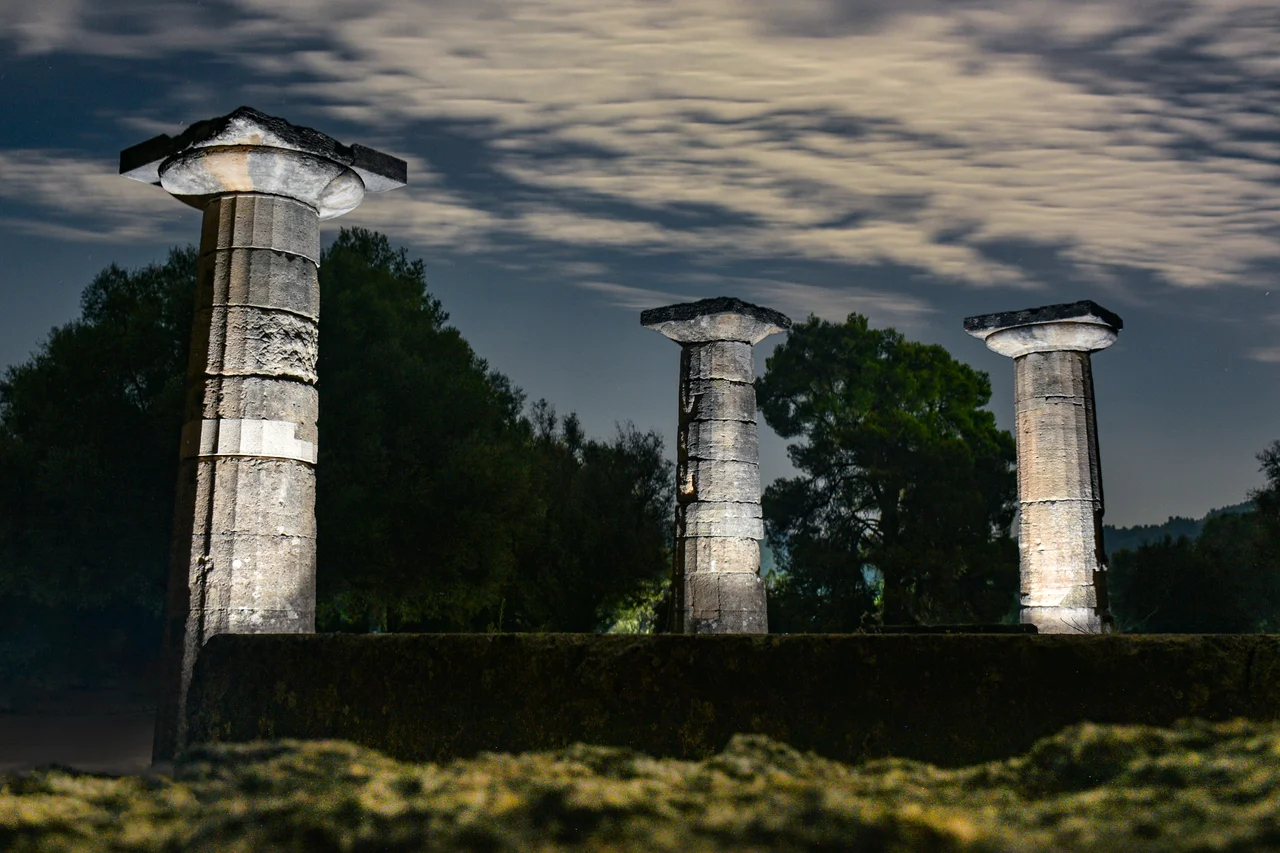

Temple of Hera, Olympia
Every four years, before the modern Olympics begin, a group of women in ancient-style robes gather in the ruins of a Greek temple. Using a curved mirror to concentrate sunlight, they kindle a flame. The flame passes from torch to torch, from runner to runner, eventually reaching the stadium of the host city, where it lights the cauldron that burns throughout the Games. The temple where this ceremony takes place is the oldest building at Olympia, older than the famous Temple of Zeus that once housed one of the Seven Wonders of the World, older than the stadium and the palaestra and every Roman-era structure at the site. The Heraion — the Temple of Hera — was built around 580 BC and has been, in one form or another, a place of sacred fire ever since.
Before Zeus Had His Own House
The temple was originally built as a joint sanctuary for Hera and Zeus, the divine couple who ruled the gods. It was dedicated, most likely, by the Triphylian city of Skillous as a gift to the sanctuary of Olympia — a donation that would have conferred enormous prestige on the donor community. The building honored Hera as the principal deity, with Zeus acknowledged alongside her. Only later, perhaps after 580 BC when political control of the sanctuary shifted from Triphylia to Elis, or in the 5th century BC when the great Temple of Zeus was constructed, did the building become more firmly identified as Hera's alone.
Set in the northern part of the Altis, the sacred precinct, the Heraion is one of the earliest Doric temples in Greece and the oldest peripteral temple at Olympia — meaning it was surrounded on all sides by a single colonnade, a row of columns running entirely around the building's exterior. The site may have been a place of worship before even this structure was built. When it was completed, around 600 to 580 BC, it replaced whatever came before as the formal religious center of the sanctuary.
A Temple Built Over Time
The most unusual thing about the Heraion's architecture is that it was never entirely finished in the same material. Its original columns were wood. Over the following centuries, spanning from the mid-6th century BC well into the Roman period, those wooden columns were gradually replaced with stone — but not all at once, and not by anyone with a unified plan. Each replacement was carved in the style of its own era, so the columns of the Heraion differ considerably in proportion, detail, and even the number of flutes. Every capital is slightly different from the next. In 173 AD, the traveler Pausanias noted that one column in the rear chamber was still made of oak.
This long, unplanned accumulation has an unintended beauty: the building became a living record of Greek architectural style across nearly a millennium. Scholars have used the variation to date different phases of construction. The walls themselves were built in layers — a stone base course, then unbaked mud-brick above it, a material typical of early Greek construction. The roof was terracotta tile; the pediments were decorated with large circular disk ornaments 2.5 meters in diameter, each made from a single piece. One of those disks is still on display in the Archaeological Museum of Olympia.
The Treasury Inside
The Heraion was more than a place of worship. Because Olympia was a pan-Greek sanctuary, its older buildings served as repositories for the portable wealth of Greek civilization — objects of extraordinary value that communities and individuals dedicated to the gods here for safekeeping and prestige. The rear chamber of the temple, the opisthodomos, held a remarkable collection.
Pausanias catalogued what he saw there: cult statues of Hera and Zeus, the latter standing and helmeted. Statues of the Seasons, by the sculptor Smilis of Aegina. Figures of Themis, the Hesperides, an Athena with helmet and shield. A marble statue of Hermes holding the infant Dionysos — generally identified today as the Hermes of Praxiteles, one of the finest surviving examples of Greek sculpture and now in the Archaeological Museum of Olympia. A small ivory-inlaid couch said to have once belonged to Hippodameia. The bronze disc of Iphitus of Elis, on which the Olympic truce was inscribed in a ring of letters running around its edge. And the great table of Colotes, made of ivory and gold, the surface on which the olive wreaths were laid before being presented to the victors of the Games.
The cedar chest of Cypselus was also stored here — a remarkable artifact inside which, according to legend, the infant Cypselus, future tyrant of Corinth, had been hidden by his mother from those who meant to kill him. The chest was later dedicated at Olympia in gratitude, its panels decorated with mythological scenes in ivory, gold, and carved wood.
Where the Flame Begins
The temple was closed under Theodosius I and eventually destroyed by a severe earthquake in the early 4th century AD, though the date is not precisely known. The earthquake toppled much of the structure; the ruined colonnade that remains today is the result of centuries of spoliation, decay, and the extraordinary violence of the flood deposits that periodically buried the entire site.
What distinguishes the Heraion from nearly every other ancient ruin in Greece is the role it plays in the present. The Olympic flame ceremony, inaugurated at the 1936 Berlin Games and formalized into its current form in subsequent decades, takes place at the altar in front of the temple. The women who perform the ceremony are titled 'High Priestess' and 'Priestesses' for the occasion. The mirror that concentrates the sun is a deliberate echo of ancient practice; the flame that results travels the world before arriving at the opening of each Games. A building damaged by earthquakes, abandoned for sixteen centuries, rediscovered by 19th-century German excavators, and largely collapsed — it nonetheless connects every modern Olympiad, across a chain of fire and ritual, to the place where the Games began.
From the Air
The Temple of Hera sits at approximately 37.639°N, 21.630°E in the northern section of the Altis at Olympia, just south of the base of Kronion hill. It is the northernmost major temple in the sanctuary, oriented east-west. The nearest major airport is LGRX (Araxos), approximately 40 km to the north-northeast, accessible via the Alpheios River valley. From the air, the parallel rows of surviving columns are visible as a linear pattern against the grass of the excavated precinct. Recommended viewing altitude: 1,500–3,000 feet AGL for clear resolution of the temple site. The Kronion ridge and the Kladeos River channel provide natural navigation landmarks immediately north and west of the site.
Nearby Stories
- Santameri Castle 4.6 km away
- Aristarchos 2.3 m Telescope 4.8 km away
- Lepreum 9.1 km away
- Arcadia (region) 13 km away
- Peloponnese 14 km away
- St. Mark's Roman Catholic Church 20 km away
- Strofades 22 km away
- County Palatine of Cephalonia and Zakynthos 39 km away