_on_16_April_2018.jpg)
Temple of Roma and Augustus
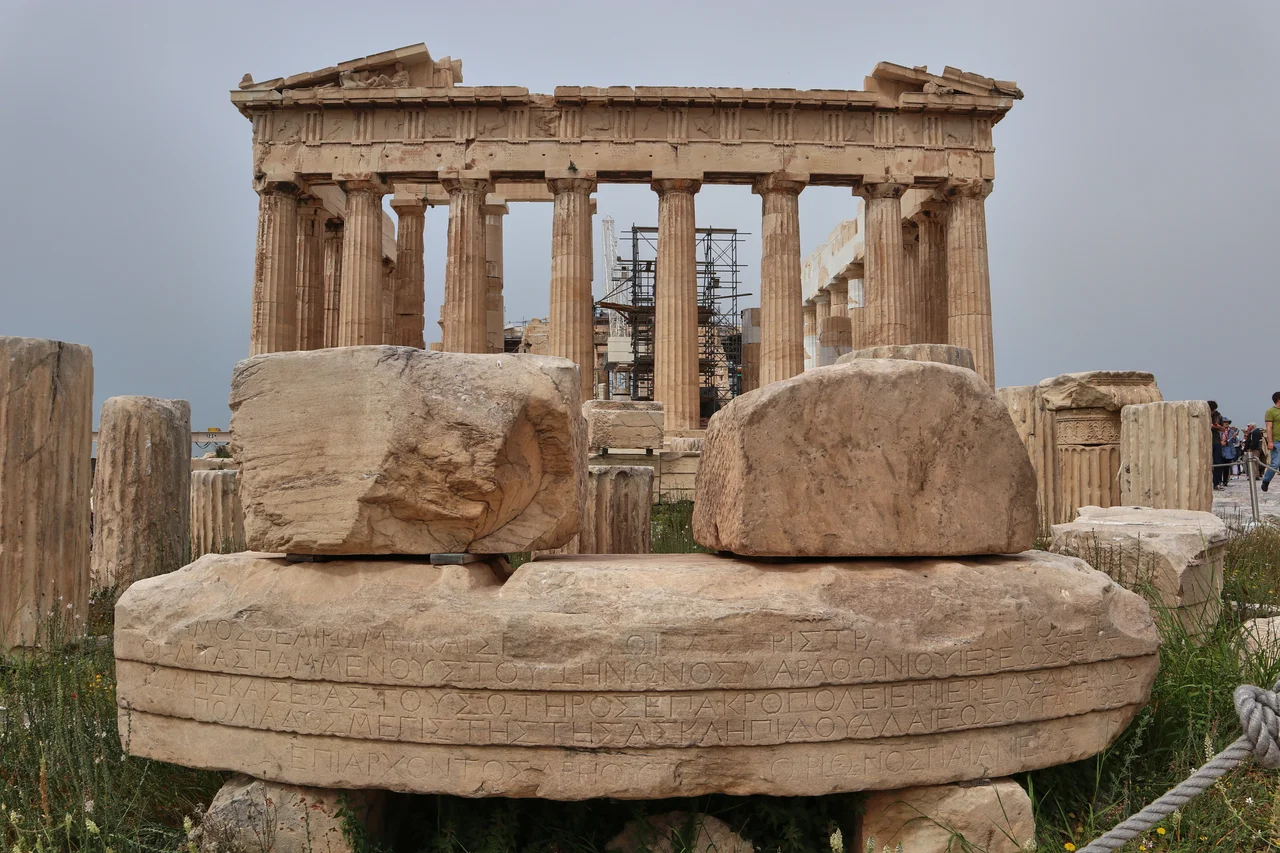
A few steps east of the Parthenon's great doorway, the marble underfoot changes character. A square foundation and scattered fragments mark where a small round temple once stood, ringed by nine slender Ionic columns under a conical marble roof. It was dedicated not to a Greek god but to Roma, the personified spirit of Rome, and to Augustus, an emperor still very much alive. On the most sacred hill in the Greek world, this was the only Roman temple ever built, and its presence there was a calculated act of diplomacy.
Athena Spits Blood
The historian Dio Cassius preserved a strange omen. In the winter of 22 to 21 BCE, as Augustus visited Athens, the great statue of Athena inside the Parthenon, which had always faced east, was said to have turned to the west and spat blood toward Rome. Whatever lay behind the story, its meaning was unmistakable. Athens resented the man now master of the Mediterranean. The city had backed Mark Antony against him in the civil war that ended at Actium, and it was paying the political price. The goddess's reported defiance captured a mood: a proud old city seething under the rule of a new power it had bet against and lost.
A Gift After the Thaw
Reconciliation came on Augustus's second visit, after his diplomatic triumph over Parthia had burnished his prestige. This time he took part in the Eleusinian Mysteries, the ancient initiation rites that meant a great deal to the Greeks, and relations warmed enough for an exchange of honors. The temple was likely raised to mark that moment, around 19 BCE. By placing a shrine to Rome and its emperor on the Acropolis itself, beside the Parthenon, Athens signaled that it was ready to embrace the imperial cult and the Augustan order. It was a monument built out of necessity, a stone apology and a wager on the future all at once.
Reading the Stones
What survives is modest but eloquent. The temple was a monopteros, a ring of columns with no enclosing wall, cut from gleaming Pentelic marble quarried in the mountains north of the city. Its nine columns echoed the elaborately carved floral capitals of the nearby Erechtheion, an early example of the classicizing Neo-Attic style that looked back to Athens's golden age. An inscription in deliberately archaic lettering ran across the architrave above the central span, which was widened and turned to face east, toward the Parthenon's door. Excavators Kavadias and Kawerau uncovered the foundation between 1885 and 1890, and found it built partly from reused blocks, including a piece taken from the Erechtheion when that older temple's west side was being repaired.
Power and Its Disguises
Scholars still debate what the Athenians meant by it. One reading sees the temple as flattery in stone, evidence of a city eagerly remaking itself in Rome's image. Another finds something more cunning. By setting the shrine within the Acropolis, the field of so many Greek victories over Persia and beyond, the Athenians may have been quietly folding Roman power into a far longer story of Greek martial glory, framing the conqueror as merely the latest chapter in a history the Greeks had been writing for centuries. Either way, a small round temple to a living emperor sat in the shadow of the Parthenon, where it asked everyone who climbed the sacred hill to consider who now ruled the world, and on whose terms.
From the Air
The temple's remains lie on the Acropolis of Athens at 37.9716 N, 23.7273 E, roughly 23 meters east of the Parthenon's eastern entrance and about 33 km west of Athens International Airport (LGAV / ATH). From the air the Acropolis is unmistakable: a flat limestone outcrop crowned by the Parthenon, rising above the dense city center. The round temple's footprint is small and best appreciated on the ground; from altitude, navigate to the rectangular bulk of the Parthenon and look just off its eastern end. Clearest in dry summer light.
Nearby Stories
- Great Sand Beach 5 km away
- Battle of Delium 7.7 km away
- Tower of Aliartos 9 km away
- HMHS Britannic 10 km away
- Saronic Gulf 15 km away
- Sousaki Volcano 17 km away
- Sanctuary of Apollo Maleatas 24 km away
- Skyros 66 km away