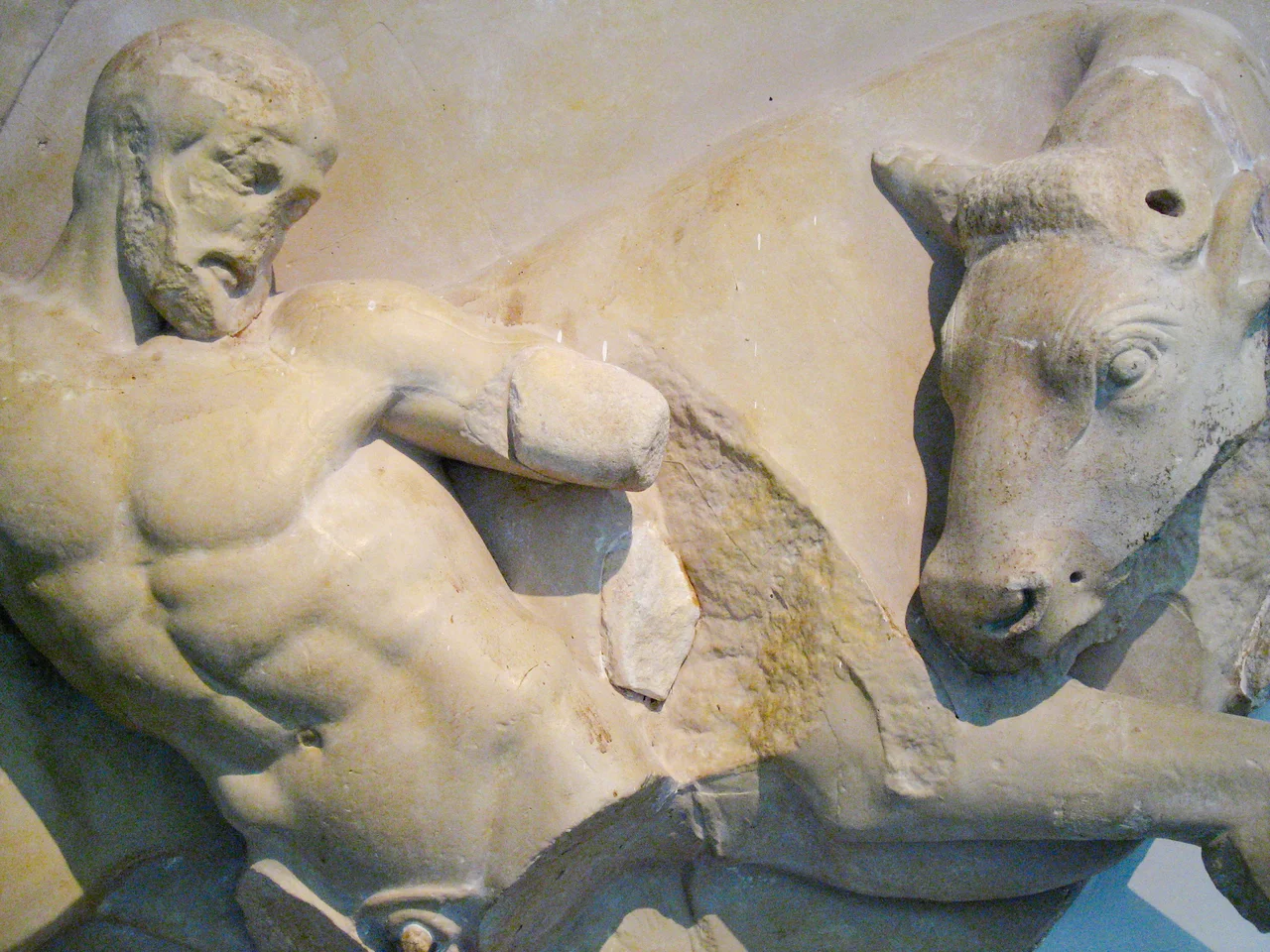

Temple of Zeus, Olympia
Imagine a roof that glows. On a summer afternoon in ancient Olympia, a visitor stepping inside the Temple of Zeus would have noticed light filtering through more than a thousand tiles of Pentelic marble, each cut thin enough to be translucent — each one casting what scholars have calculated as the equivalent of a 20-watt bulb. The temple was not simply enormous. It was a machine for producing awe. Completed around 456 BC, it set the standard for the fully developed classical Doric temple, and within its marble-faced walls the sculptor Pheidias built the most famous statue in the ancient world.
A Temple Built on Ancient Ground
Olympia was already sacred long before the great temple rose here. The Altis — the sacred enclosure of Zeus — had its roots in the tenth and ninth centuries BC, when open-air altars and a tumulus honoring the hero Pelops marked the site. By the time the temple was commissioned, Olympia had been hosting the Panhellenic Games for more than two centuries.
The building that emerged between roughly 472 and 456 BC was designed to make an unambiguous statement about scale and order. Its three-stepped platform measured 230 feet long and 95 feet wide; its height to the pediment reached 68 feet — all figures recorded by Pausanias when he visited in the second century AD. The six-by-thirteen arrangement of Doric columns, the two interior rows of seven that divided the great hall into three aisles, and the translucent marble roof tiles were the work of builders who understood that proportion could feel like power. Because the local poros limestone was unattractive, the entire structure was coated with fine white stucco to match the sculptural marble — from the outside, it appeared to be carved from a single brilliant material.
Stories Carved in Stone
The sculptural program of the temple was extraordinary, and much of it survives in the Archaeological Museum of Olympia. The metopes — twelve carved panels above the colonnade — depicted the Twelve Labours of Heracles. The pediments told larger stories in the round, in the severe, almost austere style of the early Classical period, now attributed to the workshop of the so-called Olympia Master.
The eastern pediment dramatized the chariot race between Pelops and King Oenomaus: a moment frozen before catastrophe, the figures arranged in charged stillness around the central figure of Zeus. On the western pediment, Apollo stood calmly at the center of a Centauromachy — the battle of Lapiths against centaurs at a wedding feast — his arm extended to signal his favor for the human side. Pausanias, who recorded the sculptures in his Description of Greece, attributed the eastern figures to the sculptor Paeonius and the western to Alcamenes. The pediment sculptures displayed in Olympia today remain among the finest surviving examples of Severe-style Greek carving.
The Wonder Inside
The temple was built to contain a statue. Not merely a votive offering, but one of the Seven Wonders of the Ancient World: the Statue of Zeus by Pheidias, a chryselephantine — gold and ivory — figure approximately thirteen meters high. Pheidias worked in a purpose-built workshop on the Olympia site; ancient sources date the statue's completion to around 435 BC, some years after the temple itself was finished.
The cella of the temple was modified substantially to accommodate it. Interior columns were repositioned, the floor was paved with shell stone then covered with water-resistant lime to protect the ivory from humidity. Ancient sources record that the enthroned Zeus nearly touched the ceiling — the Roman writer Strabo suggested that if the god stood up, he would lift the roof. The statue was eventually lost: whether destroyed by fire at Constantinople, where it may have been moved in late antiquity, or lost at Olympia itself, no one knows. What remains is the testimony of those who saw it, unanimous in their astonishment.
Destruction, Rediscovery, and What Remains
The temple survived the Roman period, gaining additional decoration — twenty-one gilded shields hung by the general Mummius after he sacked Corinth in 146 BC — and eventually fell to natural forces. Earthquakes in AD 522 and 551 caused severe damage across the Peloponnese; a 2014 paper raises the possibility that the columns may have been intentionally pulled down during the early Byzantine period. Flooding of the Kladeos river, possibly augmented by a tsunami, buried the site under alluvial deposits up to eight meters deep.
Olympia was forgotten for over a millennium. The English antiquarian Richard Chandler identified the site in 1766. In May 1829, French archaeologists from the Scientific Expedition of Morea conducted the first systematic excavation, removing several metope fragments to the Louvre. Systematic work began in 1875 under the German Archaeological Institute and has continued since. Today the fallen column drums lie in their rows on the grass, each drum nearly as tall as a person. The pediment sculptures are in the museum. The platform is bare. But the geometry of it — those six columns on the short ends, the long flank marching down the hill — is still legible in the stones.
Ancient Olympia from the Air
The sanctuary of Olympia sits in a green valley at the confluence of the Kladeos and Alpheios rivers in the western Peloponnese, at approximately 37.638°N, 21.630°E. From the air, the rectangular platform of the Temple of Zeus stands out clearly among the ruins of the Altis enclosure, flanked by the older Temple of Hera to the north and the great stadium to the east. The surrounding valley is lush with pines and plane trees. The nearest major airport is LGRX (Araxos Airport), roughly 40 kilometers to the north along the coast of the Gulf of Patras. Approach from the northwest at 3,000–5,000 feet for the best view of the sanctuary complex in its river-valley setting; morning light from the east is ideal for picking out the column drum alignments and the museum building adjacent to the ancient site.
From the Air
Coordinates: 37.638°N, 21.630°E. The Temple of Zeus platform is clearly visible within the Altis sanctuary complex at the confluence of the Kladeos and Alpheios rivers. Nearest airport: LGRX (Araxos), approximately 40 km to the north. Recommended altitude: 3,000–5,000 feet for the full sanctuary layout. Morning light from the east best illuminates the column drums and ruins. The valley is green year-round; visibility is generally excellent in the western Peloponnese except during summer haze.
Nearby Stories
- Santameri Castle 4.6 km away
- Aristarchos 2.3 m Telescope 4.8 km away
- Lepreum 9.1 km away
- Arcadia (region) 13 km away
- Peloponnese 14 km away
- St. Mark's Roman Catholic Church 20 km away
- Strofades 22 km away
- County Palatine of Cephalonia and Zakynthos 39 km away