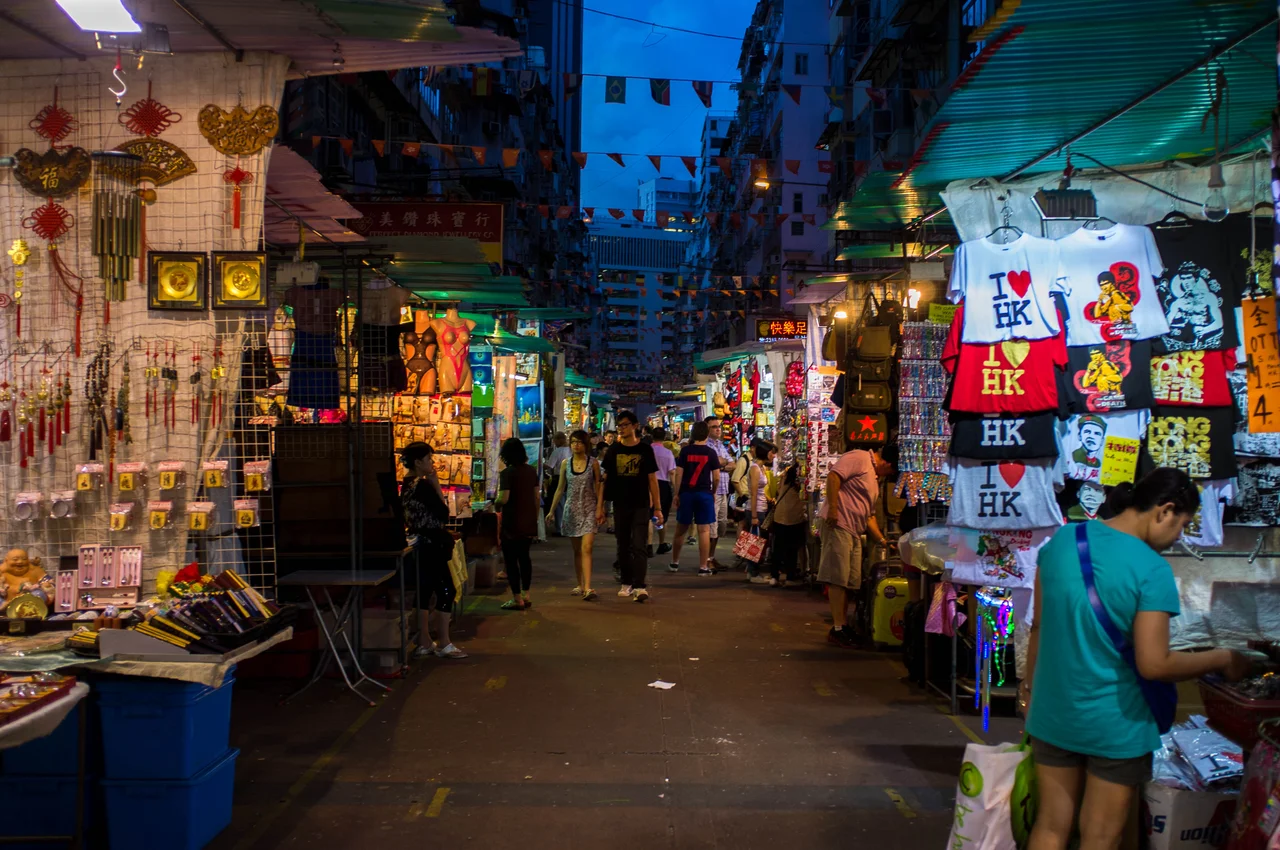

Temple Street Night Market
The name is 廟街 — Miu Gai in Cantonese, Temple Street in English — and it tells you exactly where it came from: a Tin Hau temple built on this site during the Qing dynasty, dedicated to the goddess of the sea, patron of fishermen and sailors. The temple is still here. So is just about everything else. Every evening, traffic closes, stalls unfold from nowhere, and a hundred points of colored light ignite over a street that transforms from a Kowloon thoroughfare into one of Hong Kong's most unapologetically alive night markets. People have been calling it Men's Street for decades, for the jeans and t-shirts and watches that dominate the stalls. The temple doesn't mind the company.
The Market After Dark
The stalls begin setting up around 2 p.m., but Temple Street doesn't fully wake until dusk, when the traffic barriers go up and the street belongs entirely to pedestrians. Over a hundred stalls line the road through the Yau Ma Tei and Jordan sections of Kowloon, each one piled with merchandise: jeans and t-shirts, mobile phones and watches, shoes and lighters, men's accessories of every description. Prices are negotiable — this is a market built on bargaining, and vendors expect it. Alongside the new goods are second-hand cassettes, old video tapes, vintage newspapers, and the occasional antique that may or may not be what it claims to be. The density is part of the appeal. Bodies move through narrow channels between stalls, languages mix freely, and the colored lights overhead give the whole scene the quality of a stage set — which, in a way, it is.
Old Masters and Street Kitchens
Tucked among the clothing stalls are old Chinese clinics that have operated for years, some for generations. The physicians inside practice Traditional Chinese medicine — what locals call TCM — and have earned informal titles as Masters for their years of accumulated knowledge. A consultation here is not a transaction; it is an exchange between someone who knows the old methods and someone willing to trust them. Nearby, the food stalls offer a different kind of restoration. Temple Street is famous for its street food and roadside dining: rice hot pots, seafood, local snacks, the full vocabulary of Cantonese street cuisine served from carts and makeshift kitchens. Eating here means sitting close to strangers, ordering by pointing, and accepting that the best meal you find might be in front of a stall with no fixed address.
The Street That Cinema Loved
Hong Kong cinema discovered Temple Street early. The market's density, its mixture of legitimate commerce and shadow dealings, its perpetual dusk atmosphere — all of it made the street an irresistible backdrop for films that wanted to show the full texture of Kowloon life. Gangster films in particular returned again and again: Temple Street appeared in Queen of Temple Street (1990), The Prince of Temple Street (1992), and Mean Street Story (廟街故事, 1995), building a screen mythology around the place. But the films weren't limited to crime narratives. Stephen Chow's The God of Cookery used it, as did the TVB series Street Fighters, which starred Hacken Lee and Edmond Leung. In September 2003, the inaugural Temple Street Festival brought official recognition of what residents and filmmakers already knew: this was not just a market. It was a Hong Kong institution.
The Goddess at the Center
For all its commercial energy, Temple Street still organizes itself around the Tin Hau temple that gave it its name. Tin Hau — the Empress of Heaven, Queen of the Sea — has been venerated in Hong Kong for centuries, particularly by the fishing communities that once depended entirely on the waters around the territory. The Yau Ma Tei temple complex sits along the middle stretch of the street, an older presence amid the nightly market. It doesn't compete with the stalls surrounding it. The incense smoke drifts upward, the offerings are made, and a few steps away someone is negotiating hard over the price of a watch. In Hong Kong, the sacred and the commercial have always made comfortable neighbors.
From the Air
Temple Street runs through Yau Ma Tei and Jordan at approximately 22.308°N, 114.170°E, in the densely built urban core of Kowloon. From 3,000–4,000 feet, the tight grid of Kowloon's streets is clearly visible, with Victoria Harbour to the south and the hills of the New Territories rising to the north. The former Kai Tak Airport — where pilots once made their famous curved low-altitude approach over these rooftops — was approximately 3 km to the east. Hong Kong International Airport (VHHH) on Lantau Island is roughly 30 km to the west. Jordan MTR station is the nearest transit hub, roughly 10 minutes' walk from the market's southern end; Yau Ma Tei station is 1 minute from the northern section.
Nearby Stories
- Lok Ma Chau Loop 2.3 km away
- Portas do Cerco 2.3 km away
- Kweilin Incident 17 km away
- Wanshan Archipelago Campaign 34 km away
- Nanxiong Formation 115 km away
- Battle of Nanpeng Island 148 km away
- Heyuan 169 km away
- Cape Maobitou 632 km away