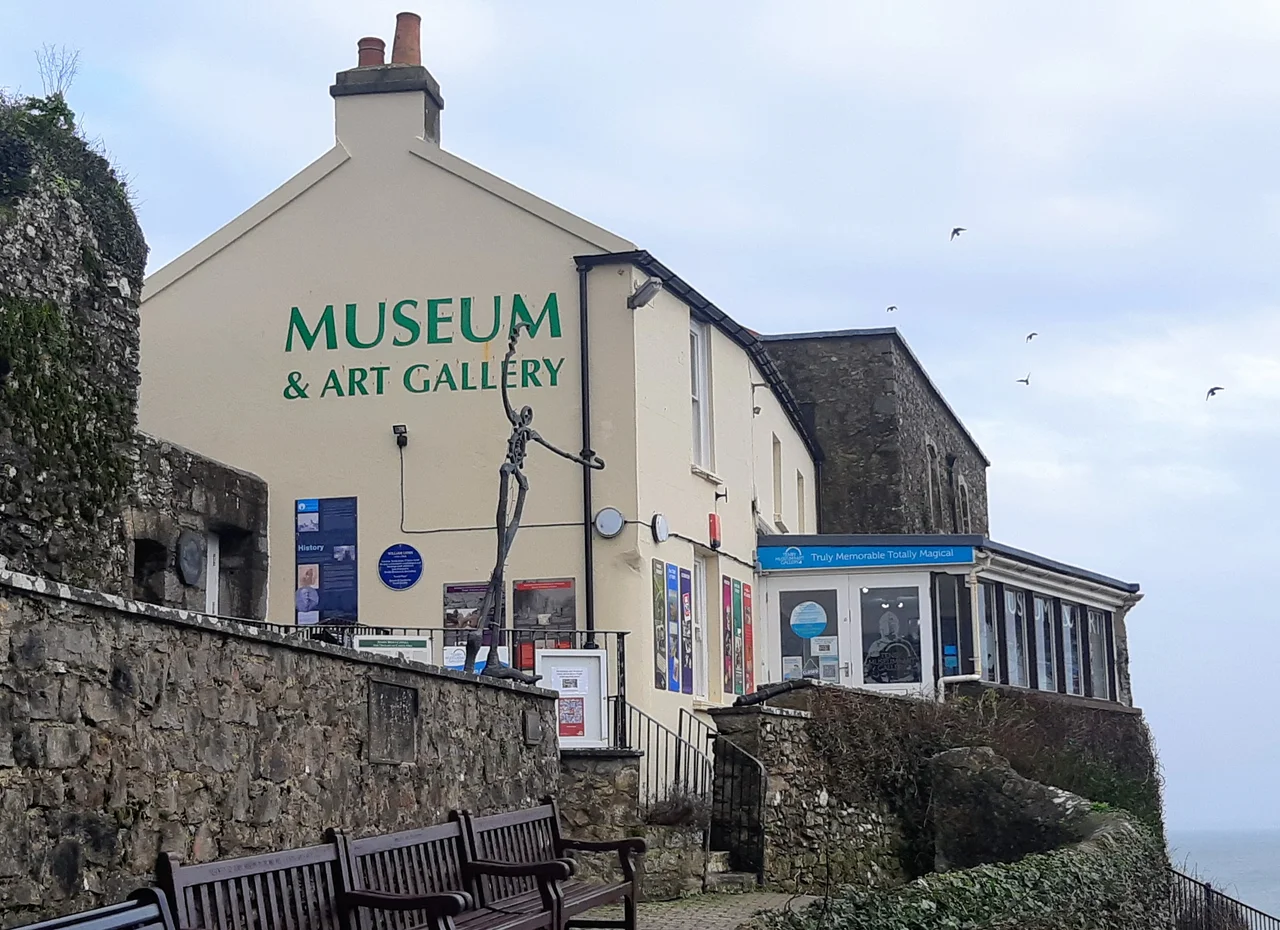

Tenby Museum and Art Gallery
In 1877, a retired Oxford professor of anatomy named George Rolleston was digging in caves near Tenby alongside an amateur archaeologist called Edward Laws. They were finding bones, flints, and the unmistakable traces of human habitation in some of the oldest occupied caves in Britain. The following year, Laws asked Rolleston to come back and open something - a museum, founded on the site of a ruined Norman castle, dedicated to the geology, biology, and human history of this corner of Wales. Rolleston accepted. On 26 July 1878, the Tenby Museum opened. It has never closed.
Castle Hill
The museum sits inside the medieval Castle of Tenby, on the headland that separates the North Beach from the South Sands. Most of the castle is ruin now - it had already been ruined for centuries by the time the museum moved in - but the surviving keep and walls form an unmistakable silhouette above the harbour. The setting is part of the point. Tenby's history is layered into its stone: Welsh kingdoms, Norman conquest, medieval merchant town, Victorian seaside resort, and modern tourist economy, all stacked on the same headland. The museum's job, from the beginning, was to tell that story honestly, with the actual objects, not just the labels.
The Founders
Edward Laws was the prime mover. Born in 1837, he had time and money and the kind of restless curiosity that made him write three books - The History of Little England beyond Wales, The Church Book of St Mary the Virgin, and The Civil War in Pembrokeshire - while also serving as the museum's first honorary secretary. The first meeting to discuss a Tenby museum was held at 10 The Norton, the home of Charles Allen, twice Mayor of Tenby and a member of a well-known Pembrokeshire family. Dr Frederick Daniel Dyster, friend and correspondent of T. H. Huxley, contributed scientific books to the new library. William Lyons's daughters donated his shell collection, gathered over a lifetime of natural history. Edward Rawdon Bingham Power, a retired colonial civil servant who had spent his career in Ceylon, attended every committee meeting and gave the museum decades of his time. None of them were professional curators. All of them showed up.
The Johns
In 1976 the museum opened the Wilfred Harrison Art Gallery, and in 1995 the New Art Gallery joined it. The collection now includes works by two artists who grew up just down the coast: Augustus John and his sister Gwen John, born in Tenby and Haverfordwest respectively, both of whom became central figures in early-twentieth-century British painting. Augustus was the celebrity in his lifetime - a tall, charismatic figure painted by everyone, painting nearly everyone. Gwen worked quietly in Paris, lived alone, and is now widely regarded as the greater artist of the two. To stand in a small gallery in their home county and look at their work hanging side by side is to see a Pembrokeshire conversation that ran across thirty years. The collection also includes Kyffin Williams, John Piper, Nina Hamnett, Claudia Williams, and John Knapp Fisher - the spine of modern Welsh painting.
Shoestring Award
In 1993 the museum won the Prince of Wales Award for restoration. In 1996 it won the Shoestring Award - the United Kingdom prize for the museum that achieves the most with the least money. The Shoestring matters in Tenby because the budget has always been small and the standards have always been high. By 2000 the museum was winning national and regional awards for professional training - the kind of awards that institutions twenty times its size compete for. On 31 July 2003, on the 125th anniversary of the opening, Prince Charles visited. Volunteers and small staff teams have run the place since the founders died; the same families show up across generations on the membership lists.
What's Inside
The collection ranges across local geology, biology, archaeology, maritime history, and the long Welsh tradition of piracy along the Bristol Channel - this was, for centuries, a coast where smuggling was a normal business. Cave-bear teeth share cabinets with Bronze Age pottery; Augustus John oils hang above 19th-century carpenters' tools. A Mesolithic flint scatter from a nearby cave sits a few yards from a watercolour of Tenby harbour. The museum's Grade II listing covers its building - a late-Victorian conversion of the castle's interior - and the building still creaks and lets in some weather, as old buildings do. The point of independence, the founders understood from the start, is that you keep going on your own resources for exactly as long as it takes. In Tenby's case, that has now been one hundred and forty-eight years.
From the Air
Located at 51.6723 N, 4.6949 W on Castle Hill, Tenby, occupying the ruined castle headland between the North Beach and South Sands. Recommended viewing altitude 2,000-3,000 feet. The headland is the most prominent feature of Tenby's coastline - a wedge of green and stone projecting south from the medieval town. Nearby airports: EGFP Pembrey (16 nm east) and EGFH Swansea (28 nm east). The lifeboat station is immediately below on Castle Beach; the Napoleonic fort on St Catherine's Island is just offshore to the south.
Nearby Stories
- Gower Peninsula 0.2 km away
- St Davids Lifeboat Station 3.6 km away
- Dryslwyn Castle 8.1 km away
- Action of 17 November 1917 8.4 km away
- 102.5 Radio Pembrokeshire 9.6 km away
- Ilfracombe Lifeboat Station 15 km away
- Lighthouses on Lundy 19 km away
- Tehidy Country Park 121 km away