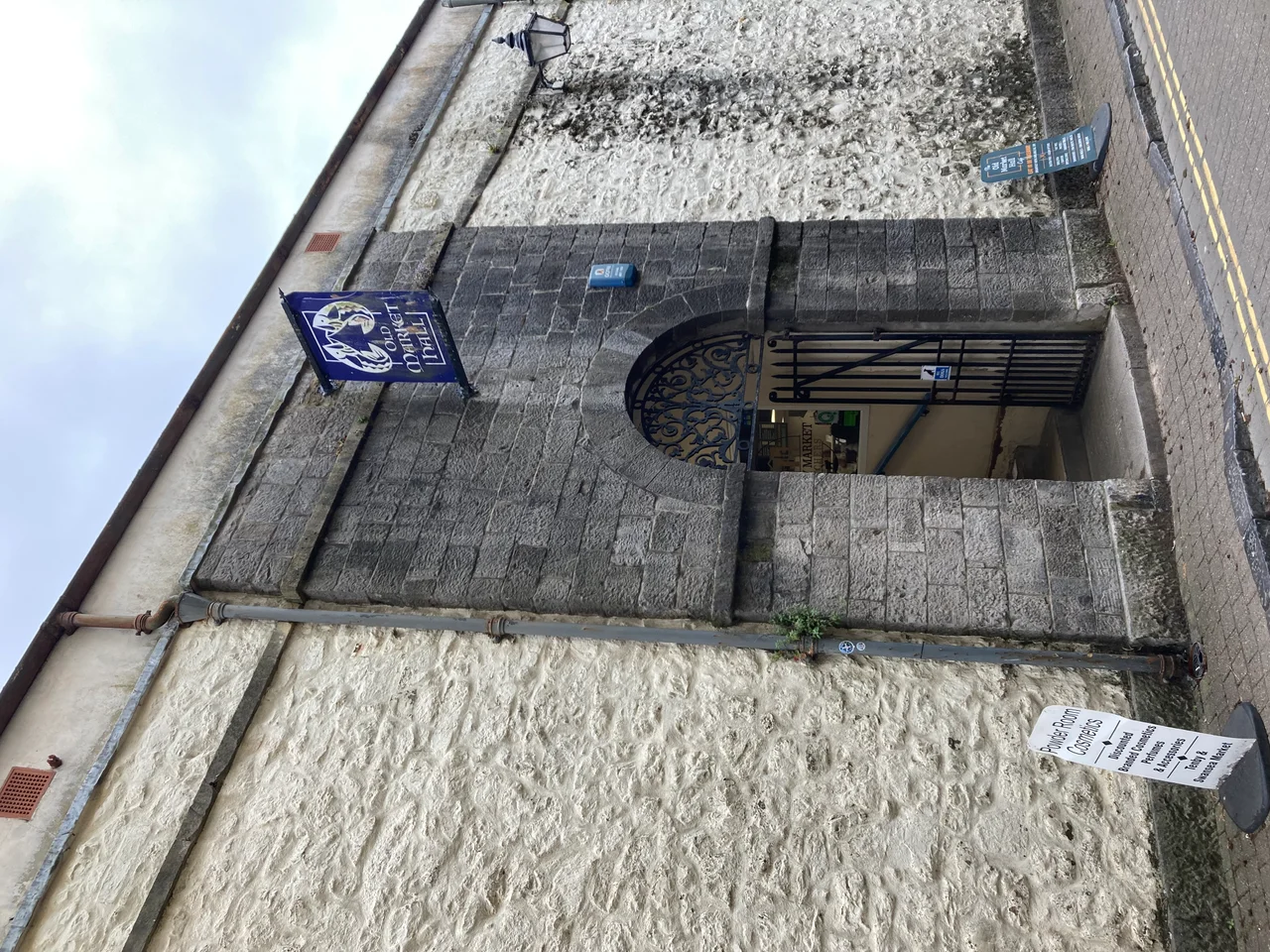

Tenby Town Hall
On a July evening in 1971, Fleetwood Mac played the Tenby Town Hall. The band was between line-ups, Peter Green had left, Christine McVie had officially joined the year before, and the High Street venue was a 142-year-old market-hall-turned-courtroom-turned-events-space that had been hosting borough councils since the Welsh Wars of Independence were rumours. Twenty-eight years later, the Super Furry Animals played the same room. The building is Grade II listed. It still does both - civic earnestness and a good Saturday-night gig.
The Guildhall Before
Tenby's first municipal building was a single medieval room above a gateway to St Mary's Church. It dated to at least the late 15th century - a stone box with two round-headed windows, accessible by a flight of steps, used by the borough council for meetings after Tenby received its charter in 1581. Inside was an iron chest where the borough archives were kept. The room is still there, embedded in the church wall on St George's Street, and the chest is too. Walk past it on a quiet morning and you can still feel that this was once where Welsh merchants argued about market tolls and the price of pilchards - the actual administrative life of a small medieval port.
The 1829 Building
By the early 19th century the borough needed more space. A new single-storey market hall went up on the High Street, designed in the neoclassical style fashionable at the time and finished in 1829. The building has a symmetrical three-bay frontage of limestone blocks, each bay framing a round-headed opening with a cast-iron fanlight. The central bay projects forward and is topped with a modillioned pediment - that is, a decorative gable supported by small carved brackets - with the borough seal carved into the oval plaque in its tympanum. Internally, the long market hall stretched back to Upper Frog Street. Doric pilasters - flat columns - support a cornice above the windows on the upper floor. The total effect is restrained, dignified, and built to last.
Council, Court, and Inquest
When the upper floor was added in the late 19th century, the principal room there became the new borough courtroom and council chamber. Glass roofing covered the market hall in 1891. The town hall held inquests as well as council meetings - a Victorian municipal building was expected to be all three things at once. In October 1909 an inquest was held here into the death of an unidentified man, aged about 35, whose body had washed up on the beach at South Sands. His identity was never established. The local newspapers reported the case briefly and then moved on; the file went into a council drawer, where it presumably still rests. Across a century, the courtroom heard hundreds of similar small Pembrokeshire dramas - drownings, drunken disputes, license applications - the slow grain of a coastal community administering itself.
Croft House
In 1947 the borough council bought a large 1820s house called Croft House on The Norton - it had been the Bay Hotel - and turned it into their new offices and meeting room. The old High Street building became the events venue it largely remains. Croft House went through three names: first 'Civic Centre', then 'Guildhall' from around 1963, then back to a more functional designation after local government reorganisation in 1974. Tenby Town Council kept meeting there until the mid-1980s, then moved to the De Valence Pavilion on Upper Frog Street. The magistrates court at Croft House closed in 2003. The Guildhall building was converted into flats. The actual town hall - the 1829 one - kept on being a town hall, just one without a council.
Bands and Bookings
What followed at the High Street was a different sort of municipal life. Promoters booked the hall for touring acts, weddings, and the South Wales Showband. Fleetwood Mac played in July 1971; the Super Furry Animals played in April 1999 during the band's purple-suit period. Local Welsh-language acts have used it as long as anyone alive remembers. The building's Grade II listing protects the architectural details - the fanlights, the pediment, the Doric pilasters - and the same protection means owners cannot drop a low ceiling or partition the long market hall into smaller rooms. Stand inside on an empty afternoon and the volume is what you notice first. This was always meant to hold a crowd.
From the Air
Located at 51.6725 N, 4.7011 W in the centre of Tenby, set back from the harbour by about 200 metres on the High Street. Recommended viewing altitude 2,500-3,500 feet over the town. The town hall is one block north of St Mary's Church - look for the church tower as your landmark, then the lower municipal frontage immediately to the north. Nearby airports: EGFP Pembrey (16 nm east) and EGFH Swansea (28 nm east). The medieval town walls form a clear D-shape around the historic core.
Nearby Stories
- Gower Peninsula 0.2 km away
- St Davids Lifeboat Station 3.6 km away
- Dryslwyn Castle 8.1 km away
- Action of 17 November 1917 8.4 km away
- 102.5 Radio Pembrokeshire 9.6 km away
- Ilfracombe Lifeboat Station 15 km away
- Lighthouses on Lundy 19 km away
- Tehidy Country Park 121 km away