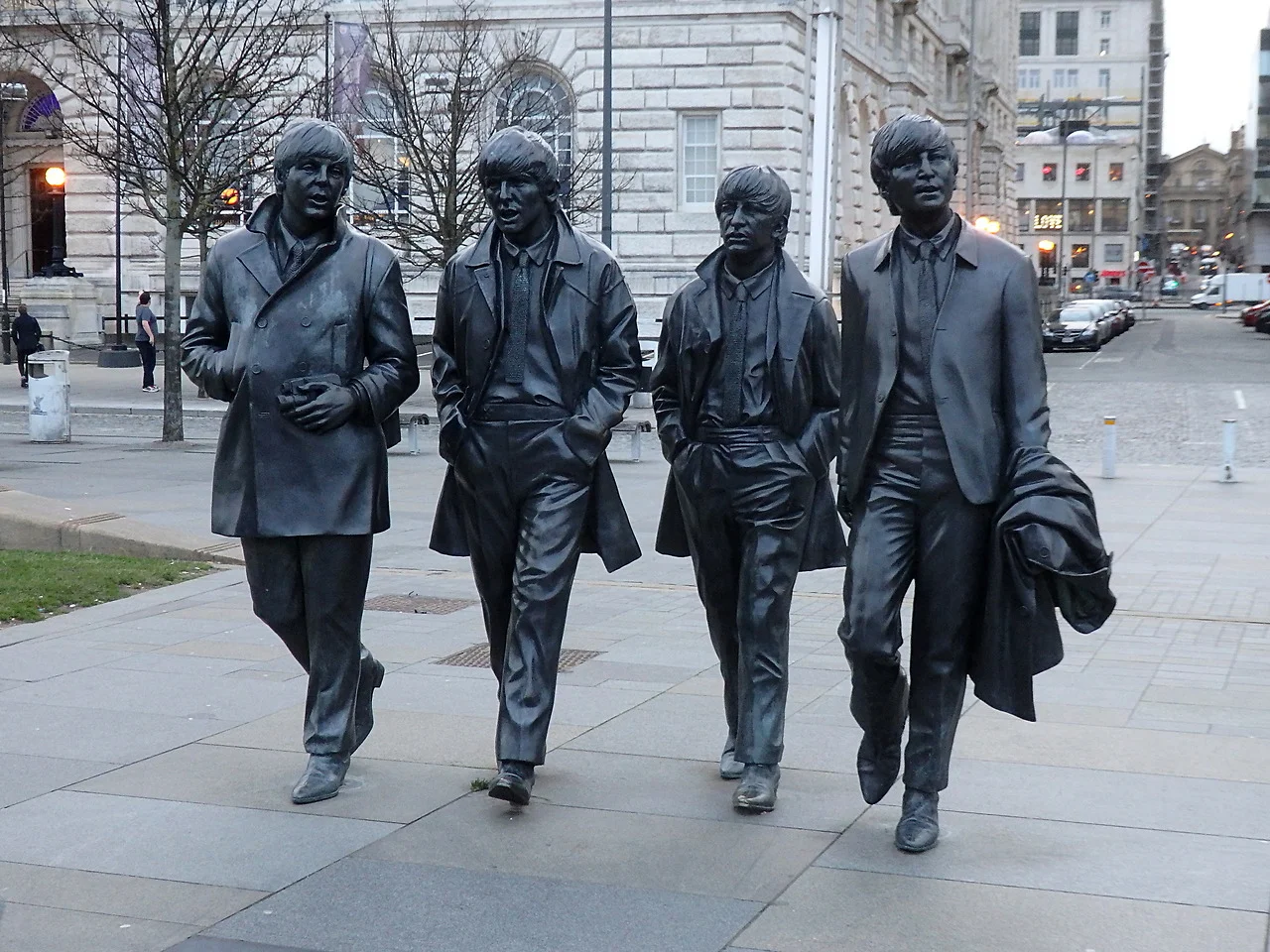

The Beatles Statue
Look closely at the sole of Ringo's right shoe. Cast into the bronze, in a deliberate little detail no casual visitor would notice, is a small card bearing the postal code L8 - the postcode of the Welsh Streets, the Liverpool district where Richard Starkey grew up before he ever became Ringo Starr. The Welsh Streets are gone now, mostly demolished and partially restored. The boy from L8 is not. He is standing, eternally bronze, on Pier Head with John, Paul, and George, walking past the Liver Building toward whatever it is that bronze Beatles walk toward. Each of the four figures carries a hidden tribute. Each tells a story about who they were and where they came from. Sculptor Andy Edwards designed the monument as a puzzle of small touches that reward attention.
Fifty Years to the Night
On 4 December 2015 a crowd of Beatles fans, Liverpool dignitaries, and family members gathered at the corner of Brunswick Street and Canada Boulevard at the Pier Head. Ann O'Byrne, Liverpool's deputy mayor, pulled the cover off with Julia Baird, John Lennon's half-sister. The next day, 5 December, would mark fifty years to the night since the Beatles had played their last Liverpool concert at the Empire Theatre on Lime Street. They had returned to the city many times since then individually, but they had never played there together as a band again. The choice of timing was deliberate. The Cavern Club - the venue where the band had played 292 sets between 1961 and 1963 - had commissioned the statue and donated it to the city of Liverpool. They wanted the unveiling to feel like a homecoming half a century delayed.
Walking Through 1963
Andy Edwards modelled the figures on a photograph taken at Pier Head itself in 1963. The Beatles were photographed walking together along the waterfront during a brief return to Liverpool that year. Edwards's bronze captures them mid-stride, larger than life, all four leaning forward in the way of people who know exactly where they are going. The composition is loose, casual, the opposite of a formal group portrait. Paul leads slightly on the left, holding a camera in his left hand against his chest. George walks beside him. Ringo is a half-step behind - the order they stood on stage, with Ringo on the drum kit at the back. John brings up the rear, hands at his sides, slightly turned toward the river. The bronze is dark and matte, contrasting with the polished granite waterfront and the pale facade of the Liver Building behind.
Paul's Camera, George's Belt
Each figure contains a private tribute. The camera in Paul's hand commemorates his late wife Linda McCartney, the American photographer who took some of the most familiar images of the band's later years and remained a working photographer for the rest of her life. Linda died of cancer in 1998. The bronze camera is a quiet acknowledgement that Paul's life had been shaped as much by her gaze as by her presence. George Harrison wears a belt with a Sanskrit inscription cast into the metal. The phrase translates to The Infinite Beyond Conception, we meditate upon that Light of Wisdom, which is the Supreme Wealth of the Gods. May it grant us to increase in our meditation. It is a verse from the Gayatri Mantra, one of the most ancient Hindu prayers, and a reference to Harrison's lifelong engagement with Indian spirituality - his discipleship with Ravi Shankar, his association with the Hare Krishna movement, his decades of meditation practice. George died of cancer in 2001. The mantra is his own, in his own language.
Ringo's Welsh Streets, John's Acorns
Ringo's hidden L8 postcode is a private nod to childhood. Richard Starkey was born at 9 Madryn Street in the Welsh Streets - a working-class district of Liverpool whose street names are mostly drawn from Welsh towns and counties, laid out by Welsh builders in the late nineteenth century. The house where he was born survived a 21st-century demolition campaign by being recognised as a heritage site. The L8 card on his shoe is a way of carrying that postcode with him wherever the bronze stands. John Lennon's right hand holds two small bronze acorns. They are not abstract symbols. They were cast from real acorns collected outside the Dakota apartment building in New York City - where John and Yoko Ono had lived, and where John was murdered on 8 December 1980. In 1968 John and Yoko had sent acorns to fifty world leaders as a peace gesture, asking each one to plant the acorn for peace. The bronze acorns in his hand commemorate that gesture and the place where his life ended.
Pilgrimage at Pier Head
Since the unveiling, the statue has become one of the most photographed sites in Britain. The bronze surface of Ringo's right knee, Paul's shoulder, and John's hands are polished to a brighter shade by the hands of tourists touching them for photographs. The Cavern Club's Mathew Street site is half a mile inland; the Beatles Statue at Pier Head bookends the river-end of a Beatles pilgrimage route that runs through the city centre, takes in Eleanor Rigby's bench on Stanley Street, passes the Albert Dock and the Beatles Story museum, and culminates here at the waterfront. The four bronze figures walk on with the Liver Building behind them and the Mersey stretching out west toward the Wirral. The fans who come to photograph them know it is not really the Beatles. It is the city's gift to itself - a memorial to a band that put Liverpool on the world's stage and never quite left, and a quiet inventory of the small details that made each member who he was.
From the Air
The Beatles Statue is at Pier Head, Liverpool, at the intersection of Brunswick Street and Canada Boulevard, at 53.405°N, 2.996°W. Best viewed at 1,500-3,000 ft. Liverpool John Lennon Airport (EGGP) is 5 nm south-southeast. Look for the broad open paved area between the Liver Building and the river just south of the Cunard Building - the statue sits in the open piazza, with the river to the west and the Three Graces behind.
Nearby Stories
- RAF Wrexham 3.3 km away
- Birkdale Palace Hotel 3.7 km away
- Turton Tower 4.1 km away
- Tatton Park 5.6 km away
- Abergele Rail Disaster 9.6 km away
- Diglake Colliery Disaster 13 km away
- Ysbyty Ifan 16 km away
- Celtic Array 62 km away