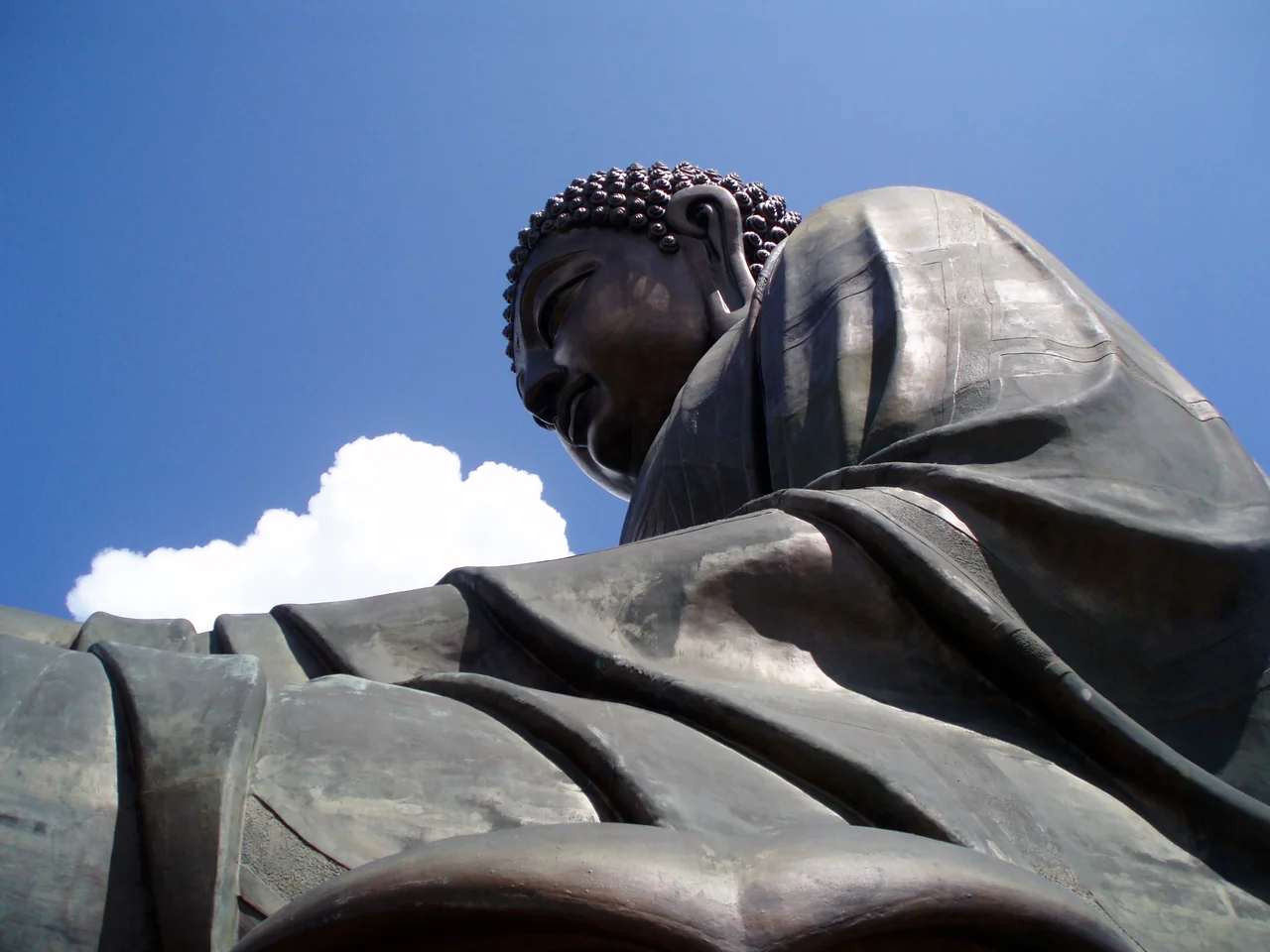

The Big Buddha (Hong Kong)
The monks of Po Lin Monastery had seen two great Buddha statues before they decided to build a third. In 1973, they visited the Great Buddha of Kamakura in Japan and the Great Buddha of Changhua in Taiwan, and came home convinced that Hong Kong's Lantau Island deserved something similar — a presence that could anchor the mountains' silence and give form to the region's Buddhist tradition. The British colonial government agreed, granting a 6,567-square-metre plot of land beside the monastery the following year. What eventually rose there, completed in 1993, was 34 metres of bronze skin laid over a steel skeleton: the Tian Tan Buddha, 268 steps above the valley floor, gazing southward across the Pearl River estuary.
Two Hundred and Two Pieces of Bronze
Building a colossal statue requires solving problems that architects rarely encounter. The Tian Tan Buddha weighs over 250 metric tons — roughly the weight of a fully loaded Boeing 747. That mass can't simply rest on stone; it needs an internal frame strong enough to survive typhoons funneling through the South China Sea. Engineers built a steel skeleton inside the hollow figure before cladding it in 202 individually cast bronze panels, fitted together with the precision of a three-dimensional puzzle.
The result sits on a three-tiered altar shaped like a lotus flower. Around the base, six smaller bronze figures — the Offering of the Six Devas — present gifts to the Buddha: flowers, incense, lamp, ointment, fruit, and music. Each offering represents one of the Six Perfections required for enlightenment. Together the figures create a kind of theological conversation in bronze, the lesser surrounding the greater, the offering pointing toward what it means to live well.
The Climb and What Waits at the Top
Visiting the Buddha means earning it. The 268 steps from the lower platform to the statue's feet aren't steep enough to be punishing, but they're enough to change the experience — each landing reveals a wider view of the mountains, the Ngong Ping plateau, and, on clear days, the ocean beyond. The outdoor approach is free; paying admission lets visitors enter the pedestal's interior, which houses a small museum and, according to the monastery, some of the Buddha's alleged cremated remains.
At the top, the scale becomes physical rather than visual. Looking up from the base, the face seems impossibly far away. Looking out from the platforms below, the coastal lowlands of Lantau and the towers of Tung Chung appear surprisingly small. The monastery below — Po Lin, meaning "Precious Lotus" — has been here since the early twentieth century, long before the statue arrived. The Buddha came to the monastery, not the other way around.
A Stamp, a Film, and a Gondola
Cultural recognition arrived in 1999 when the Hong Kong Post Office featured the statue on a HK$2.50 definitive stamp — the kind of distinction reserved for landmarks the city considers defining. Another stamp followed in 2012, this time celebrating the birth of Sakyamuni Buddha. In 2003, the opening of Infernal Affairs III used the Big Buddha as its establishing shot: a detective contemplating mortality against one of the territory's most enduring symbols of transcendence.
Access transformed when the Ngong Ping 360 gondola opened — a 25-minute cable car ride from Tung Chung that makes the plateau reachable without a bus and offers a view of Lantau's ridgelines and the airport below that no road can match. The older routes — bus from Mui Wo (via ferry from Central's pier No. 6), or NLB routes 2 and 23 — still work for those who prefer to arrive at ground level.
Silence Above the City
Hong Kong is not a quiet place. Even on Lantau — the largest of the outlying islands, twice the size of Hong Kong Island — the urban roar of Tung Chung and the airport reaches the lower valleys. The Ngong Ping plateau, at roughly 500 metres above sea level, sits above most of that noise. Clouds sometimes settle between the peaks and the valley floor, leaving the monastery and the Buddha in a separate layer of atmosphere altogether.
That separation is part of what the monks from Po Lin were looking for when they set out on their research trips half a century ago. They weren't trying to build a tourist attraction — though that's partly what they got. They were trying to build a place where the contemplative traditions of Chinese Buddhism could take a form visible from the sea, a figure large enough to be seen by fishermen, ferry passengers, and eventually airline travelers descending toward Chek Lap Kok. They succeeded beyond anything a 1973 monastery committee could reasonably have predicted.
From the Air
The Tian Tan Buddha sits at approximately 22.2541°N, 113.9051°E on the Ngong Ping plateau of Lantau Island, at roughly 500 metres elevation. From the air, the white lotus-shaped altar and bronze figure are visible against the green ridgeline even from altitude, particularly when approaching Hong Kong from the west or southwest. The nearby Chek Lap Kok airport (VHHH) is approximately 7 km to the north; the statue is directly visible on the approach from the Pearl River estuary. Recommended viewing altitude for a clear look at the plateau setting is 3,000–5,000 feet on a westward departure from VHHH. The Po Lin Monastery complex and the winding mountain roads to Ngong Ping Village are also identifiable from the air.
Nearby Stories
- Tai Tau Chau (Southern District) 0.7 km away
- Lai Chi Wo 3 km away
- Wanshan Archipelago Campaign 3.2 km away
- Pearl River Delta 3.7 km away
- Battle of Yamen 13 km away
- Jiangmen 15 km away
- Hong Kong 12 32 km away
- Battle of Nanpeng Island 114 km away