.jpg)
The Cavern Club
Fans at the bus stop knew where you had been. It clung to your coat, that sweet ghost of ripening tropical fruit from a warehouse cellar in Liverpool. The locals called it Cavern Perfume - the result of dancing teenagers and a packed basement, the bricks themselves sweating and giving back the warm honeyed smell the fruit had soaked into the sandstone before the cellar became a jazz club. Number 10 Mathew Street did not look like anywhere. A narrow door. A flight of stairs. A low arched cellar smelling, faintly, of pineapple. And then, between 1961 and 1963, the most consequential band in the history of popular music played there 292 times.
A Paris Idea Brought Home
Alan Sytner had been to Paris and seen Le Caveau de la Huchette, where jazz fans crammed into a Left Bank cellar to hear the bands play. He wanted that for Liverpool. He found his cellar in a fruit warehouse on Mathew Street whose basement had served as a Second World War air raid shelter. On 16 January 1957, the Merseysippi Jazz Band opened the new club. It was strictly a jazz venue. Skiffle - the homegrown washboard-and-tea-chest cousin of American folk - was just barely tolerated. Rock and roll was forbidden. That summer, on 7 August 1957, a skiffle group called the Quarrymen took the stage between jazz sets. Halfway through their slot, a teenager with a guitar called for the band to swing into Elvis Presley's "Don't Be Cruel." The boy was John Lennon. A note arrived from the management mid-song. "Cut out the bloody rock 'n roll," it read.
Before They Were the Beatles
Paul McCartney first played the Cavern with the Quarrymen on 24 January 1958. George Harrison turned up for a lunchtime session on 9 February 1961. That same evening, the band - now calling themselves the Beatles, fresh back from grueling residencies at the Indra and the Kaiserkeller in Hamburg - took the Cavern stage for the first time as a unit. Some in the audience thought they were a German group, since the posters billed them as visiting from Hamburg. Over the next two and a half years they would come back nearly three hundred times. Cilla Black worked the cloakroom and watched it all from behind the coat racks before her own singing career began. On 9 November 1961, a Liverpool record-shop manager named Brian Epstein came down the stairs to see what the lunchtime fuss was about. He left determined to manage the band. Two years later they would be on The Ed Sullivan Show. By then the Cavern stage was already too small to hold them.
Closed, Buried, Rebuilt
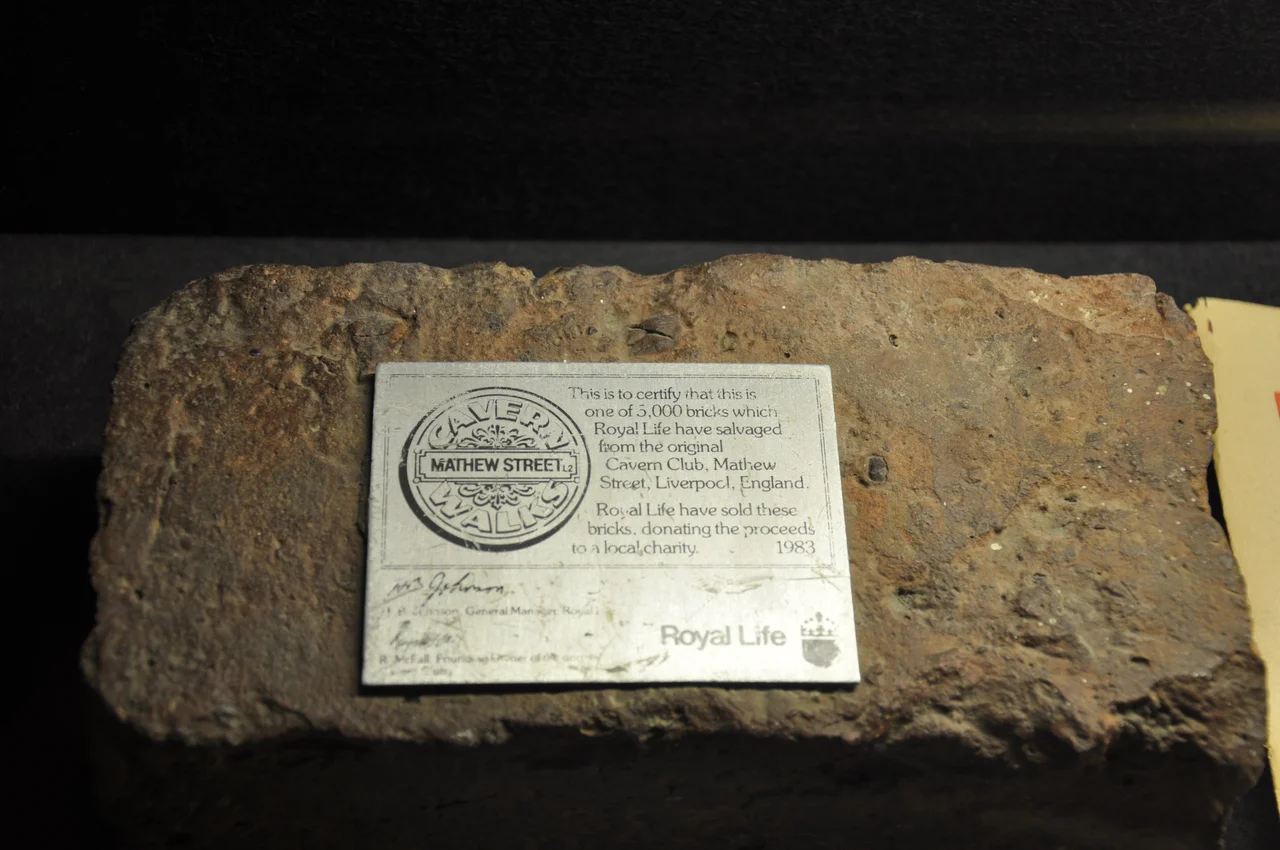
The Beatles played their farewell Cavern gig on 3 August 1963, a month after recording "She Loves You," six months before flying to America. Beatlemania had outgrown a 200-capacity cellar. The club soldiered on through the late sixties and early seventies, hosting the Rolling Stones, the Yardbirds, the Kinks, Elton John, Black Sabbath, Queen, the Who, and John Lee Hooker. Then in 1973, British Rail compulsorily purchased the warehouses above to dig a ventilation shaft for the new Merseyrail underground line. The Cavern was filled in. The ventilation shaft was never built. The site became a car park. A 1982 attempt to excavate the original cellar found the brick arches too badly damaged from the demolition to rescue. Instead, 5,000 bricks were sold to fans at five pounds each - each one with a certificate signed by former owner Ray McFall, the proceeds going to Strawberry Field children's home. The club we visit today, opened in 1984, sits at ninety degrees to the original cellar and covers about seventy percent of the original footprint. It is rebuilt, painstakingly, from 15,000 reclaimed Cavern bricks.
Pilgrimage on Mathew Street
The new Cavern works hard to honor what was lost. The fire exit, next to the Cilla Black statue, marks where the original entrance stood. The Live Lounge replicates the old room precisely, using as many original bricks as could be salvaged. Around forty live acts play here every week - tribute bands, original artists, and the occasional secret warm-up gig from a touring act that knows the symbolic weight of this stage. The Arctic Monkeys played here in October 2005. Jake Bugg followed in November 2013. Oasis and Travis have used the room to shake off the rust before tours. In June 2018, Paul McCartney returned and opened a surprise two-hour set with "Liverpool! Cavern! These are words that go together well!" On the wall behind the stage are the signatures of musicians who passed through - a tradition that runs back to the jazz days of the 1950s. In November 2008, the brick belonging to Gary Glitter was removed; a brass plaque now marks where it was. The room remembers.
From the Air
The Cavern Club sits in central Liverpool at 53.41 degrees north, 2.99 degrees west, on Mathew Street between Whitechapel and North John Street. From the air the most obvious landmarks are the Royal Liver Building on the waterfront half a mile to the west and the Anglican Cathedral rising above Hope Street to the south. Liverpool John Lennon Airport (EGGP) lies about seven nautical miles south-southeast on the Mersey shoreline; the airport's name itself a quiet acknowledgement of the city's most famous Cavern alumnus. Recommended viewing altitude 2,000 to 3,000 feet for a clear look at the compact street grid of the city centre.
Nearby Stories
- RAF Wrexham 3.3 km away
- Birkdale Palace Hotel 3.7 km away
- Turton Tower 4.1 km away
- Tatton Park 5.6 km away
- Abergele Rail Disaster 9.6 km away
- Diglake Colliery Disaster 13 km away
- Ysbyty Ifan 16 km away
- Celtic Array 62 km away