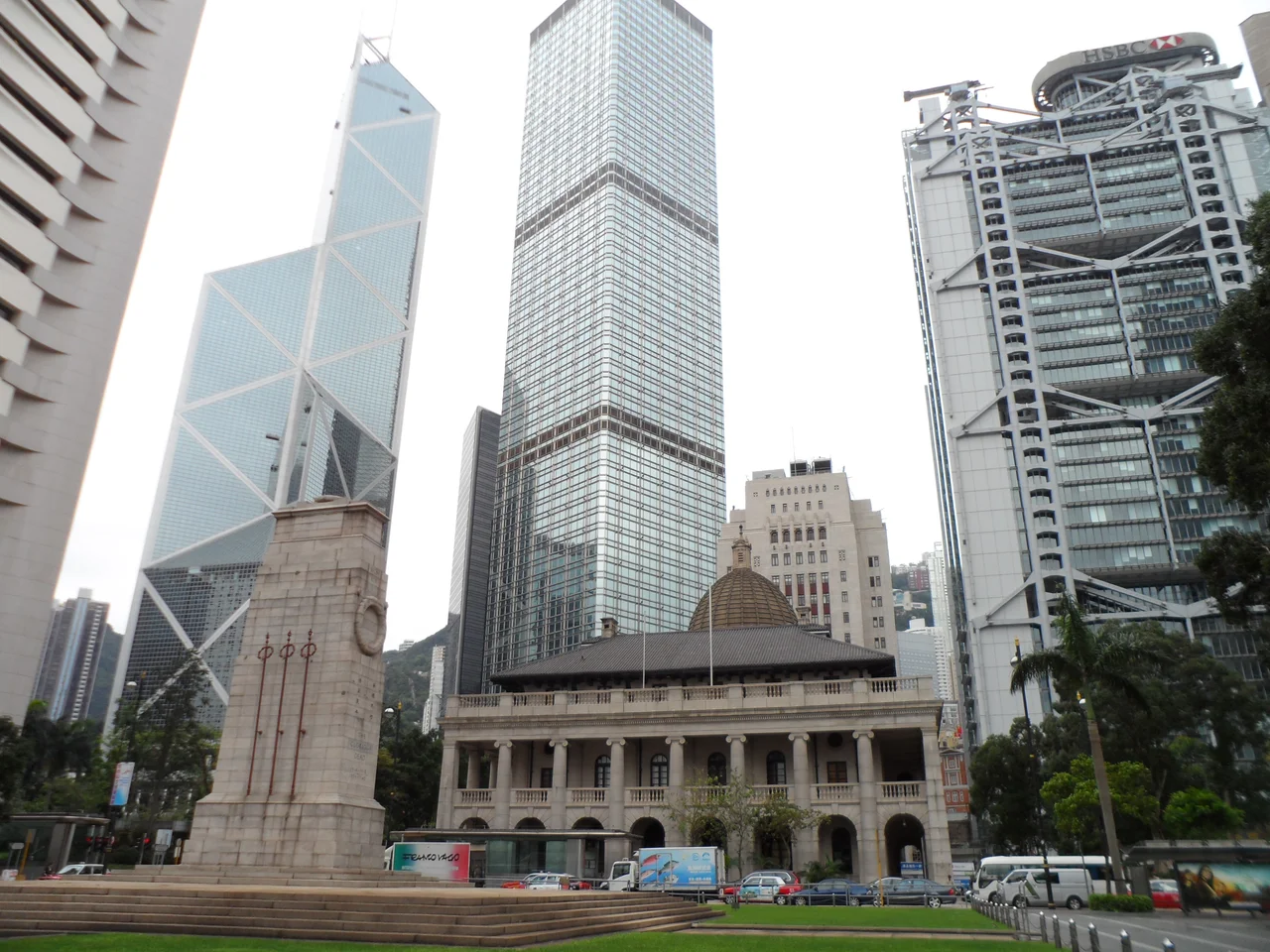

The Cenotaph, Hong Kong
Two words are carved into the stone: "The Glorious Dead." They are the same words cut into the Cenotaph on Whitehall in London, in the same font, by the same design — because this memorial in Central Hong Kong is an almost exact replica of that one. Designed by Sir Edwin Lutyens and unveiled in 1923, three years after its London counterpart, the Hong Kong Cenotaph stands between Statue Square and the City Hall, a few hundred metres from Victoria Harbour. When it was built, it stood right at the water's edge. The land that now surrounds it was reclaimed from the sea. The memorial has not moved, but the city has grown around it, and the ceremonies that once gathered here have grown quieter since 1997.
Stone Facing the Sea
Lutyens designed the original Whitehall Cenotaph in 1919 as a temporary wood-and-plaster structure for a Peace Day parade. It was rebuilt permanently in Portland stone in 1920. When Hong Kong followed in 1923, it chose the same austere form: a tapered rectangular shaft with a flat top bearing a wreath, no religious imagery, no named individuals. The restraint was deliberate. A cenotaph — from the Greek for "empty tomb" — is a memorial to people whose bodies lie elsewhere. It asks the observer to fill the silence with their own understanding of loss. In Central Hong Kong, on a street corner flanked by banks and law firms, that silence still arrives in November.
Layers of Inscription
The original inscription commemorated the dead of the First World War — Hong Kong servicemen who served in the Royal Navy, British Army, and Royal Air Force. After 1945, the dates 1939–1945 were added to the stone. The Second World War brought a particular grief to Hong Kong: the territory fell to Japanese forces on Christmas Day, 1941, after eighteen days of fighting now known as the Battle of Hong Kong. Commonwealth soldiers, many of them Canadian, died defending the colony. Others survived to endure years as prisoners of war in camps across the territory. In the 1970s, a further inscription was added in Chinese: "May their martyred souls be immortal, and their noble spirits endure" — words that honoured those who lost their lives specifically during the Japanese invasion, and that marked a shift toward acknowledging the Chinese community's own losses in those years.
Ceremonies After the Handover
During British rule, Liberation Day — the last Monday in August, marking Hong Kong's liberation from Japanese occupation in 1945 — was commemorated at the Cenotaph with official ceremony. That stopped in 1997, when sovereignty transferred to the People's Republic of China. Remembrance Sunday in November continues, organised by the Royal British Legion and the Hong Kong Ex-Servicemen's Association. The service brings together representatives of the Anglican, Roman Catholic, Eastern Orthodox, Buddhist, Taoist, Muslim, and Sikh communities, and includes the sounding of the Last Post, two minutes of silence, the laying of wreaths, and the Ode of Remembrance. The Hong Kong Police Force Pipe Band still performs. It looks, in many ways, like a Commonwealth ceremony — though Hong Kong has not been part of the Commonwealth since 1997. ANZAC Day dawn services also take place at the Cenotaph each year, attended by Australian and New Zealand Consuls-General.
What the Flags Tell
Before 1997, flags flew at the Cenotaph every day, in the same order as on its Whitehall counterpart. After the handover, no flags are flown except during ceremonies. When Remembrance Day arrives now, three flags appear: Hong Kong's bauhinia flag, the flag of the People's Republic of China, and the flag of the Hong Kong Ex-Servicemen's Association. The change in flags is small but telling. The memorial itself has not changed — the same stone, the same words, the same empty space. What has changed is who stands before it, and what it means to them to be standing there.
A Declared Monument
The Hong Kong government declared the Cenotaph a protected monument in 2013, giving it the highest available heritage designation. The category matters because it prevents alteration or demolition without government approval. Central Hong Kong has changed almost beyond recognition since 1923: the waterfront where the Cenotaph once stood has been pushed far out into the harbour by decades of land reclamation, and towers of glass and steel have replaced nearly every colonial-era building in the surrounding blocks. The Cenotaph remains — an unadorned block of stone in a dense financial district, still accumulating its November wreaths.
From the Air
The Cenotaph sits at approximately 22.2815°N, 114.161°E in Central Hong Kong, between Statue Square and Hong Kong City Hall, a short walk from the waterfront. From the air at 1,500–2,000 feet, Central's dense cluster of skyscrapers is visible with the green expanse of Hong Kong Park to the south and Victoria Harbour to the north. The nearest airport is Hong Kong International (VHHH), about 35km to the west on Lantau Island. Approach the area from the harbour side for the clearest view of Central's financial district layout.
Nearby Stories
- Lok Ma Chau Loop 2.3 km away
- Portas do Cerco 2.3 km away
- Kweilin Incident 17 km away
- Wanshan Archipelago Campaign 34 km away
- Nanxiong Formation 115 km away
- Battle of Nanpeng Island 148 km away
- Heyuan 169 km away
- Cape Maobitou 632 km away