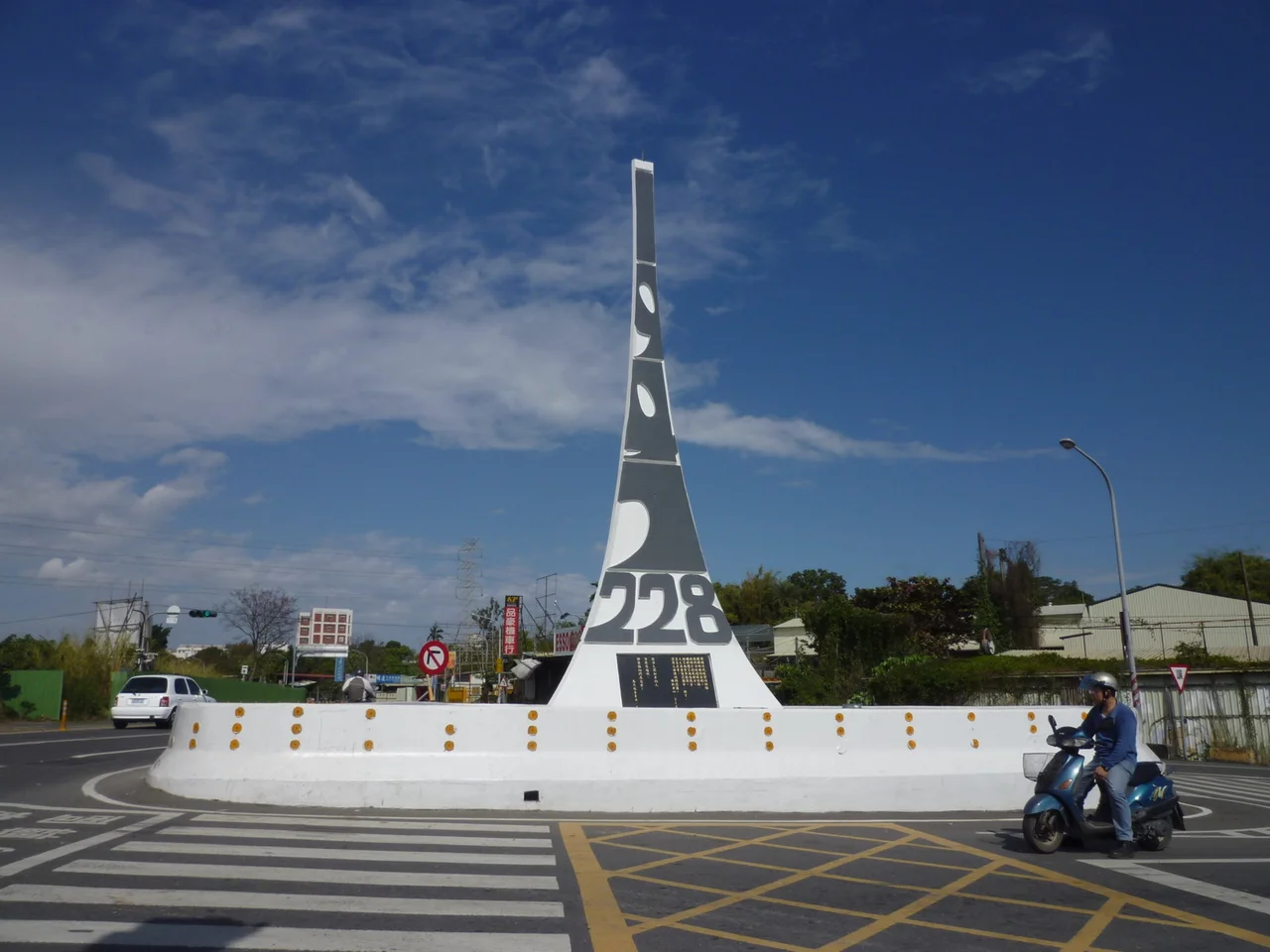

The First 228 Peace Memorial Monument
It took forty-two years for Taiwan to erect its first monument to the February 28 Incident. The stone stands in Chiayi City — one of the places where the violence of 1947 struck hardest — and it arrived not from Taipei, not from a national government, but from a municipal mayor willing to name what had been officially unnamed for more than four decades. When it was dedicated on August 19, 1989, this small memorial in southern Taiwan became something rare: an act of public acknowledgment in a country still emerging from martial law.
What Happened in 1947
The February 28 Incident began on the evening of February 27, 1947, when agents of the Taiwan Monopoly Bureau beat a widow selling untaxed cigarettes in Taipei, then shot into a crowd of bystanders who protested. Within days, the anger spread across the island. In Chiayi, local residents and community leaders joined the uprising that followed, attempting to mediate and restore order. What came next was devastating. Beginning February 28 and continuing through the weeks that followed, Kuomintang forces carried out a violent suppression. Estimates of those killed across Taiwan range from the tens of thousands on the high end to several thousand at minimum; a 1992 Executive Yuan report placed the figure between 18,000 and 28,000, including deaths and disappearances. In Chiayi, the painter Chen Cheng-po — a celebrated artist and community figure who went to the airport to negotiate with military forces — was arrested and then publicly executed at Chiayi train station. The dead included teachers, doctors, lawyers, local leaders: the educated generation of Taiwanese civic life. For decades afterward, public discussion of the events was suppressed under martial law, which lasted until 1987.
A City That Would Not Forget
Chiayi had reason to remember. The city was a focal point of the uprising, and its residents had lived with the absence of acknowledgment for generations. When Taiwan lifted martial law in July 1987, something shifted. Within two years, Chiayi City Mayor Chang Po-ya moved to do what no public official on the island had done: commission and build a memorial to the victims. The monument was completed on August 19, 1989 — the only 228 memorial built anywhere in Taiwan in the 1980s, and the only one built before the decade of the 1990s, when national commemoration slowly became possible. Its designer had personal stakes in the history; he had been imprisoned for anti-Kuomintang activity in 1981, less than a decade before he was asked to give the grief a form in stone. That history lives in the monument's lines.
Three Inscriptions
On the surface of the memorial, three inscriptions are engraved. Among them are passages from the Book of Micah (IV:3–4) and the Gospel of Matthew (V:9) — biblical texts about the turning of swords into plowshares, and about those who make peace. The choice of scripture was deliberate. These were not triumphant words; they were words of longing, addressed to a wound that had not healed and a reckoning that had not yet fully arrived. A monument like this works partly through what it doesn't say: the names of the dead are too many to list, the causes too tangled with politics still unresolved. The inscriptions point instead toward something hoped for — justice, peace — without claiming it has been achieved.
A Monument That Had to Move
The memorial stood for nearly three decades at its original location on Mituo Road, near the boundary between Chiayi City and Zhongpu Township. In 2017, a road-widening project required it to be relocated. The city moved it carefully to the Chiayi City 228 Memorial Park, at the intersection of Mituo Road, Qiming Road, and Gongyi Road — a dedicated space, rather than a roadside monument. The relocation gave the memorial a more formal home, better suited to contemplation. What the first generation of mourners built in relative defiance has become, in time, an established landmark. More than ten 228 memorials now exist across Taiwan; the most prominent is in 228 Peace Memorial Park in Taipei. But this one, in Chiayi, came first — and what it cost to build it first is part of what it means.
Memory and Accountability
Taiwan observes February 28 as Peace Memorial Day, a national holiday since 1997. The government has offered apologies, provided compensation, and opened archives. The Taipei 228 Memorial Museum preserves records and testimonies. The conversation about what happened — and what it means for Taiwan's identity, its relationship with the mainland, its understanding of itself — continues. But the first voice in that conversation was not a national institution. It was a city, and a mayor, and a sculptor, on a street in Chiayi, completing a stone in 1989 that said, simply: this happened, these people lived, and they deserve to be remembered.
From the Air
The First 228 Peace Memorial Monument is located at approximately 23.475°N, 120.462°E in the East District of Chiayi City. The nearest airport is Chiayi Airport (RCKU), roughly 6 km to the northwest. Approaching from the north at low altitude, the Chiayi urban grid is clearly visible; the memorial park sits near Mituo Road in the city's southeastern residential district. Recommended viewing altitude is 500–1,000 feet for urban context. The flat Chiayi plain extends west toward the Taiwan Strait, with the mountains of the Alishan range rising sharply to the east.
Nearby Stories
- Paiyun Lodge 1.2 km away
- Wushantou Reservoir 4.3 km away
- 1999 Jiji Earthquake 6.5 km away
- Xiluo 7.4 km away
- Bunun Cultural Museum 27 km away
- TransAsia Airways Flight 222 28 km away
- Mudouyu Lighthouse 29 km away
- Daya Bay 551 km away