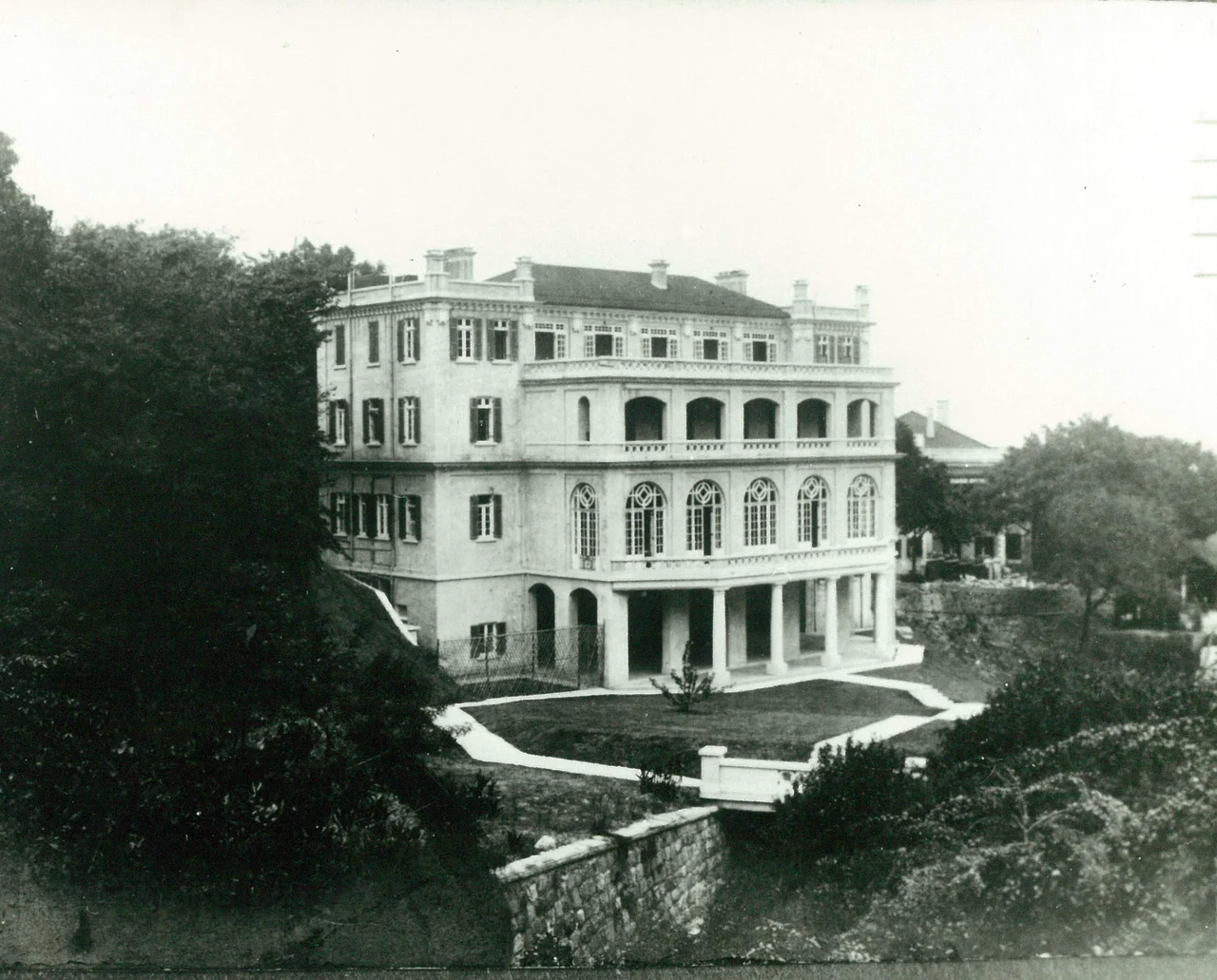

The Helena May
Helena May had four daughters and a clear-eyed view of the dangers a young woman could face in colonial Hong Kong in the early twentieth century. As the wife of Governor Henry May, she had position and connections. She used both. Through her initiative — and generous donations from two philanthropic businessmen, Sir Ellis Kadoorie and Mr Ho Kom Tong — a building went up at 35 Garden Road in 1916: a sanctuary for young single women who had arrived in a thriving, unfamiliar city with few places to go. More than a century later, the Helena May still stands at that address, and the ballet classes that started in its basement in 1948 still run today.
A Haven Above the Tram
The site at 35 Garden Road was chosen deliberately: close to Central, and just a short walk from the Peak Tram's lower station. For a new arrival without local contacts, that proximity mattered — the Peak Tram was both a practical transport link and a social lifeline to the residential hilltops above. When the Helena May Institute, as it was originally called, opened its three-story building, it offered an office, a library, rooms for reading, dining, and socialising, bedrooms for residents, and quarters for a matron. The lower-level rooms opening onto the garden became a ballroom, then a dining room; they now house the library. Extensions were added on the north and south sides to increase accommodation. In the late 1950s, when citywide housing was scarce, the area where the tennis court had stood was converted into the Court Building to create more rooms.
Edwardian Elegance in the Mid-Levels
The building's exterior was designed in the Edwardian Classical Revival style, with elements borrowed from Beaux-Arts, Baroque, and Mannerist traditions — a mix that was fashionable in British colonial architecture of the period and produced an imposing but welcoming facade. In 1993, the exterior was declared a Monument by the Hong Kong government, the highest designation available for heritage buildings. By that point, the surrounding neighbourhood had changed dramatically: concrete towers had replaced most of the colonial streetscape, and the Helena May's Edwardian facade stood out as a rare survivor. The building is now featured on Hong Kong's Heritage Trail, drawing visitors who come specifically to see it.
Through War and Requisition
In the 1920s and 1930s, the Helena May was a favoured venue for public music recitals, lectures, and dances — its spacious ground-floor lounge and central location made it well suited to social gatherings. That role ended abruptly during the Second World War. When Japanese forces occupied Hong Kong from December 1941, the Helena May was taken over by Japanese troops. The Main Lounge was converted into offices and a short-lived library of a different kind. After the war ended in 1945, the building was requisitioned again — this time by the British Royal Air Force — and it was not until 1947 that the club returned to its original purpose. Recovery came quickly: children's dance classes began in the basement the following year, in 1948, and continue to this day under the Carol Bateman School of Dancing.
The Library That Survived Everything
The Helena May's library has a particular distinction: it is the largest private English-language library in Hong Kong, with approximately 25,000 books covering a wide range of genres. The collection occupies the basement level adjacent to the garden and includes a dedicated section for children's books. It survived the war years — when the building itself was occupied and its shelves emptied — and rebuilt slowly afterward. That a private club in a space-constrained city managed to accumulate and maintain a library of this scale across a century of upheaval says something about the membership's commitment to the place. The Helena May today also hosts weddings and receptions in its heritage building, charitable outreach, and a full calendar of member activities.
Still Standing, Still Needed
The original mission — a safe, welcoming space for women arriving in Hong Kong — has evolved over more than a hundred years into a broader private members club that retains its heritage character and its founding ethos. The building itself makes a quiet argument for preservation: surrounded by towers, it demonstrates that a century-old structure with good bones and genuine community purpose can outlast many of its neighbours. The garden still exists. The ballet classes still run on the original basement floor. The library still lends books. In a district defined by transactions and turnover, the Helena May has stayed.
From the Air
The Helena May sits at approximately 22.2775°N, 114.158°E, on Garden Road in Central, between the Central Business District below and the Mid-Levels residential area above. From the air at 1,500–2,000 feet, it is near the lower terminus of the Peak Tram on Garden Road, with Hong Kong Park visible to the east and the dense Central skyline to the north. The nearest airport is Hong Kong International (VHHH), approximately 35km to the west on Lantau Island.
Nearby Stories
- Lok Ma Chau Loop 2.3 km away
- Portas do Cerco 2.3 km away
- Kweilin Incident 17 km away
- Wanshan Archipelago Campaign 34 km away
- Nanxiong Formation 115 km away
- Battle of Nanpeng Island 148 km away
- Heyuan 169 km away
- Cape Maobitou 632 km away