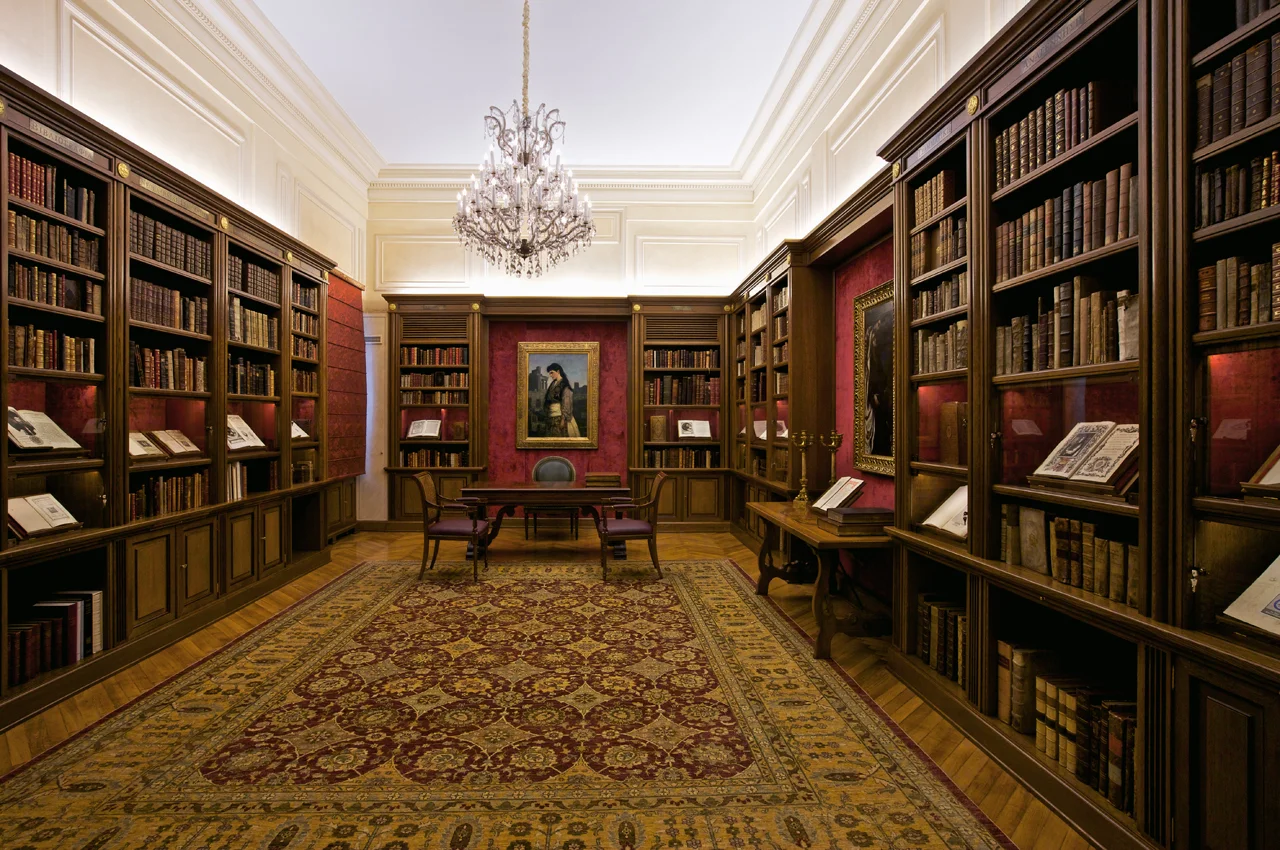

The Hellenic Library of the Onassis Foundation
Behind a neoclassical facade at 56 Amalias Avenue, in the old Plaka quarter of Athens, oak shelves hold one of the most particular book collections in Greece. The library grew from a single obsession: the lifelong search by collector Konstantinos Sp. Staikos for every printed book that could shed light on how Greek learning reached the wider world after the Italian Renaissance. The Onassis Foundation acquired the collection and gave it this home, but the library remains closed to casual visitors. To enter, you must make an appointment.
One Collector's Pursuit
The collection began to take shape in the 1970s, and by the early 1980s it had become a working instrument for a single, systematic quest. Staikos set out to gather every printed book that could illuminate the publishing path Greeks had taken from the years of the Italian Renaissance onward, wherever in the world those books were made. It is a collector's library in the truest sense, assembled not to be comprehensive about everything but exhaustive about one thing: the moment when Greek letters, newly set in movable type, began to circulate through Europe and shape the rebirth of classical learning.
The Greeks Who Taught the Humanists
Behind the books lies a story the collection was built to tell. When the great Italian humanists hungered for the wisdom of ancient Greece, it was often Greek scholars who supplied it, men who taught the language and edited the texts, and whose pupils included some of the leading minds of the Italian Renaissance. The library was meant to demonstrate that contribution and the relationships those scholars cultivated with the humanists of Italy. Exhibitions drawn from the collection, accompanied by detailed bilingual catalogues, traveled abroad, including to the Hellenic Institute of Byzantine and Post-Byzantine Studies in Venice in 1993, carrying that argument to the very cities where the books were first printed.
Rooms Made of Oak
The space itself was designed by Staikos, the same hand that shaped the collection shaping the place that holds it. The stacks were built in the spirit of stable, enduring structures, finished in oak that gives the interior its weight and warmth. The books are arranged by theme, and the section names sketch the intellectual map of the collection: Renaissance and Humanism, Neo-Hellenic Literature, Liturgical Books, Travel Literature, Treatises of Theology, the Neo-Hellenic Enlightenment. Most of the volumes came off presses in Venice, the great early center of Greek printing, or from other publishers who served readers of Greek across the diaspora.
A Library Kept Apart
This is not a place you wander into between sights. The Hellenic Library is not open to the public, and organized visits take place by appointment only. That restraint suits its character. A collection this focused, housed in rooms designed around it, is closer to a scholar's private study than a public reading room, a quiet repository where the long story of Greek printing is preserved on oak shelves a short walk from the Acropolis, waiting for the few who come looking for it.
From the Air
The library occupies a neoclassical building at 56 Amalias Avenue in the Plaka district, at roughly 37.9700 N, 23.7315 E, about 33 km west of Athens International Airport (LGAV / ATH). It sits just south of Syntagma Square and the National Gardens, a short walk northeast of the Acropolis. From the air, navigate to the Acropolis and the long green strip of the National Gardens; the building lies along Amalias Avenue between them. The structure is a single mansion amid dense central Athens and is best identified from the ground rather than altitude.
Nearby Stories
- Great Sand Beach 5 km away
- Battle of Delium 7.7 km away
- Tower of Aliartos 9 km away
- HMHS Britannic 10 km away
- Saronic Gulf 15 km away
- Sousaki Volcano 17 km away
- Sanctuary of Apollo Maleatas 24 km away
- Skyros 66 km away