
The Lighthouse, Glasgow
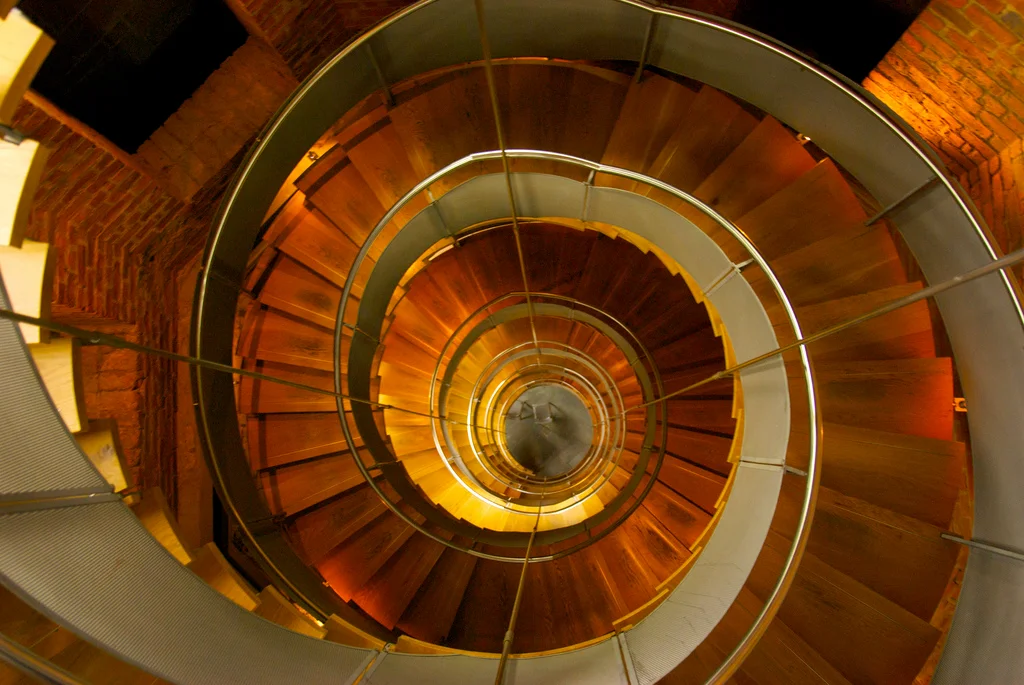
Climb the helical staircase that twists up through the Mackintosh Tower at the north end of the building. It coils inside a narrow brick shaft, treading you steadily upward until the cityscape suddenly opens beneath you - tenement rooftops, slate ridges, sandstone gables, the spires and cranes of central Glasgow, the river curling toward the sea. This was a 27-year-old Charles Rennie Mackintosh's first major public commission. He was a draughtsman at Honeyman and Keppie in 1895 when his firm won the contract to design new offices for the Glasgow Herald. The water tower he produced for it would, more than a century later, give Scotland's national centre for design its name and its viewing platform.
From Herald to Lighthouse
The building was completed in 1895 as the headquarters of the Glasgow Herald, then one of the most important newspapers in Scotland. Mackintosh designed it with the discipline of a young architect determined to be taken seriously. The water tower on Mitchell Lane was its showpiece, a vertical accent in an otherwise tightly packed commercial district. The Herald moved out in the twentieth century. The building stood, but its purpose drifted. In 1999, when Glasgow was named UK City of Architecture and Design, the council and partners converted it into a new institution: Scotland's Centre for Design and Architecture. The conversion was deliberate. The Herald building had Mackintosh in its bones. The new centre would put design in front of the public.
The View From the Top
There are two viewing platforms. The famous one, reached by Mackintosh's helical staircase from the third floor, sits inside the original water tower at the north end of the building. The steps are tight, the brickwork close around you, the climb deliberately physical. The other platform, on the sixth floor at the south end, is reached by lift and offers an easier panorama for those who would rather not spiral upward. Both look out over a city whose architectural ambitions have always been higher than its reputation suggests. From either, you can read the West End to the north, the river and shipyards to the west, the Merchant City roofs to the east, and the towers of the Gorbals beyond the Clyde.
A Brief Closure, A Long Future
The Lighthouse Trust went into administration in August 2009. At its peak the Trust had employed around 90 people. The closure was sudden, and the city took some time to work out what to do with a national design centre that had run out of money. The building remained in the ownership of Glasgow City Council, which made financial provision to keep it operating. Its director, Nick Barley, moved on to lead the Edinburgh International Book Festival. The remaining staff transferred to Architecture and Design Scotland and to the council itself. A steering group was formed, drawing in the Glasgow School of Art, Scottish Enterprise, Creative Scotland, and independent practitioners. The building reopened as Scotland's National Centre for Architecture and Design, with exhibition halls, a conference programme, a cafe, and a design shop on the ground floor.
A Banknote, A City, A Movement
In 1999, the Clydesdale Bank issued a 20-pound note to mark Glasgow's status as UK City of Architecture and Design. The reverse showed the Lighthouse building alongside the dome of Holmwood House, designed by Alexander 'Greek' Thomson - the Glaswegian architect whose portrait appeared on the obverse. The pairing was telling. Glasgow's nineteenth century gave the world Thomson, the classicist who built temples in tenement land. Its turn of the century gave it Mackintosh, the Art Nouveau master who would become an international name only after his lifetime. Putting them together on currency was the city's way of saying: we built this, twice, and you should pay attention. The Lighthouse, perched on Mitchell Lane between the two eras, makes the argument every day in glass and brick and the spiral of a staircase you can still climb.
From the Air
Located at 55.8596°N, 4.2556°W, on Mitchell Lane between Buchanan Street and Union Street in central Glasgow. The water tower is small but identifiable in dense rooftop context. Glasgow Central station and its train shed lie a few hundred metres south. Glasgow Airport (EGPF) is 13 km west; Glasgow Prestwick (EGPK) is roughly 50 km south-southwest. Best viewed at low altitude over the city centre in clear daylight.
Nearby Stories
- Mauchline 3.6 km away
- Shotts 4.2 km away
- HMS Ulysses (1917) 7.7 km away
- Rothesay Castle 8.8 km away
- Inchcailloch 10 km away
- Strachur 14 km away
- Battle of Dollar 16 km away
- Crawford Castle 16 km away