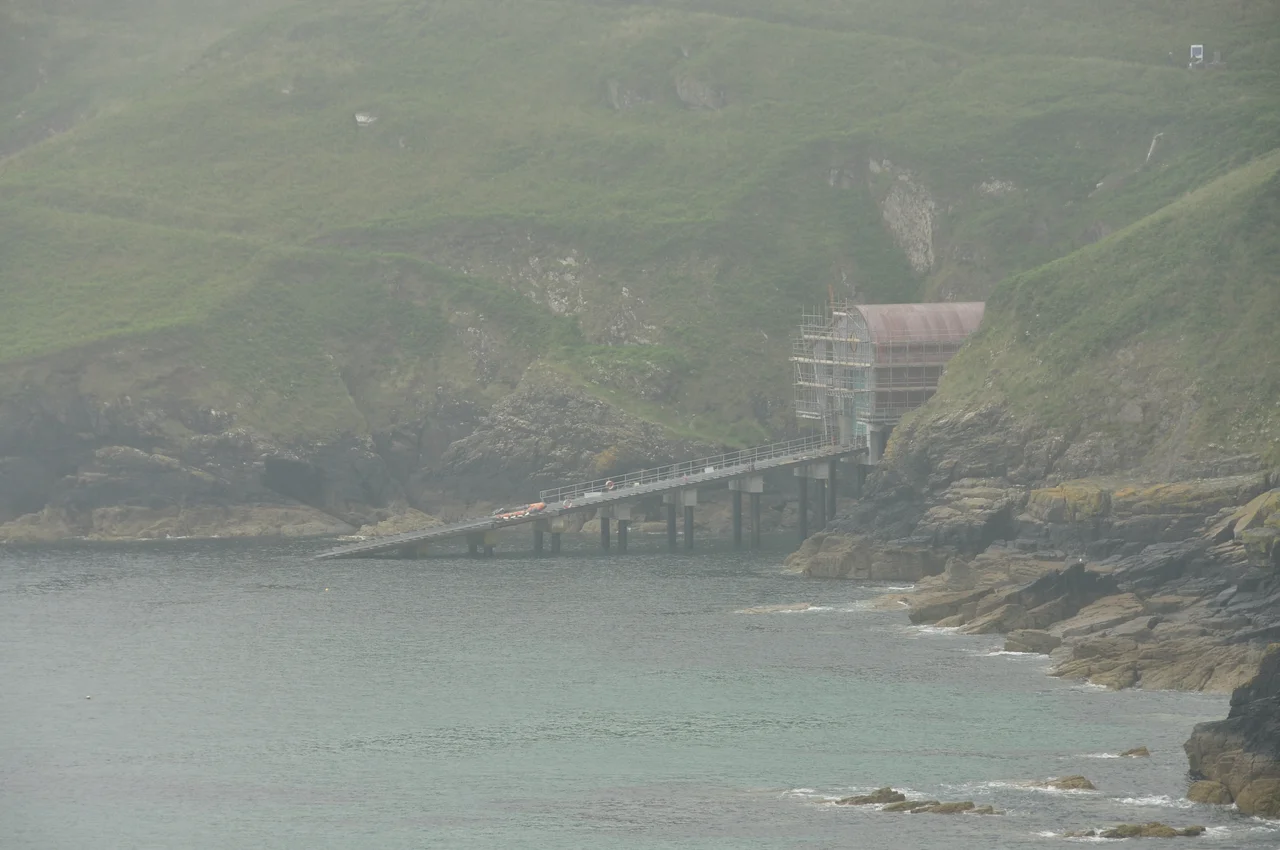

The Lizard Lifeboat Station
Up to 400 ships pass the Lizard every day. It is one of the busiest shipping lanes in the world, and from the deck of a coaster running west in a January gale, the cliffs at the southern tip of Cornwall are the last hard edge before the open Atlantic. They have always taken their share. A Mrs Agar of Lanhydrock, watching the wrecks pile up off Bass Point and Polpeor Cove in 1859, paid for the first lifeboat herself and named it Anna Maria. The RNLI's Lizard stations have been launching boats into that gauntlet ever since.
Polpeor Cove, and the Cost of a Bad Site
The first Lizard station opened in 1859, perched atop the cliffs above Polpeor Cove about a kilometre south of Lizard village. The boathouse cost £120 to build. The location, magnificent in calm weather, was lethal in a gale: every launch meant manhandling a heavy self-righting boat down a long, exposed slipway in conditions that were by definition terrible. On 2 January 1866, during a storm exercise, the lifeboat broke up after launching. It was driven onto the rocks below. Coxswain Peter Mitchell and crew members Richard Harris and Nicholas Stevens were killed. The station kept operating - it had to - but the lesson was learnt slowly. Successive boats served from Polpeor for over a century, with sister stations also opened at Cadgwith and Church Cove to cover the same coastline from less hostile launch points. Polpeor Cove finally closed in 1961 in favour of a better site at Kilcobben Cove.
Coxswain Edwin Matthews, 1888
Awards from the Lizard's stations read like a roll-call of nineteenth- and twentieth-century courage. Edwin Matthews, coxswain at Polpeor, won the RNLI Silver Medal in 1888. Captain David G. Ball, master of the Gustav Bitter, won one in 1893. The grandest entries cluster around 17 March 1907, the day the 12,000-tonne White Star liner SS Suevic struck the Maenheere Reef in dense fog and a strong gale. RNLI volunteers from the Lizard, Cadgwith, Coverack, and Porthleven rowed open boats out to her, returning again and again across sixteen continuous hours. They got every one of the 456 passengers and crew off, including seventy babies. Coxswain William Edward Mitchell and Second Coxswain Edwin Mitchell each received a Silver Medal. Two Silver Medals were also awarded to crewmen of the Suevic herself - George Anderson and William Williams - who joined the rescue. It remains the largest single rescue in the RNLI's history.
Kilcobben Cove, 1985
The current station, built into the cliff at Kilcobben Cove half a mile east of Lizard village, opened to replace Polpeor in 1961. Its great innovation is a funicular railway that runs straight down the cliff, hauling crews from the clifftop car park to the boathouse at the base in less than a minute. When the pager sounds, the crew are out the door, into the cab, dropping down the rock face, and into a Tamar-class lifeboat that lives at sea level. In 1985 Coxswain Peter Mitchell - a descendant of the Mitchells who had served Polpeor for three generations - won the RNLI Bronze Medal for a service in heavy weather. In 1993 a collective Letter of Thanks went to the whole crew, including coxswain Philip Burgess, for services that year. Burgess himself was awarded the Thanks of the Institution inscribed on Vellum in 2004. In 2021 Edward Nuzum, the station's Lifeboat Operations Manager, received the British Empire Medal.
The Watch Continues
The Lizard's coastline has not become safer with time. Modern ships are bigger, faster, and better equipped, but the cliffs and rocks have not moved, and the same shipping lane that fed the Mitchells' work in 1907 funnels more traffic past it now. The current crew operate a Tamar-class boat held ready at the base of the cliff; the funicular still drops them down the rock when the pager goes. The names on the medal lists change. The water does not. The Lizard Station, in its different incarnations across more than a century and a half, has launched into nearly every kind of weather the western approaches can produce, and brought home people who would otherwise be statistics. The names on the casualty list of 1866 - Mitchell, Harris, Stevens - are a permanent reminder of the cost of doing it. The medals are the rest of the answer.
From the Air
The current Lizard Lifeboat Station is at Kilcobben Cove, 49.97 degrees north, 5.187 degrees west, on the southeast coast of the Lizard Peninsula about 1 km east of Lizard village. Look from the air for the clifftop access road and the diagonal line of the funicular railway running down the cliff face to a boathouse at sea level (the station operates a Tamar-class lifeboat). Nearest commercial airport is Newquay (EGHQ), 65 km north. RNAS Culdrose (EGDR, military) is 14 km north and provides regular Merlin search-and-rescue and support flights over this coast. Best viewed 1,500 to 3,000 feet in clear weather. The disused Polpeor Cove slipway is still visible 2 km west, below Lizard Point itself.
Nearby Stories
- Logan Rock 3.6 km away
- Polperro 7.4 km away
- Great Wheal Charlotte 10 km away
- Battle of Plymouth (1652) 26 km away
- SS Irma (1905) 30 km away
- Black Swan Project 75 km away
- HMS Affray 77 km away
- 1979 Fastnet Race 100 km away