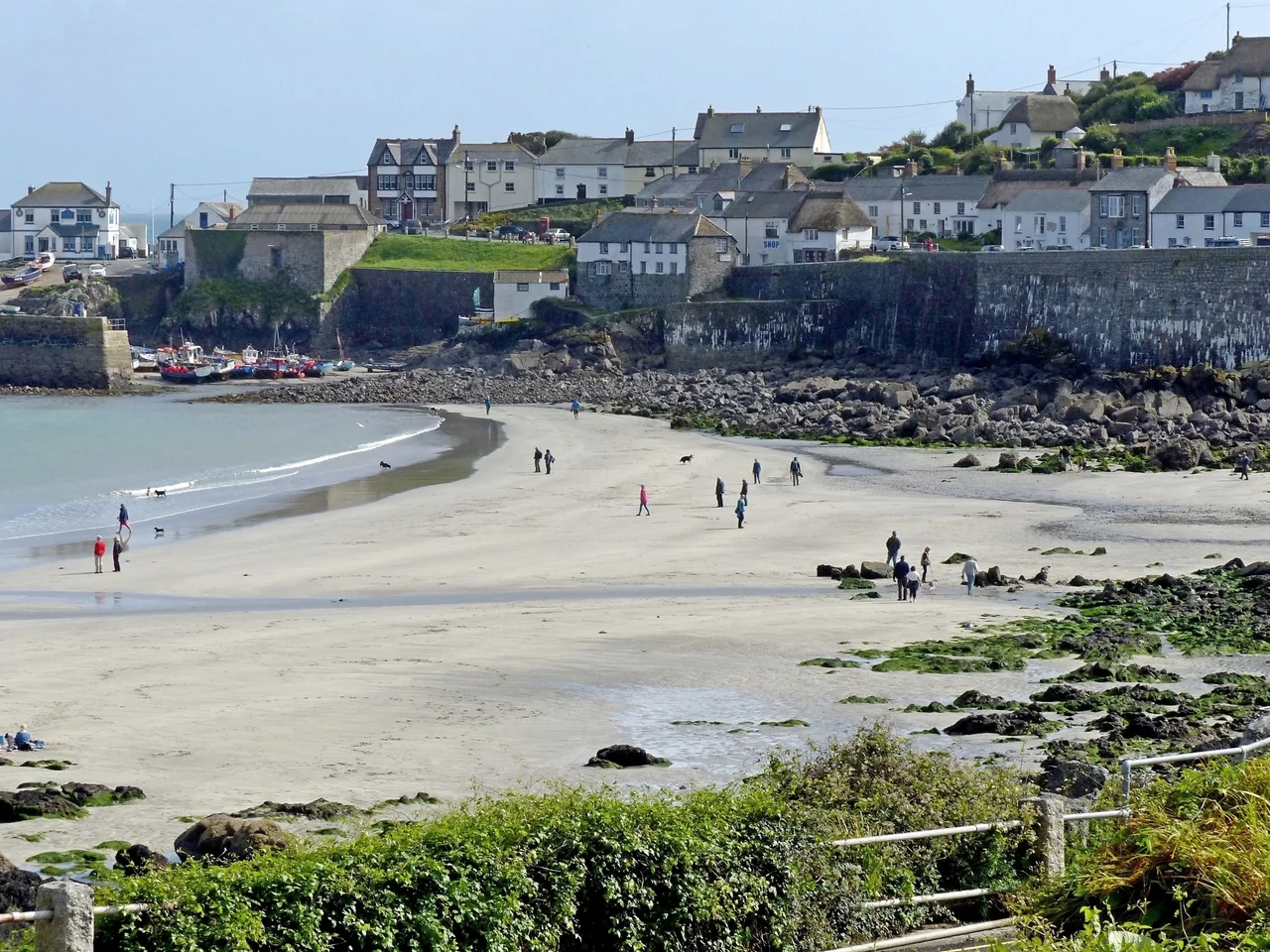

The Lizard
The name is a beautiful piece of accidental zoology. 'The Lizard' is most likely a corruption of the Cornish Lys Ardh - 'high court' - the original meaning long since dissolved in English ears that heard a reptile instead. That the peninsula happens to be made largely of serpentine, a mineral once thought to resemble snakeskin, is pure coincidence. The Cornish were probably calling it something else first: Bridanoc, from Britannakon, 'the British one,' a name that survives in the modern Predannack on the west coast. Whatever you call it, the place is the southernmost piece of mainland Britain, and it has been catching events out of the air and out of the Atlantic for as long as anyone has been counting.
A Slice of the Mantle
Geologists call the Lizard a complex. What they mean is the best-preserved exposed ophiolite in the United Kingdom - a piece of ancient ocean floor, including the top of the Earth's mantle, that has been shoved up onto the continental crust. The peninsula is, in literal geological terms, a piece of the seabed pushed inland. Three units make up the Lizard: serpentinites at the top, an oceanic complex in the middle, and a metamorphic basement underneath. The serpentinite here is so distinctive that in 1955 mineralogists named a specific polymorph after the peninsula: lizardite. The Cornish chough, England's rarest breeding corvid, returned to nest on these cliffs in 2001 after a long absence; a quarter of all British flowering plant species grow somewhere on the peninsula. The Cornish heath, Erica vagans, lives here in abundance and almost nowhere else in Britain. The richness comes not from gentleness but from extremes: mild maritime climate, salt-laden gales, alkaline serpentine soils that bake dry in summer and waterlog in winter.
The Graveyard of Ships
The seaways round the Lizard were known historically as the Graveyard of Ships. The first Lizard light was thrown up by Sir John Killigrew in 1619 at the cost of '20 nobles a year' for 30 years; King James I considered charging vessels for the privilege of passing it, the funding model collapsed, and the tower was demolished. The replacement, built in 1751 by Thomas Fonnereau, still works. The casualty list down those cliffs is long. In 1721 the Royal Anne Galley, an oared frigate, was wrecked at Lizard Point with the loss of around 198 of her 200 crew and passengers, including Lord Belhaven on his way to take up the Governorship of Barbados. In 1807 HMS Anson, a 44-gun frigate, was driven onto Loe Bar a few kilometres north; the disaster inspired Henry Trengrouse to invent the rocket-fired rescue line, which became the breeches buoy. In 1809 the transport ship Dispatch piled into the Manacles rocks on the way home from the Peninsular War, losing 104 men of the 7th Hussars. The 1898 wreck of the SS Mohegan on the same rocks killed 106. And in 1907 came the SS Suevic - the rescue that saved 456 lives and remains the largest in RNLI history.
The First Wireless Signal
In 1900 a young Italian engineer named Guglielmo Marconi rented rooms at the Housel Bay Hotel and leased a plot 'in the wheat field adjoining the hotel.' What he built there - the Lizard Wireless Telegraph Station, a wooden hut on the cliff west of the Lloyds Signal Station - is the oldest Marconi station to survive in its original state. From this hut in January 1901 Marconi received a record-distance signal from his transmitter at Niton on the Isle of Wight, 186 miles away. The hut is now restored by the National Trust and looks much as it did the day it earned that record. Eleven months later, on 12 December 1901, from Marconi's other Lizard station at Poldhu Point, a signal travelled across the Atlantic and was received at St John's, Newfoundland. The first transatlantic wireless transmission had been made. Radio, television, satellite communications, the internet - all of it traces a line back to a wooden hut above Cornish cliffs and a kite carrying a wire over the cold air of Newfoundland.
The Cornish Rebellion and the Discovery of Titanium
The Lizard's history is not all sea and salt. In 1497 the village blacksmith Michael Joseph - 'An Gof,' the smith - led the Cornish Rebellion from St Keverne, protesting the punitive taxes that Henry VII had levied to fund his war against the Scots. Joseph and his fellow leader Thomas Flamank marched their army to Blackheath outside London, where the rebellion was routed. Both men were hanged, drawn, and quartered. The Lizard has a long memory; their names are still spoken in the parishes here. In 1791, in a more peaceful contribution, the Reverend William Gregor discovered a new element in black sand from a Cornish stream. He called it menachanite, after the local parish. The element is now called titanium. The Solar Eclipse of 11 August 1999 left the UK mainland from these cliffs, the last shadow falling on the southernmost soil before sliding out over the Atlantic. Cornwall has a habit of being where the world starts, or ends, or briefly becomes something else.
From the Air
The Lizard Peninsula extends from about 50.13 degrees north at the Helford River south to Lizard Point at 49.96 degrees north, 5.18 degrees west - the southernmost mainland point of Great Britain. From the air the peninsula reads as open heath and serpentine cliffs, with the Helford River and Loe Pool marking the northern boundary. Nearest commercial airport is Newquay (EGHQ), 60 km north. RNAS Culdrose (EGDR, military) sits on the peninsula itself and is one of Europe's largest helicopter bases - expect Merlin activity throughout the area, plus drone operations from the satellite airfield at Predannack. The Goonhilly satellite dishes and the wind farm beside them are both prominent from cruise altitude. Recommended viewing altitude 3,000 to 6,000 feet for the full peninsula in a single frame.
Nearby Stories
- Logan Rock 3.6 km away
- Polperro 7.4 km away
- Great Wheal Charlotte 10 km away
- Battle of Plymouth (1652) 26 km away
- SS Irma (1905) 30 km away
- Black Swan Project 75 km away
- HMS Affray 77 km away
- 1979 Fastnet Race 100 km away