.jpg)
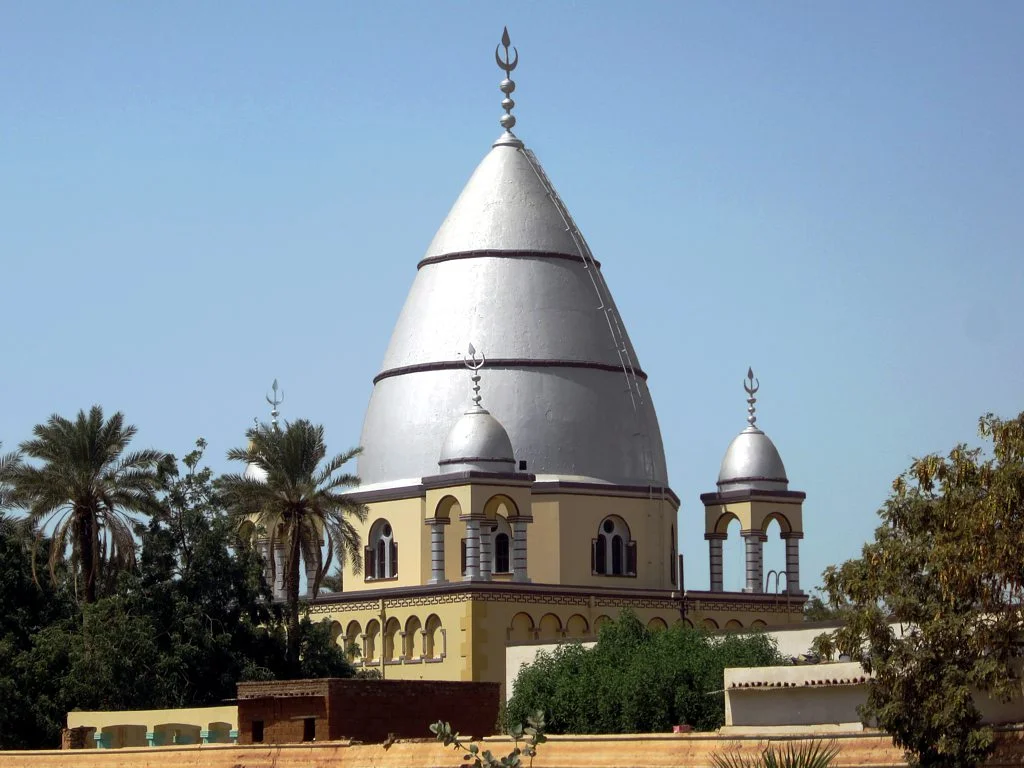
The Mahdi's Tomb
On 2 September 1898, Kitchener's gunboats on the White Nile turned their guns on a dome. The qubba of Muhammad Ahmad - the Mahdi, liberator of Sudan, founder of the state the British had come to destroy - stood in central Omdurman as the most sacred building in the country. British shells collapsed it. Then British soldiers exhumed the body inside, cut off its head, and threw the rest into the Nile. For Sudanese Muslims the desecration was a wound that did not close, and for the Mahdi's son Abd al-Rahman, rebuilding the tomb in 1947 was the work of a lifetime.
Why He Rose
Muhammad Ahmad grew up in a country squeezed by taxes. Turco-Egyptian Sudan had been administered from Cairo since the 1820s, and its fiscal machinery was known locally for its ruthlessness - the jallaba merchant classes, the rural tribes, the Sufi orders all carried the weight of an extraction regime whose beneficiaries lived far away. Starting in the 1870s the Egyptian government, pressured by Europe, began placing Christian officials like Charles Gordon in senior positions, and moved to suppress the long-established slave trade on which many Sudanese traders depended. The religious objections and the economic ones pointed the same direction. In 1881, a boat-builder's son from Dongola named Muhammad Ahmad proclaimed himself al-Mahdi al-Muntazar - the Expected Rightly-Guided One, the redeemer prophesied in Islamic tradition. He called for jihad against the Turco-Egyptian occupation. His followers, drawn from Sufi and non-Sufi orders alike, took the name ansar - an echo of the first followers of the Prophet Muhammad at Medina. Within four years the movement had taken Sudan.
A State, Then a Grave
The Mahdist victory came on 26 January 1885 at Khartoum, where the siege of the Egyptian garrison ended with Gordon's death and the establishment of the Mahdist State. Muhammad Ahmad did not live to rule it. Six months later, in June 1885, he died unexpectedly - probably of typhoid - and was buried at Omdurman, the mud-brick city his forces had built across the White Nile from Khartoum. The tomb built over him, with its silver-finialed dome, became the center of the Mahdist state both religiously and politically. Pilgrims visited. Prayers were offered. His successor the Khalifa Abdallahi ibn Muhammad governed the Mahdiyya from Omdurman for the next thirteen years. For Sudanese Muslims of the period, the tomb was what Medina had been for the first ansar - the physical heart of a community that had remade itself.
Kitchener's Reconquest
In 1896 the British began the Anglo-Egyptian reconquest of Sudan under Herbert Kitchener, officially in response to broader imperial calculations but popularly framed in Britain as revenge for Gordon's death eleven years earlier. On 2 September 1898 at the Battle of Omdurman, Kitchener's forces - equipped with Maxim guns - killed roughly 11,000 Mahdist soldiers in a single day while losing fewer than 50 of their own. What followed was the part the British press later struggled to justify. Kitchener ordered gunboats to destroy the dome of the Mahdi's qubba. His men then disinterred the body, cut off the head, and threw the corpse into the Nile. Winston Churchill, who was present as a young cavalry officer, wrote that Kitchener "carried off the Mahdi's head in a kerosene can as a trophy." It was said that Kitchener considered using the skull as a drinking cup or an inkwell. Allegedly the skull was eventually buried quietly at Wadi Halfa.
What Britain Felt
News of the desecration reached London and caused immediate public unease. Some British commentators argued that it was justified by the perceived savagery of the Mahdist army. But many British soldiers who had fought the ansar respected them - Rudyard Kipling's Fuzzy-Wuzzy, published in 1892 and using what was even then a derogatory term for the Beja tribesmen of the Mahdist forces, included the line "you're a first-class fightin' man." Queen Victoria was disturbed enough to demand an explanation; Kitchener was eventually required to write a letter of apology. Fragments of the tomb returned to Britain as trophies. At least three large brass finials from the domes survive today - one at the Royal Engineers Museum in Kent, one at Blair Castle in Scotland, and one, in a kind of restorative gesture, back at the Khalifa House Museum in Omdurman beside the reconstructed tomb.
The Son's Rebuilding
The Mahdi's son Abd al-Rahman al-Mahdi spent decades working within the Anglo-Egyptian condominium to preserve his father's movement and its religious significance. In 1947 - half a century after the destruction - he oversaw the reconstruction of the tomb on its original site. The new qubba, with its whitewashed conical dome, today sits beside the Khalifa House Museum, which preserves the house of Abdallahi ibn Muhammad along with a collection of Mahdist-era weapons and artifacts. UNESCO has listed the tomb as a site of outstanding cultural value. The Ansar sect continues as a major religious and political movement in Sudan, and Sadiq al-Mahdi - Abd al-Rahman's son and the Mahdi's great-grandson - served as Prime Minister of Sudan twice before his death in 2020. The tomb still stands. The dome is visible across Omdurman. What Kitchener destroyed, Sudan rebuilt, and what Sudan rebuilt has outlasted the empire that tore it down.
From the Air
The Mahdi's Tomb sits at 15.640°N, 32.489°E in central Omdurman, on the west bank of the White Nile about 1.5km from the river. From altitude the twin cities of Khartoum and Omdurman bracket the confluence of the Blue and White Niles; the tomb lies in Omdurman's core, a compact zone of older mud-brick architecture amid the surrounding denser city. The distinctive whitewashed conical dome is best spotted from lower altitudes. Nearest airport is Khartoum International (HSSS) roughly 10km east, and Wadi Seidna Air Base (HSSW) about 20km north. In clear weather the site's position relative to the Khalifa House Museum next door makes it identifiable.
Nearby Stories
- Esh Shaheinab 27 km away
- Naqa 56 km away
- Mahdist War 65 km away
- Musawwarat es-Sufra 100 km away
- Gezira State 101 km away
- Northern Sudan 215 km away