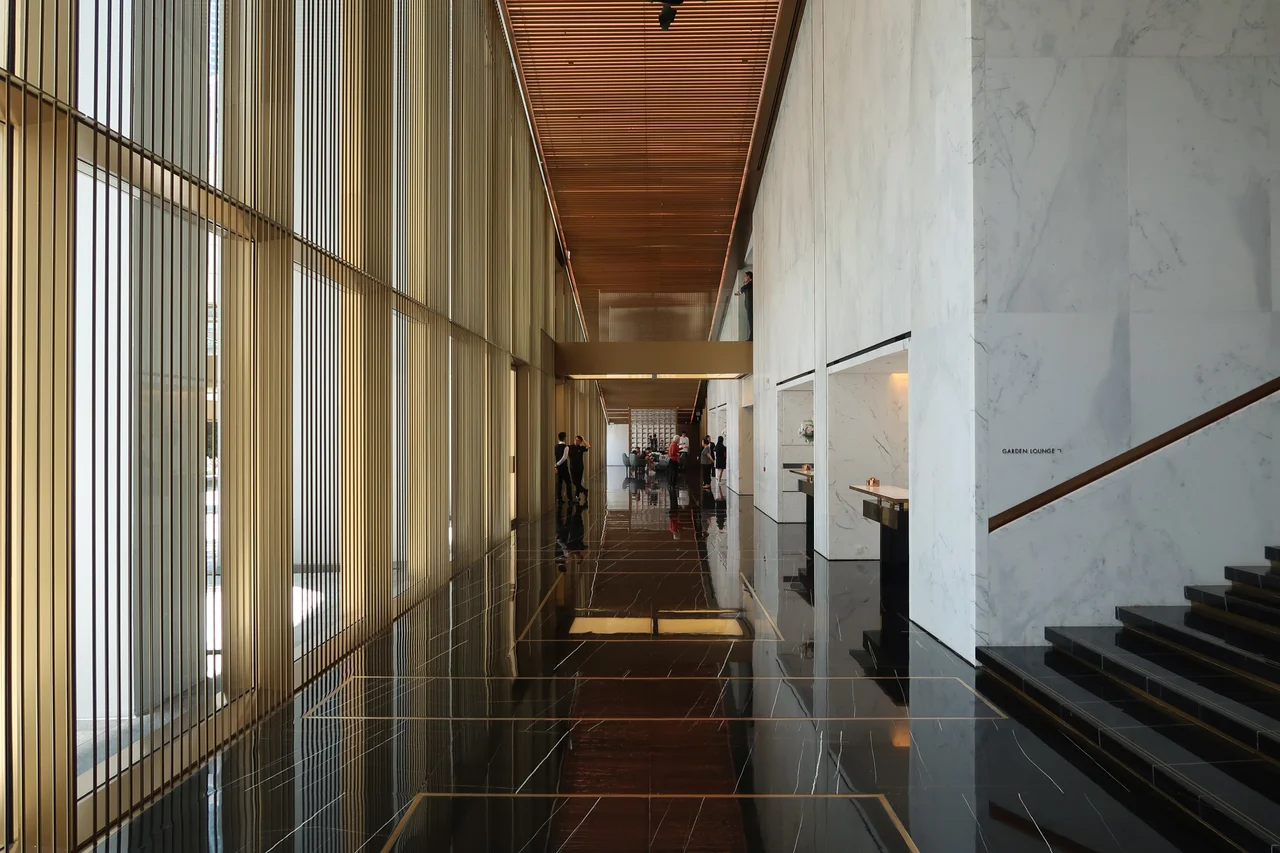

The Murray, Hong Kong
The windows are the first thing architects notice about The Murray. Every one of them is oriented to minimise direct sunlight intrusion — a design decision made not for aesthetics, but for energy efficiency, by the Hong Kong Public Works Department back in 1969. That calculation earned the building a Certificate of Merit in the Energy Efficient Building Award in 1994, twenty-five years after the building opened and more than twenty years before anyone started talking about converting it into a hotel. Good design, it turned out, was worth preserving.
The Government's Tallest Tower
When the Murray Building was completed on 22 Cotton Tree Drive in 1969, it was the tallest government building in Hong Kong. At 27 storeys, it dominated the skyline at the edge of Hong Kong Park, with the Peak Tram's Garden Road lower terminus nearby and Cotton Tree Drive threading steeply around its base. The building's designers addressed the challenge of a site surrounded by major roads on all sides by integrating the vehicular entrance directly into the slope of Cotton Tree Drive — a practical solution that became one of the building's more admired features. For four decades, the Murray Building housed government offices, including some of the key decision-making bureaus of the Hong Kong administration.
The Controversy of Sale
In 2006, Hong Kong confirmed plans to build a new government headquarters at Tamar, on the waterfront in Admiralty. The future of the Murray Building became a public question. In his 2009 policy address, Chief Executive Sir Donald Tsang announced that the Murray Building would be converted into a 300-room hotel once the offices relocated. That announcement did not go smoothly. The Central and Western District Council chairman Chan Tak-chor expressed outrage at a decision made without public consultation. The debate touched a recurring tension in Hong Kong urban development: the pull between heritage preservation and commercial opportunity. A 2011 survey of opinion leaders found 61% supported leasing the building to the private sector, with 15% against — a majority in favour, but a significant minority uncomfortable with the loss of a public asset.
Vacant and Then Auctioned
The new Central Government Complex at Tamar opened in 2011. By the end of that year, the Murray Building was empty — its occupants had moved to the new complex, and the building fell quiet for the first time since its construction. The Lands Department auctioned it for hotel redevelopment in December 2011. Conversion took several years, involving both the original design sensibility and new interventions that worked with the building's distinctive window banding rather than against it. The hotel — The Murray, Hong Kong, a Niccolo Hotel — opened in 2018, nearly fifty years after the original building had first received its occupants.
A Second Life in Central
The location that made the Murray Building attractive as a government office makes it equally attractive as a hotel: steps from Hong Kong Park, near the Peak Tram, and embedded in the heart of Central. The surrounding streets — Cotton Tree Drive, Garden Road, Queensway — connect the hotel to the city's financial district to the north and the hillside residential mid-levels to the south. For a building that once housed the machinery of colonial and post-handover administration, the conversion to hospitality represents a particular kind of reuse: the structure preserved, the purpose entirely remade. The windows still face the same directions. The afternoon light still falls the same way.
From the Air
The Murray sits at approximately 22.2794°N, 114.1636°E on Cotton Tree Drive in Central Hong Kong, adjacent to Hong Kong Park. From the air at 1,500–2,000 feet, the building is identifiable by its distinctive horizontal banding and its position at the junction of Cotton Tree Drive and Queensway, with the green canopy of Hong Kong Park immediately to the east. The Peak rises to the south. The nearest airport is Hong Kong International (VHHH), approximately 35km to the west on Lantau Island.
Nearby Stories
- Lok Ma Chau Loop 2.3 km away
- Portas do Cerco 2.3 km away
- Kweilin Incident 17 km away
- Wanshan Archipelago Campaign 34 km away
- Nanxiong Formation 115 km away
- Battle of Nanpeng Island 148 km away
- Heyuan 169 km away
- Cape Maobitou 632 km away