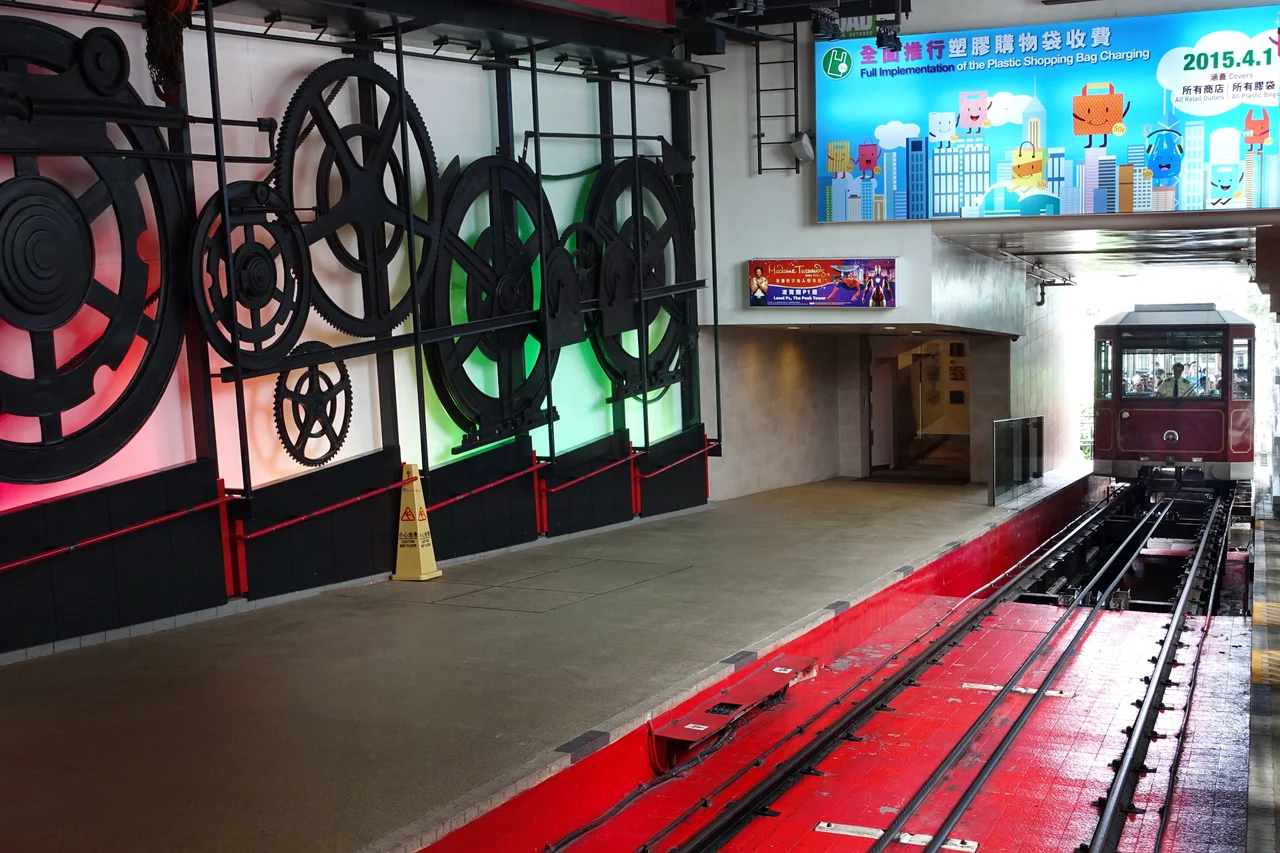

The Peak Terminus
There is a moment on every Peak Tram journey when the tram car tips back beyond any reasonable angle and the city below appears to slide sideways. Skyscrapers tilt. The harbour lists. Passengers grip the handrails. Then, after seven minutes of climbing 368 vertical metres of track, the cars level out and glide into the Peak Terminus — and Hong Kong spreads itself across the horizon in one of the great urban panoramas of the world. That arrival has been startling visitors in exactly this fashion since 30 May 1888.
The Tram That Changed the Peak
Before the Peak Tram opened, Victoria Peak was the exclusive preserve of Hong Kong's colonial elite — and even reaching it was an ordeal. Sedan chairs carried by four bearers were the only practical option along the steep mountain paths, a journey that could take the better part of an hour. When the funicular opened in 1888, it compressed that climb into minutes and fundamentally altered who could reach the top. The terminus sat at Victoria Gap, 398 metres above sea level, where the gap in the ridge offered a natural platform. The tram line was engineered with a maximum gradient of around 1 in 2.6 — steep enough that the cars are built with sloped floors to keep passengers roughly upright. At the terminus, those floors align with the platform, and first-time arrivals often feel oddly tilted even when standing perfectly still.
A Station Inside a Wok
The Peak Terminus today sits inside the Peak Tower, the unmistakable wok-shaped structure designed by Terry Farrell and Partners that has crowned Victoria Gap since 1997. The building's distinctive silhouette — a broad curved platform supported on tapered legs — was controversial when it replaced an earlier Victorian building, but it has become its own kind of landmark. The station occupies the lower levels while observation decks, restaurants, and attractions fill the space above. As of 2007, more than four million people were riding the Peak Tram annually, an average of over 11,000 a day. On clear evenings the terminus is alive with visitors jostling for position along the railings, camera lights pricking the dusk like earthbound stars.
The View That Earns Its Reputation
What the terminus delivers on arrival justifies every superlative. Victoria Harbour stretches north, its waters threaded with ferries and container ships. Kowloon's dense grid of towers rises on the far shore. On the clearest days, the mountains of the New Territories are visible beyond. Looking south and west, the view opens across Pok Fu Lam Reservoir toward the open South China Sea. The perspective is disorienting in the best sense — the city that seems vast and overwhelming at street level reveals itself, from up here, as something contained and comprehensible. It occupies a peninsula and an island, surrounded by water on all sides. The harbour that made Hong Kong famous is suddenly visible in its entirety, and the logic of the place becomes clear in a way it never does from below.
Neighbours at the Gap
The terminus shares Victoria Gap with the Peak Galleria, a shopping mall built on what was once the site of the lower Peak Hotel, and a handful of walking trails that fan out along the ridgeline. The circular Peak Road offers a roughly level walk around the summit with harbour views from multiple angles. More ambitious hikers can continue up the final stretch to the actual summit of Victoria Peak at 552 metres — higher and quieter than the tourist bustle at the Gap. The terminus itself, though, remains the destination for most visitors. It is the punctuation mark at the end of a journey that begins at sea level in Central and ends in a city-wide view that rewards every step — and every white-knuckle degree of incline.
From the Air
The Peak Terminus sits at 22.2711°N, 114.1500°E at an elevation of 398 metres on Victoria Peak, the highest point on Hong Kong Island. From the air, the distinctive wok-shaped Peak Tower is visible against the ridge. Approach from the north offers panoramic views of Victoria Harbour and Kowloon beyond. The nearest major airport is Hong Kong International Airport (VHHH), approximately 30 km to the northwest on Lantau Island. Recommended viewing altitude: 1,500–2,500 feet for the full urban panorama. Be aware of the mountainous terrain that rises steeply above sea level and the controlled airspace surrounding VHHH.
Nearby Stories
- Lok Ma Chau Loop 2.3 km away
- Portas do Cerco 2.3 km away
- Kweilin Incident 17 km away
- Wanshan Archipelago Campaign 34 km away
- Nanxiong Formation 115 km away
- Battle of Nanpeng Island 148 km away
- Heyuan 169 km away
- Cape Maobitou 632 km away