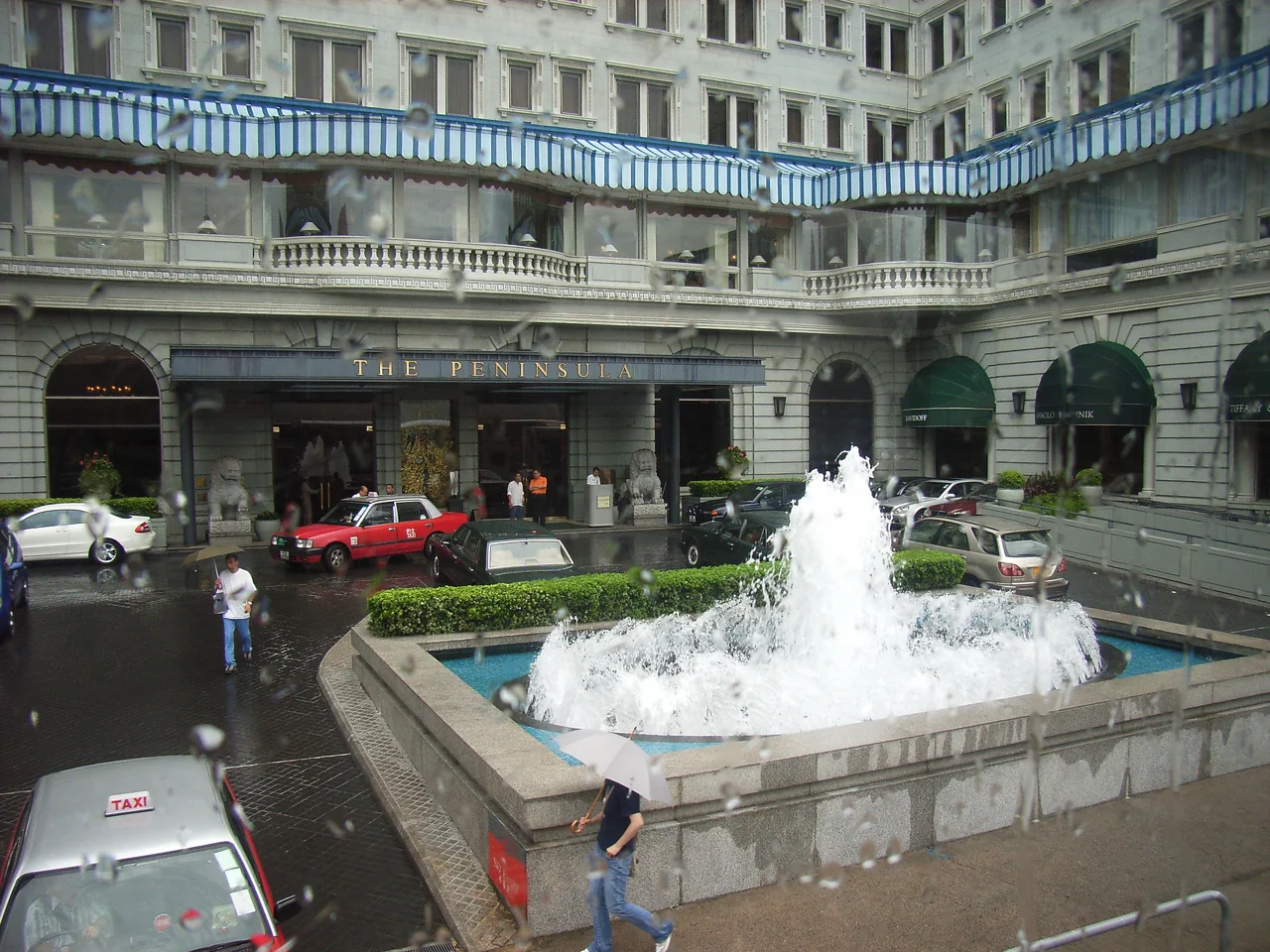

The Peninsula Hong Kong
On Christmas Day 1941, the Governor of Hong Kong walked into the lobby of The Peninsula Hotel and surrendered the British colony to Japan. It was the most ignominious moment in Hong Kong's colonial history, and it happened here — in the grandest hotel east of Suez, in a lobby hung with stained glass and carpeted with patterns unchanged since 1928 — because The Peninsula was the Japanese headquarters, the most prestigious address in Kowloon. No other building in Hong Kong has been present for so much history. The hotel did not merely witness the twentieth century in this city; it furnished the backdrop for its defining scenes.
Built to Impress an Empire
The Kadoorie family conceived The Peninsula as a statement. When it opened on 11 December 1928 — four years behind its original schedule — it was designed to be nothing less than the finest hotel east of the Suez Canal. The location was deliberate and strategic: Tsim Sha Tsui, at the tip of the Kowloon Peninsula, directly opposite the quays where ocean liners docked and adjacent to the terminus of the Kowloon-Canton Railway. Every wealthy passenger arriving by sea would see The Peninsula first, and those who could afford it would stay there. The hotel succeeded immediately. Sunday concerts, nightly terrace dinners, twice-weekly Rose Room dinners, and Afternoon Tea Dances became the social calendar of colonial Hong Kong. Charlie Chaplin and Paulette Goddard were among the early guests. The Peninsula became the place to be seen in Asia.
War Comes to the Lobby
The Battle of Hong Kong lasted eighteen days, ending on Christmas Day 1941 when Governor Sir Mark Aitchison Young crossed Victoria Harbour under a white flag and surrendered in person on The Peninsula's third floor — which the Japanese had already converted into their headquarters. Young was held in a hotel suite for two months before being transferred to a prison in Shanghai. The Japanese renamed the building the "Tōa Hotel" and reserved its rooms for officers and dignitaries. Less than a year later, American colonel Robert Lee Scott Jr. flew his Curtiss P-40K Warhawk over Victoria Harbour and strafed the building's penthouse windows. He described the broken glass cascading to the street like snow. The building survived the war. In 1945, the Japanese surrendered, the British returned, and The Peninsula reclaimed its name.
Green Phantoms and a Rooftop Helipad
The 1994 expansion added a 30-storey tower while preserving the original facade, forecourt, and lobby. The new tower's roof carries a helipad — used to ferry VIP guests to Hong Kong International Airport in a seven-minute flight rather than the hour-long road journey. In December 2006, the hotel placed the largest single order in Rolls-Royce history at the time: fourteen long-wheelbase Phantoms, painted in the hotel's signature Peninsula green. The fleet replaced an earlier complement of Silver Spurs. Today those green Phantoms line up under the porte-cochère with the quiet authority of vehicles that know they are themselves a spectacle. The hotel now holds 300 rooms and suites across the historic wing and the tower, a combination of Edwardian lobby grandeur and contemporary heights above Kowloon's roofline.
A Kitchen That Gave the World XO Sauce
The Peninsula's Spring Moon Cantonese restaurant is sometimes credited with the invention of XO sauce, the umami-rich condiment of dried seafood, cured ham, and chillies that became standard in fine Cantonese cooking. The hotel's culinary range is considerable: Gaddi's French restaurant is one of the oldest fine-dining institutions in Hong Kong; the Philippe Starck-designed Felix bar occupies a glass-walled aerie at the top of the tower with views across the harbour. The Lobby still serves traditional Afternoon Tea to long queues of visitors, a ritual unchanged in spirit since 1928, though the guest list now spans every continent. The hotel has appeared in James Bond films, Dynasty, The Dark Knight, and Michael Palin's Around the World in 80 Days. Its presence is so habitual in popular culture that it has become shorthand for Hong Kong itself.
From the Air
The Peninsula Hong Kong sits at 22.2953°N, 114.1715°E in Tsim Sha Tsui, Kowloon — the southernmost tip of the Kowloon Peninsula, directly across Victoria Harbour from Central on Hong Kong Island. From the air the building is identifiable by its neoclassical facade and the modern 30-storey tower rising behind it, with a helipad on top. The nearest major airport is Hong Kong International Airport (VHHH) on Lantau Island, approximately 25 km to the west. Recommended viewing altitude: 1,000–2,000 feet over Victoria Harbour for the full harbour context. The harbour below is active with ferry traffic; Kai Tak, the former airport, lies to the northeast.
Nearby Stories
- Lok Ma Chau Loop 2.3 km away
- Portas do Cerco 2.3 km away
- Kweilin Incident 17 km away
- Wanshan Archipelago Campaign 34 km away
- Nanxiong Formation 115 km away
- Battle of Nanpeng Island 148 km away
- Heyuan 169 km away
- Cape Maobitou 632 km away