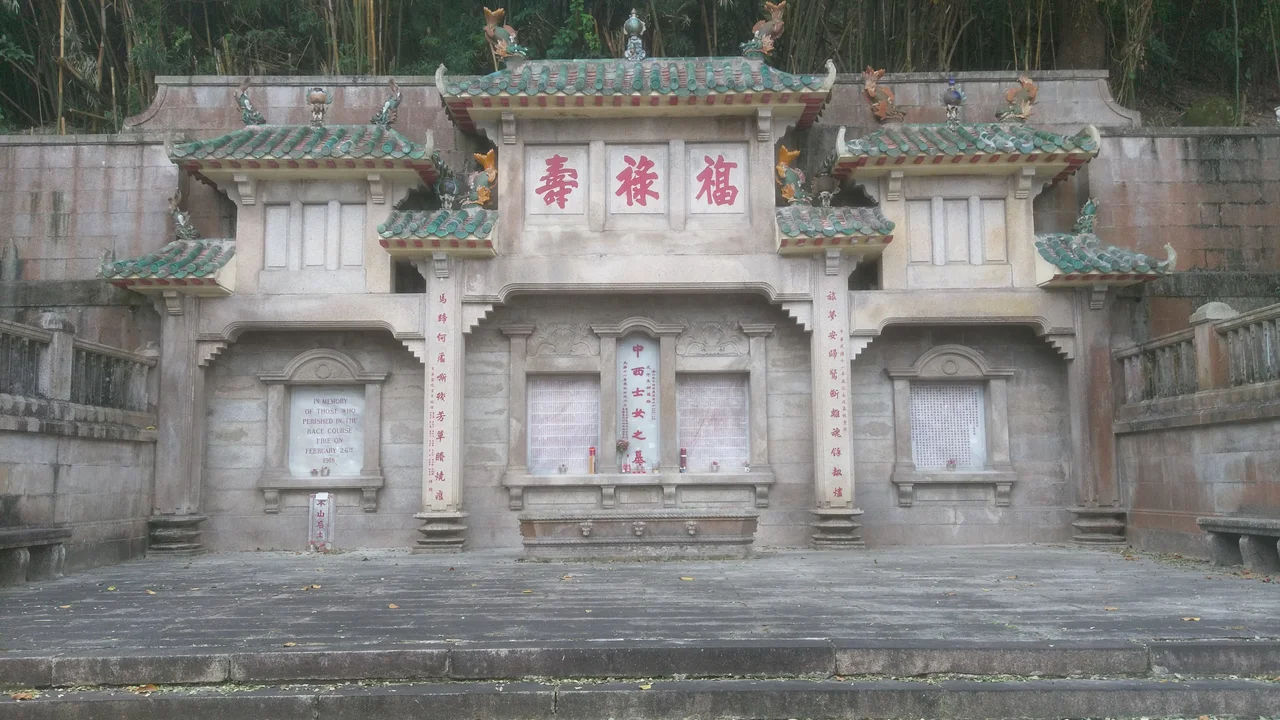

The Race Course Fire Memorial
The names are still there, carved into stone: 610 of the dead, recorded in Chinese characters on plaques that have stood in this small enclosure near Happy Valley for over a century. The Race Course Fire Memorial was completed in 1922, four years after the disaster it commemorates. It does not shout. It offers no dramatic statuary, no eternal flame. It is a quiet place of stone in the middle of a city that rarely stays quiet — a site where the living are asked to pause and consider 670 people who went to the races on a February afternoon in 1918 and never came home.
Derby Day, 1918
The Happy Valley Racecourse had been the social heart of colonial Hong Kong since the mid-nineteenth century. By 1918 it drew enormous crowds for its annual Derby Day meeting — too enormous for the permanent grandstands alone. Temporary bamboo matshed structures were erected to accommodate the overflow, packed with an estimated 3,000 spectators for the 26 February races. The crowd included both European residents and Chinese spectators. At some point during the afternoon, one of the temporary structures collapsed under the combined weight. The fall knocked over food stalls and cooking stoves. Within minutes the dry bamboo and wooden fittings were alight. People were trapped in the wreckage, burned, asphyxiated, or crushed in the stampede to escape. By the time it was over, 670 people were dead. Approximately 400 more were injured. It remains one of the deadliest fires in Hong Kong's history and one of the worst disasters in the history of spectator sport.
Who Bore the Cost
A Coroner's Enquiry followed, but no individual was held criminally responsible. The inquiry found fault with the Director of Public Works and the Captain Superintendent of Police for allowing the temporary structure to be built without adequate safety precautions — but criticism stopped short of prosecution. What the disaster revealed was the hazardous informality with which large crowds had been accommodated for years: bamboo matsheds were everywhere in colonial Hong Kong, used as theatres, temples, and spectator stands, built quickly and packed tightly. The people who died on 26 February 1918 were in a structure that had no reliable means of escape. Many of the 610 Chinese victims whose names were recorded on the memorial were workers and their families, people who had saved to attend Derby Day as a rare holiday outing. Their deaths were preventable. The memorial, managed by the Tung Wah Group of Hospitals, records their names so that they are not absorbed back into the city's anonymity.
Stone and Memory
The memorial was completed in 1922 and has occupied this site near what is now Hong Kong Stadium ever since. It stands in a district called So Kon Po, in the hills above Happy Valley — close enough to the racecourse that you can hear the crowd on race days if the wind is right. The Antiquities and Monuments Office declared it a protected monument in 2015, more than nine decades after it was built. The designation matters because it ensures the memorial cannot simply be cleared away as the neighbourhood changes around it. In 2018 and 2019, Typhoon Mangkhut damaged the only road leading to the memorial, leaving it inaccessible for over a year. It is open daily, with restricted hours, except for the first three days of the Lunar New Year — a small calendar exception that feels, in context, entirely appropriate.
A Reckoning That Keeps Recurring
Memorial sites like this one do quiet but essential work. The Race Course Fire of 1918 predates living memory — there is no one left who witnessed it, no photographs of the moment, no film footage. What remains is the stone record: 610 names, a description of events on a plaque, and the bare fact that the Tung Wah Group of Hospitals has kept this place open and maintained for over a century. Tung Wah, founded in 1870 as a charitable organization to serve Hong Kong's Chinese community, organized much of the disaster relief in 1918 and has been the memorial's caretaker ever since. To visit it today is to stand at the intersection of tragedy and institutional memory — and to acknowledge that these 670 people, who gathered for an afternoon of racing and never left, deserve to be known by name.
From the Air
The Race Course Fire Memorial sits at 22.2727°N, 114.1900°E in the So Kon Po area of Wan Chai District, near Hong Kong Stadium on the eastern edge of Happy Valley. From the air, the Happy Valley Racecourse oval is a clear landmark — one of the few open green spaces on Hong Kong Island — with the memorial in the hills immediately to its east. The nearest major airport is Hong Kong International Airport (VHHH), approximately 35 km to the west. Recommended viewing altitude: 1,500–2,500 feet over Happy Valley. The surrounding hills rise steeply; the Noon-day Gun and the Causeway Bay typhoon shelter are visible to the north.
Nearby Stories
- Lok Ma Chau Loop 2.3 km away
- Portas do Cerco 2.3 km away
- Kweilin Incident 17 km away
- Wanshan Archipelago Campaign 34 km away
- Nanxiong Formation 115 km away
- Battle of Nanpeng Island 148 km away
- Heyuan 169 km away
- Cape Maobitou 632 km away