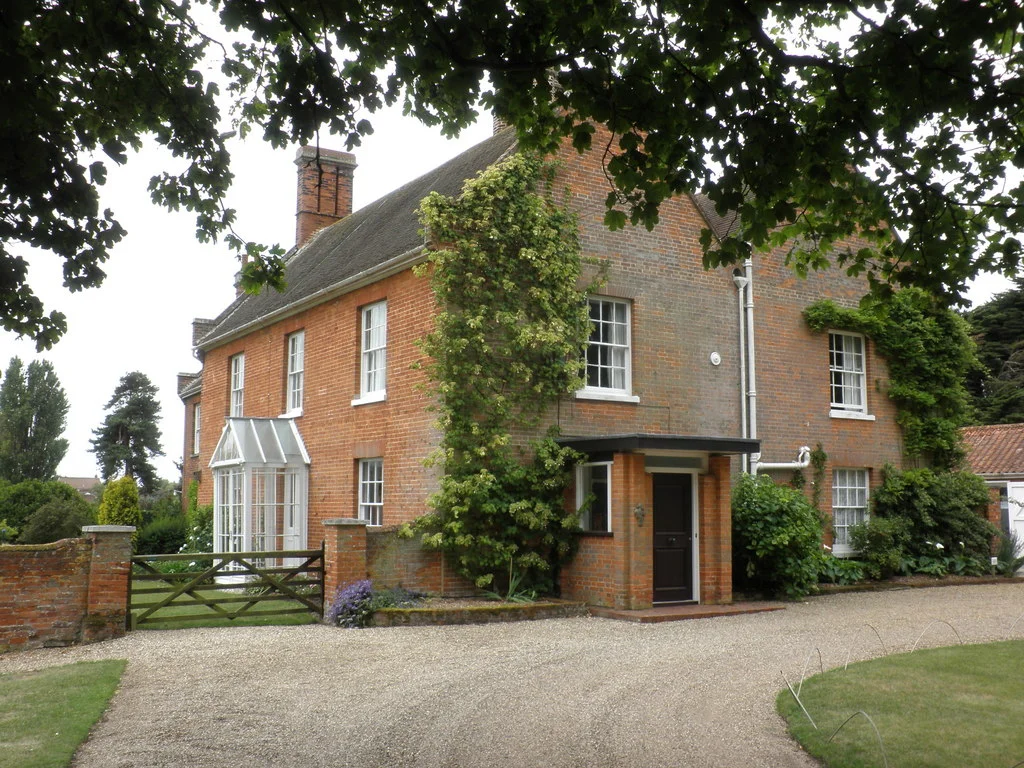

The Red House, Aldeburgh
Britten and Pears swapped houses with the painter Mary Potter in 1957 because the seafront cottage they had been living in, Crag House, had become too public. Tourists pressed their faces to the windows. Curious onlookers waited on the shingle. The Red House sat back from the town behind a hedge, originally a late-seventeenth-century farmhouse, and it gave them what they needed: a quiet place to work, garden, and live together for the rest of their lives. Britten composed there for nineteen years. Pears stayed another ten after Britten's death.
A House Becomes a Sanctuary
The Red House began as a working farmhouse in the late seventeenth century, brick on a timber frame, and grew through three centuries of extensions into a double-pile, two-storey, three-bay home set in gardens just outside Aldeburgh's centre. Mary Potter had been living there. Britten had bought Crag House on the seafront in 1947, and by the mid-1950s his fame, and that of the Aldeburgh Festival he had founded in 1948 with Pears and the librettist Eric Crozier, was making seafront life impossible. In 1957 the two artists exchanged. Potter moved to Crag House, where she would paint the sea and shore until her death. Britten and Pears moved inland to the Red House, where Britten lived as his main residence until his death in 1976.
Composing in the Library
Britten worked in a library studio in the grounds. He composed much of his late output here, including the War Requiem premiered in 1962 at the consecration of the new Coventry Cathedral, the operas Curlew River, The Burning Fiery Furnace, and The Prodigal Son, the children's opera The Golden Vanity, and the chamber operas Owen Wingrave and Death in Venice. Pears, the tenor for whom Britten wrote so much of his vocal music, was alongside him for almost all of it. The Foundation reinstated Britten's grand piano to the first-floor studio in 2013 as part of a £4.7 million restoration project, and the studio now feels close to what it would have looked like when he was working in it. The garden, the small writing room, the proportions of the rooms themselves all turn out to have shaped the music in ways biographers have spent decades tracing.
The Art Collection
Britten and Pears built an art collection of about 1,300 works across their lives. Sculpture by Geoffrey Clarke and Georg Ehrlich. Paintings by friends and contemporaries. Many of the works came directly through the Aldeburgh circle of artists, including Mary Potter herself, John Piper who designed sets for several Britten operas, and Sidney Nolan. The Britten-Pears Foundation, established as the base for their joint legacy after Pears' death in 1986, has continued to acquire works either by artists Britten worked with or by those influenced by him. The collection lives alongside the manuscripts, letters, and recordings in the Archive Building added to the grounds in 2011-13 to a design by Stanton Williams, a long, low structure that holds Britten's working papers in conditions that should preserve them indefinitely.
Britten Pears Arts Today
The Red House is now one of two headquarters for Britten Pears Arts, the organisation that grew from the Britten-Pears Foundation. The other is Snape Maltings Concert Hall, the converted Victorian malthouse on the River Alde that became the festival's main venue after a fire in 1969 destroyed the original. The house is open to the public for much of the year, with the studios, library, gardens, exhibition gallery added in 1993, and the modern Archive Building all part of the visit. Subsequent additions during Britten's own time include a porch by Peter Collymore from 1967 and studios by Collymore and by H. T. Cadbury-Brown from the 1950s and 1960s. The accretions of a working artistic life have become, decades later, the architecture of memory. Walking through the rooms you can sometimes hear a piano. Britten Pears Arts holds masterclasses for young singers in the studio where Britten wrote, and the line from one tenor to the next runs unbroken.
From the Air
The Red House sits at 52.165 N, 1.588 E on the western edge of Aldeburgh, Suffolk, set back from the seafront behind gardens. Not visible from cruising altitude as a standalone landmark, but easily found at 1,500-2,500 feet by locating Aldeburgh on the coast and looking just inland from the town. The Snape Maltings concert hall is five miles to the west along the River Alde. Nearby airfields: Wattisham (EGUW) 25 miles west, Norwich (EGSH) 35 miles north.
Nearby Stories
- Beccles 7.6 km away
- The Food Museum 8.6 km away
- Old Buckenham Airfield 13 km away
- White House Farm murders 20 km away
- Walton-on-the-Naze 22 km away
- Four Days' Battle 22 km away
- Southern Bight 51 km away
- Battle of Lowestoft 56 km away