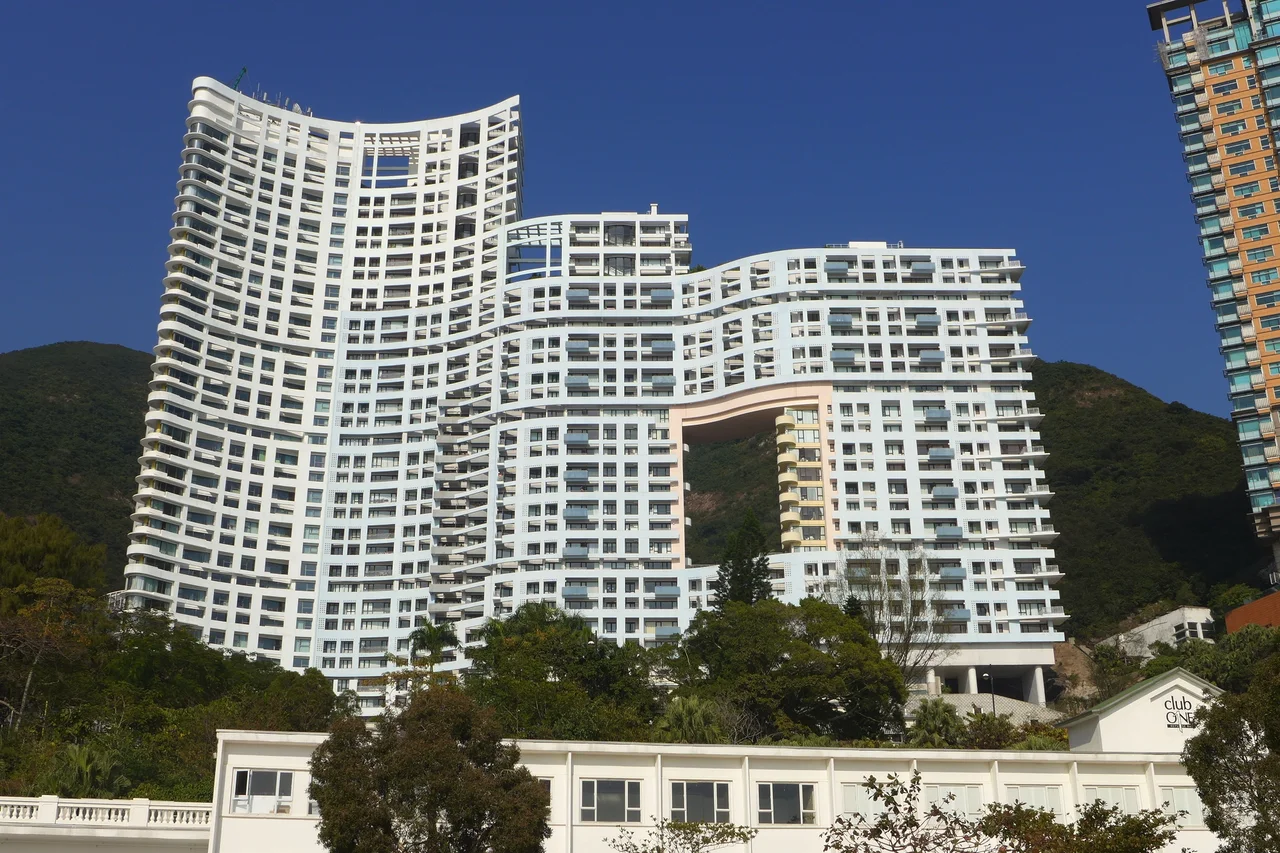

The Repulse Bay
There is a square hole cut through the middle of a 37-storey residential tower on the south side of Hong Kong Island, and the reason for it is dragons. According to feng shui principles, the mountains behind the building are home to dragons that need a clear path to the sea. The architects of The Repulse Bay, working in the mid-1980s, complied: the gap runs straight through the building's midsection, ensuring the dragons — and the good fortune they carry — can pass unobstructed to the water below. The hole has made The Repulse Bay one of the most recognized buildings in Hong Kong.
The Hotel That Stood Here First
Before the present towers, something much older occupied this site. The Repulse Bay Hotel opened in 1920 as a colonial retreat on the south side of Hong Kong Island, facing the sheltered crescent of Repulse Bay beach. It was everything a colonial escape was supposed to be: white-painted, verandahed, surrounded by tropical gardens, positioned where the South China Sea breeze made the heat bearable. Over the following decades it attracted an extraordinary procession of guests. George Bernard Shaw and Noël Coward both stayed here. Marlon Brando was a guest in the 1950s. Spain's Crown Prince Juan Carlos and Crown Princess Sofia spent their honeymoon at the hotel. Prince Axel of Denmark and Prince Peter of Greece also stayed. The hotel became the address for anyone who was anyone in mid-century Asia, the preferred retreat of the colony's social establishment and its international visitors alike.
Demolition and What Came After
The original Repulse Bay Hotel was demolished in 1982 to make way for redevelopment. The decision was controversial — the building had become genuinely beloved — but the site's value was too great. What replaced it was The Repulse Bay: four residential towers named Taggart, Hartson, Nicholson, and De Ricou after people associated with the original hotel, rising 37 storeys and housing some of Hong Kong's most expensive private apartments. In a gesture toward the demolished original, a replica of the hotel's lobby building was reconstructed on the site in 1986. It now houses The Verandah restaurant and Spices — dining rooms that attempt, with considerable success, to conjure the atmosphere of the colonial original. The 1989 Hong Kong Institute of Architects Annual Awards gave the complex a silver medal. The De Ricou tower is LEED certified and was refurbished in 2012-2013.
The Architecture of Belief
The dragon gap is the building's most discussed feature, but it reflects something that runs through much of Hong Kong's built environment: a serious engagement with feng shui principles in commercial architecture. The idea that structures should be positioned and designed to allow the flow of beneficial energy — qi — through a site is not mere superstition in Hong Kong; it is a calculation made by developers and architects alongside structural engineering. At The Repulse Bay, the result is a design quirk that doubles as a visual identity. From the beach, from the road, and from the air, the square hole through the building's facade is instantly recognizable. It has been photographed millions of times. It has been cited in architectural discussions of how belief systems shape built form. It earned the building a silver medal at the HKIA awards.
On Film, Twice
The original Repulse Bay Hotel appeared in the 1978 American film Coming Home. Its successor, the replica lobby building, was chosen by director Ang Lee for a key sequence in his 2007 adaptation of Eileen Chang's novel Lust, Caution — a film about wartime Hong Kong, shot partly in a building on a site that has its own wartime history. During the Japanese occupation of Hong Kong from 1941 to 1945, the Battle of Repulse Bay was fought on the beach and in the waters directly below this site. The restaurant that now operates in the replica lobby building carries some of that layered weight whether it means to or not. The Verandah serves colonial-style high tea on a terrace facing the bay, in a building that is itself a copy of a building that was itself a set piece of colonial life.
From the Air
The Repulse Bay building sits at 22.2394°N, 114.1960°E on the south shore of Hong Kong Island, overlooking Repulse Bay beach and the South China Sea. From the air, the crescent-shaped bay is clearly identifiable, with the distinctive towers — and their feng shui hole — visible on the hillside above the beach. The nearest major airport is Hong Kong International Airport (VHHH), approximately 35 km to the northwest. Recommended viewing altitude: 1,500–2,500 feet over the bay for the full south-coast perspective. The Stanley Peninsula and Tai Tam Reservoirs are visible to the east; the open South China Sea extends to the south.
Nearby Stories
- Lok Ma Chau Loop 2.3 km away
- Portas do Cerco 2.3 km away
- Kweilin Incident 17 km away
- Wanshan Archipelago Campaign 34 km away
- Nanxiong Formation 115 km away
- Battle of Nanpeng Island 148 km away
- Heyuan 169 km away
- Cape Maobitou 632 km away