.jpg)
The Ruins
They call it the Taj Mahal of Negros, and the comparison is not mere flattery. Like its Indian namesake, the Lacson Ruins in Talisay began as a monument to a man's grief for his wife. Don Mariano Ledesma Lacson built this Italian-inspired mansion in the early 1900s on his 440-hectare sugar plantation, dedicating every column and cornice to the memory of Maria Braga Lacson, who died giving birth to their eighth child. What he could not have known was that the building's greatest story was still decades away, waiting in the fires of a world war.
Sugar, Revolution, and the Lacson Name
The Lacson family shaped more than just the sugar fields of Negros Occidental. Don Mariano's brother, General Aniceto Lacson, led the Negrense revolution and served as president of the short-lived Cantonal Republic of Negros. Another brother, Rosendo, was a signatory to that republic's founding documents. A third, Domingo Lacson Sr., founded Sta. Clara Estate Inc., one of the province's industrial pillars. Against this backdrop of political ambition and agricultural wealth, Don Mariano chose a different kind of legacy. His mansion rose from the flat sugarcane country south of Bacolod, its Italianate facade an anomaly among the wooden plantation houses of the era. Every detail was a tribute, not to power, but to a woman he had lost.
Three Days of Fire
When Japanese forces advanced across Negros during World War II, Filipino guerrillas faced an impossible calculation. The mansion's grandeur made it an obvious candidate for a Japanese military headquarters, and allowing the enemy to entrench there would have endangered the surrounding communities. The guerrillas made their choice: they set the mansion ablaze. The fire burned for three days. Stone walls cracked. Timber ceilings collapsed. The ornamental ironwork warped in the heat. But when the smoke cleared, the skeleton of Don Mariano's tribute remained upright. The reinforced concrete foundation and thick walls, built to Italian standards in a tropical climate, refused to fall. What the fire destroyed in detail, it created in silhouette: a ruin more dramatic than the original building had ever been.
A Family's Stubborn Devotion
After the war, the easy choice would have been demolition. Instead, generation after generation of Lacson heirs maintained the ruins exactly as they found them. No reconstruction, no modern additions. The family understood something instinctive about the building's new power: the absence was the point. Roofless walls framing nothing but sky. Window openings that let tropical sunlight pour through where glass once filtered it. The ruins became more eloquent in their destruction than the intact mansion had been, a physical metaphor for love that persists after loss. Today the property remains in private family hands, the descendants of Don Mariano and Cora Maria Osorio Rosa-Braga preserving the ruin amid operational farmland.
Dusk at the Ruins
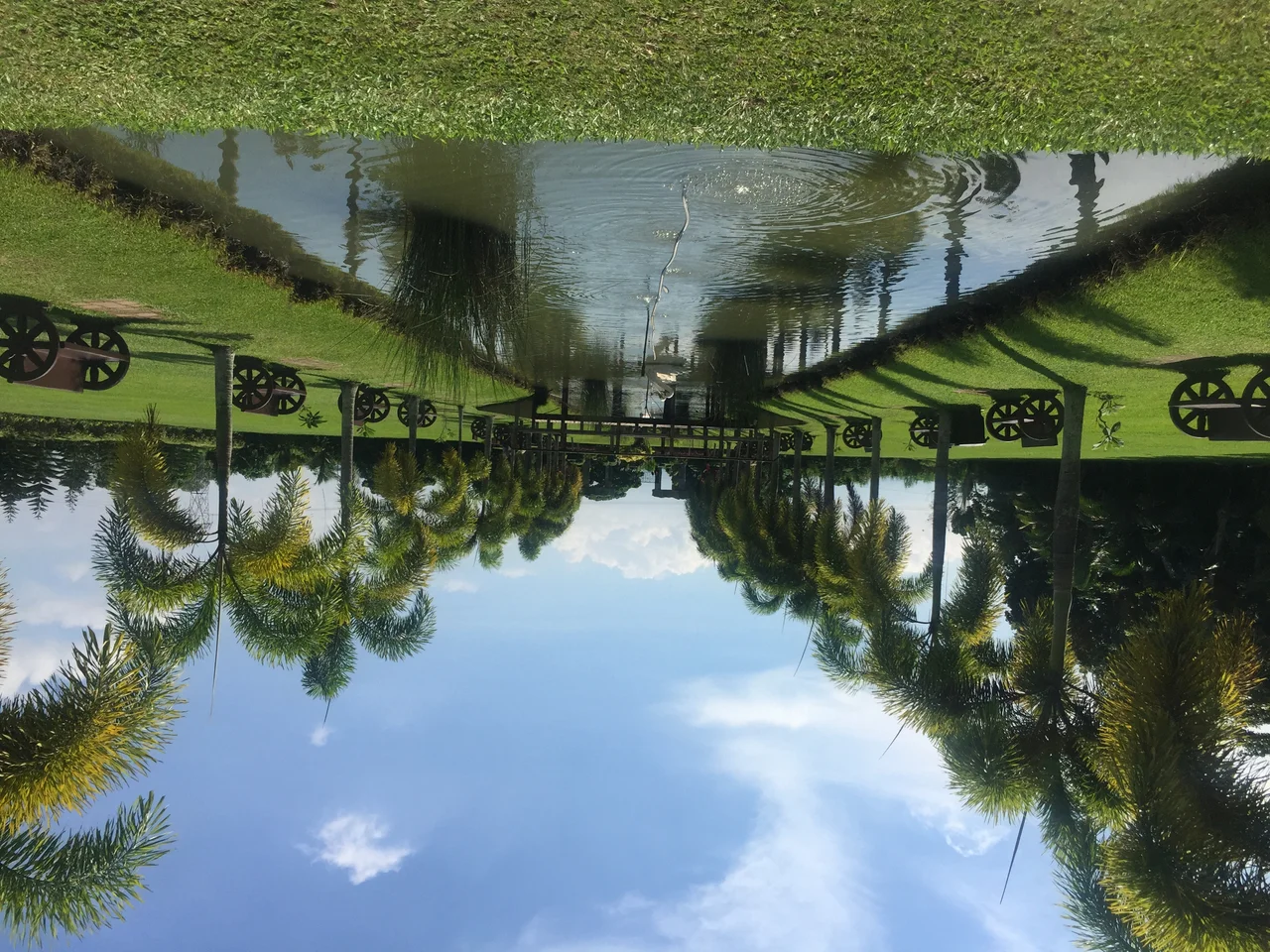
Visitors arrive throughout the day, but the Ruins earn their reputation at sunset. As the light drops, the exposed concrete and stone catch the golden hour in ways a roofed building never could. Every window becomes a frame for the sky. Every empty doorway becomes an invitation. The grounds include gardens and a fountain on the south facade, manicured against the rawness of the structure itself. For photographers and couples, the contrast is irresistible: lush tropical greenery pressing against war-scarred walls, formality interrupted by history. The site is open daily from 8 AM to 8 PM, and the family charges a modest entrance fee. It remains one of the most photographed landmarks in the Philippines, proof that some things become more beautiful in their breaking.
From the Air
Located at 10.71N, 122.98E in Talisay, Negros Occidental, just south of Bacolod City. The nearest major airport is Bacolod-Silay International Airport (RPVB), approximately 20 km to the north. From the air, the mansion's roofless rectangular footprint is visible amid green sugarcane fields. Best viewed at low altitude on approach from the north. The flat terrain of the sugar country offers excellent visibility in clear weather.
Nearby Stories
- Sagay Massacre 9.9 km away
- Baroque Churches of the Philippines 12 km away
- Escalante, Negros Occidental 25 km away
- Hacienda Rosalia 30 km away
- Republic of Negros 44 km away
- Moalboal 47 km away
- Maniguin Island Lighthouse 105 km away
- Canatuan Mine 293 km away