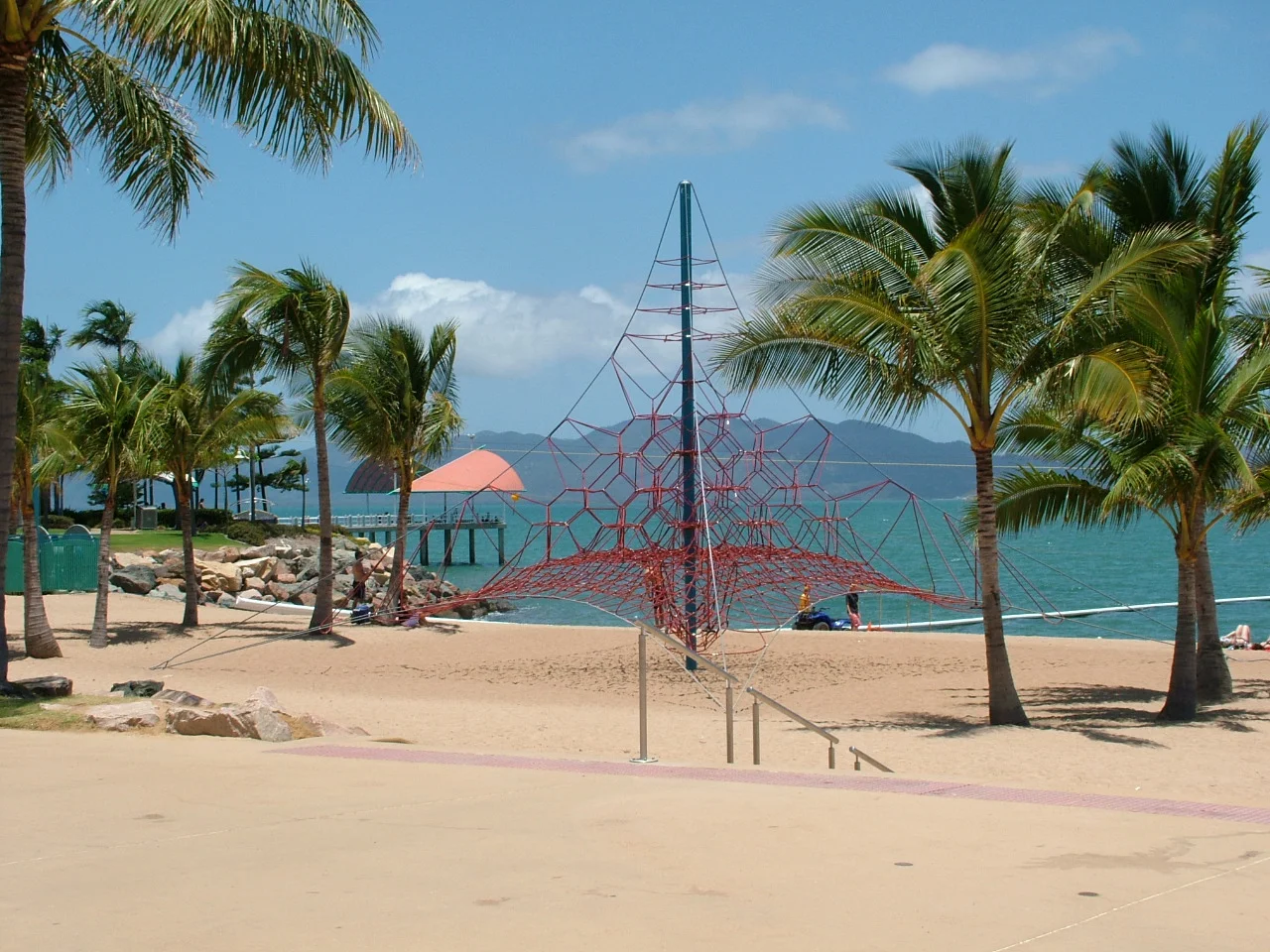

The Strand, Townsville
On a winter morning in the dry tropics, The Strand is one of the most pleasant places in Australia to be alive. Joggers trace the 2.2 kilometres of palm-lined pathway, kids shriek in the free waterpark, and out across Cleveland Bay the green hump of Magnetic Island sits close enough to seem touchable. This is Townsville's front yard - a beachfront promenade in the suburb of North Ward that the city has rebuilt, fought the sea for, and rebuilt again. It is beautiful now. It has not always been kind.
Swimming Behind the Net
Townsville's water is gorgeous and, for several months a year, genuinely dangerous. From November to May, the warm shallows can carry box jellyfish and the tiny, agonising Irukandji, so swimmers gather inside the stinger enclosures - nets strung out from the beach to fence off a patch of safe sea. The instinct to wall off the water here is old. As far back as 1929 the local Country Women's Association built a "sharkproof" swimming enclosure at Kissing Point, and the records of those early decades carry a grim tally of shark attacks along this shore. The Strand has always asked its swimmers to respect what lives beyond the net, and the people of Townsville have learned to love the sea on its own terms.
The Rock Pool and the Figs
Not everything here is held back behind a net. The Rock Pool is a free, palm-fringed saltwater lagoon perched right at the water's edge, open year-round and beloved by families who want the tropics without the sting. Shading the promenade are great spreading figs and tropical plantings, and at the headland the old guns of Kissing Point still point out to sea from what was once a military fort and is now the Army Museum of North Queensland. Anzac Memorial Park, which began as a simple recreation ground in the 1910s and was formally renamed in 1934, threads the city's war memory into the everyday business of a walk by the water. The Strand is layered like that - leisure laid gently over history.
What the Sea Takes, the City Rebuilds
This foreshore exists in its present form because the old one was destroyed. Tropical Cyclone Sid and a run of monsoonal storms in 1997 and 1998 chewed away the original beach, and the rebuilt Strand opened in 1999, only to be battered again by Cyclone Tessi in 2000. Townsville kept spending and kept rebuilding - a major redevelopment in 2010 drew an estimated 80,000 people to its opening weekend. The promenade has hosted the Sydney 2000 Olympic torch relay's local cauldron, Federation centenary fireworks that pulled crowds of 86,000, and dawn Anzac marches twenty thousand strong. Twice in five years it was named Australia's cleanest beach. Every other year the foreshore turns gallery for the Strand Ephemera, when local and regional artists line the promenade with work made for the open air, and a few favourites - like the Silver Coconuts near the Rock Pool - have been allowed to stay. For a beachfront that the cyclones keep trying to erase, that is a quiet kind of defiance.
A Sentinel in the Shallows
Wade out at the northern end and you will find the Ocean Siren standing in the sea - a four-metre figure modelled on Takoda Johnson, a young Wulgurukaba girl, holding up a traditional Bayliss shell toward Magnetic Island and the reef beyond. By day she is a striking statue. By night she becomes something stranger and more moving: her surface glows, and the colour she shows is set by the live water temperature out on Davies Reef. When the reef runs hot, she warns of it in light. The work of artist Jason deCaires Taylor, she is the shore-bound piece of the Museum of Underwater Art, and she turns an evening stroll along The Strand into a quiet conversation about the living, vulnerable sea just over the horizon.
From the Air
The Strand runs along Townsville's northern shoreline in North Ward at roughly 19.246 degrees S, 146.811 degrees E, a 2.2 km arc facing Cleveland Bay. From the air it reads as a green, palm-edged ribbon between the city and the water, with Kissing Point headland at its northwest end and Magnetic Island 8 km offshore. Townsville Airport (ICAO YBTL) is about 5 km west; expect adjacent RAAF Base Townsville military traffic. Cairns (YBCS) lies some 250 km north. Best viewing is during the dry season (May to October) when skies are clear; the wet season brings monsoonal cloud and cyclone risk that has repeatedly reshaped this very foreshore.
Nearby Stories
- Ayr 13 km away
- SS Yongala 34 km away
- Great Palm Island 35 km away
- Bindal People 50 km away
- Cardwell UFO Festival 83 km away
- Hinchinbrook Island 113 km away
- Porcupine Gorge 215 km away
- Samarai 998 km away