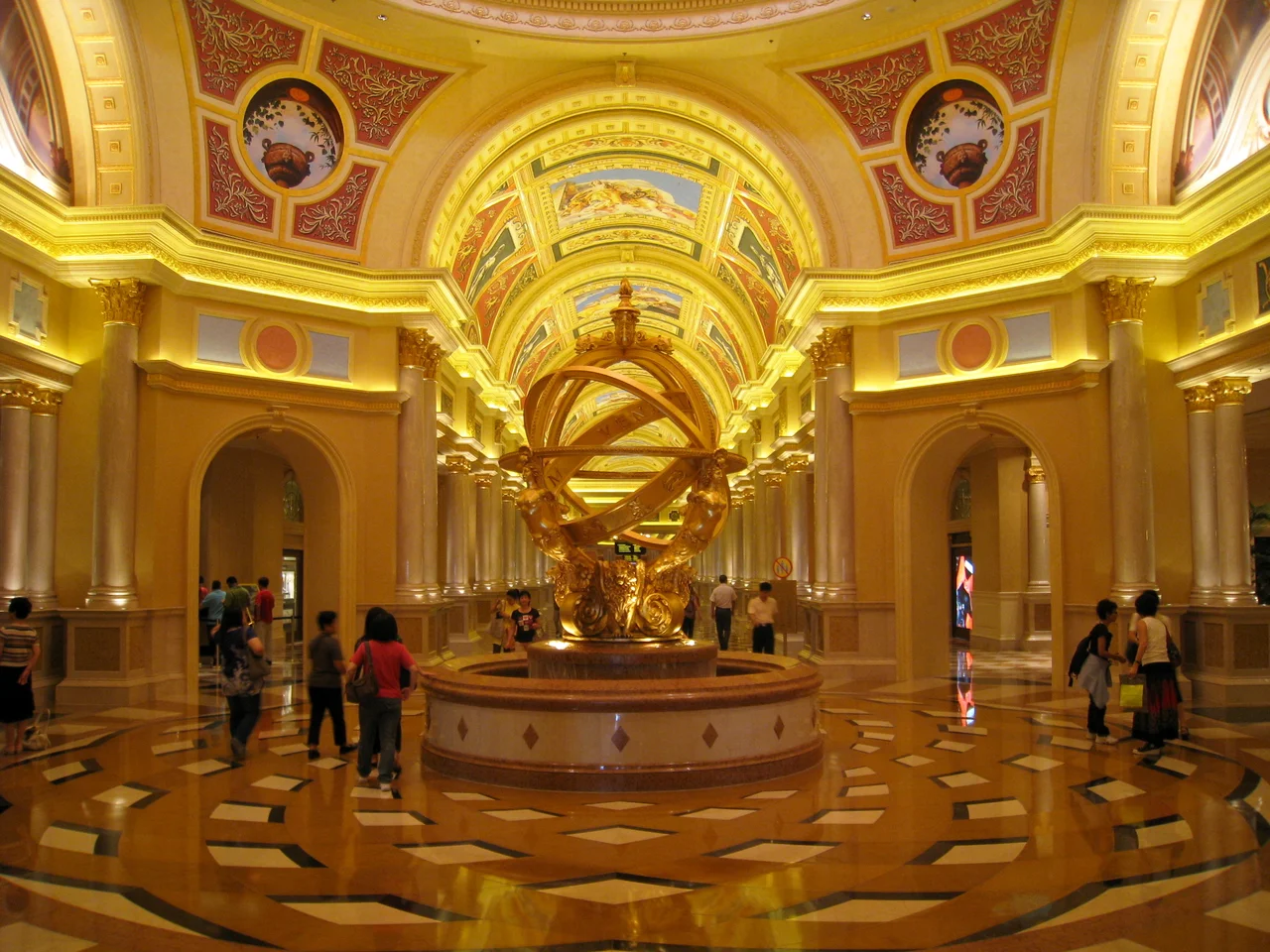

The Venetian Macao
Venice doesn't have gondoliers in a shopping mall, but The Venetian Macao does. That distinction — absurd and entirely intentional — captures something essential about what Las Vegas Sands built on Macau's Cotai Strip in 2007. The 39-story complex isn't trying to evoke Venice; it's trying to exceed Las Vegas, which itself was trying to exceed everywhere else. The result is a building so large — 10.5 million square feet of floor space — that its scale stops being a number and becomes an environment. You don't visit The Venetian Macao. You enter it, and then you navigate.
A City Built on a Sandbar
Cotai is not a natural place. The strip of land connecting the islands of Taipa and Coloane in Macau was reclaimed from shallow tidal flats, and The Venetian sits on a foundation of 1,530 concrete pilings driven through that new earth into what lies beneath. Architects Aedas and HKS designed the hotel tower, which was finished in July 2007; the full resort opened on 28 August of that year.
The numbers are difficult to absorb individually. Three thousand suites. Eight hundred gambling tables. Three thousand four hundred slot machines. A convention space of 1.2 million square feet. A retail space of 1.6 million square feet. A casino floor of 550,000 square feet divided into four themed gaming areas — Golden Fish, Imperial House, Red Dragon, and Phoenix. By any metric, The Venetian is not a large hotel with a casino attached. It is, in architectural fact, the largest casino in the world.
The Logic of the Cotai Strip
Macau's casino industry predates Las Vegas by centuries — Portuguese colonial administrators licensed gambling here in the nineteenth century — but the Cotai Strip represents something qualitatively different: the deliberate construction of a new Las Vegas Strip on reclaimed ground. The Venetian opened as the anchor property of that project, flanked by what would become a dozen multibillion-dollar resorts, a private university campus, and a garrison of the People's Liberation Army.
The model was transparent. Las Vegas Sands had already built The Venetian in Las Vegas; the Macao property was its explicit sister. Where the American version replaced the demolished Sands hotel on the Strip, the Macao version needed no demolition — there was nothing there before the land was made. That blankness was the point. On Cotai, the company could build at a scale the Las Vegas Strip's existing urban fabric wouldn't allow.
Paiza Club and the Geography of Privilege
Not all of The Venetian's 550,000 square feet of casino space are accessible in the same way. The Paiza Club is reserved for premium guests, its gaming area divided into private rooms named for cities and regions across Asia: Yunnan, Guangzhou, Hong Kong, Singapore, Kuala Lumpur. The names are chosen deliberately — a geography of aspiration, placing the high-stakes player at the center of the continent's economic map.
The 15,000-seat Cotai Arena, attached to the complex, operates as one of Asia's major entertainment venues. The Venetian also runs its own private bus fleet, moving guests between the resort and various terminals — including the Cotai Jet catamaran ferry service it operates between Taipa and Hong Kong. At this scale, the resort functions less like a building than like a transit node: you arrive, you stay, you leave via systems the property controls.
Scale, Scrutiny, and the Larger Story
A project this large, operating in a jurisdiction with Macau's particular history, has not been without controversy. In 2010, Chinese authorities reported finding more than a hundred people involved in prostitution inside the casino during an enforcement operation. More significant legally: in early 2011, the U.S. Department of Justice and the Securities and Exchange Commission opened investigations into Las Vegas Sands Corporation over compliance of its Macao properties with the Foreign Corrupt Practices Act. The company paid $6.96 million in 2017 to settle criminal allegations brought by the DOJ.
These episodes are part of The Venetian's record, not footnotes to it. A casino resort operating at this scale — the largest in the world, in a city where gambling revenue once dwarfed that of Las Vegas — operates inside systems of money, regulation, and political relationship that go well beyond the gondoliers in the shopping atrium. The spectacle and the complexity come together in the same structure, built on the same pilings, driven into the same reclaimed ground.
From the Air
The Venetian Macao is located at approximately 22.1486°N, 113.5606°E on the Cotai Strip between Taipa and Coloane islands in Macau. The building's massive footprint is distinctly visible from altitude — one of the largest roofprints in the region. From the air approaching from the east (Hong Kong direction), the Cotai Strip's cluster of large hotel towers appears as a dense rectangle of high-rises on reclaimed flatland, with The Venetian identifiable by its scale and the distinctive curved profile of the Cotai Arena on its flank. Macau International Airport (VMMC) is approximately 2 km to the east. The Hong Kong-Zhuhai-Macau Bridge, which crosses the Pearl River estuary nearby, provides an additional visual reference. Recommended altitude for a clear view of the Cotai reclamation geography is 4,000–6,000 feet on the approach to VMMC from the northeast.
Nearby Stories
- Tai Tau Chau (Southern District) 0.7 km away
- Lai Chi Wo 3 km away
- Wanshan Archipelago Campaign 3.2 km away
- Pearl River Delta 3.7 km away
- Battle of Yamen 13 km away
- Jiangmen 15 km away
- Hong Kong 12 32 km away
- Battle of Nanpeng Island 114 km away