.jpg)
The World of Suzie Wong (film)
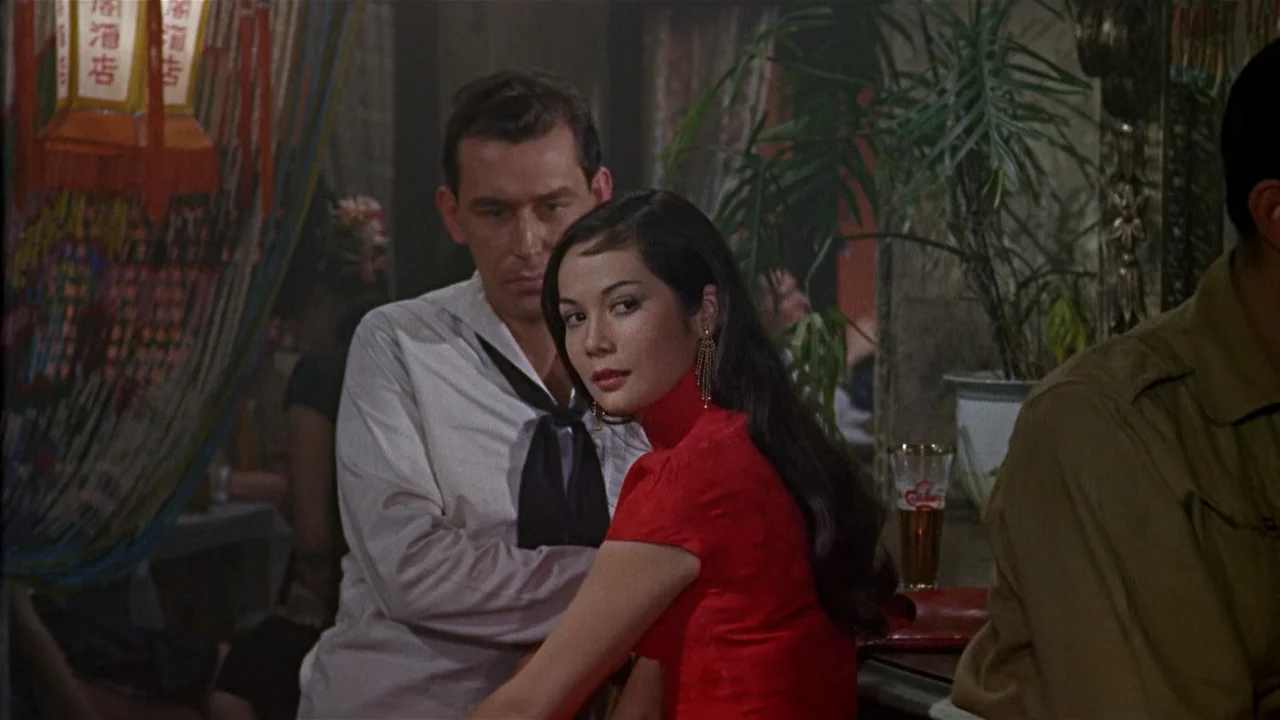
Before a single frame was shot, the role of Suzie Wong had already passed through a Broadway stage and three different actresses. France Nuyen originated the character opposite William Shatner in the 1958 New York production. When Hollywood came calling, she signed to reprise the role on film — until personal turmoil during the Hong Kong location shoot led executive producer Ray Stark to replace her with Nancy Kwan, a largely unknown understudy then touring the road company. All five weeks of completed Hong Kong footage had to be reshot. The finished film that opened at Radio City Music Hall in November 1960 was not quite what anyone had planned, and that instability runs through it — a love story built on shifting ground, set in a city that was itself in the middle of becoming something entirely new.
The Story Wan Chai Told About Itself
The film follows American architect Robert Lomax, played by William Holden, who comes to Hong Kong to spend a year painting. He falls for Suzie Wong, a bar girl at the Nam Kok Hotel in Wan Chai — a character presented as charming, devoted, and resilient, but whose entire existence in the story is organized around the Western man who sees her true worth. She had been abandoned as a child and forced into sex work, details the screenplay treats as background texture rather than the center of her story. Critics at the time noted the tension. Bosley Crowther of the New York Times wrote that the film almost convinced you it was sincere — "unless you shut your eyes and start thinking." Time Out, reviewing it years later, was blunter: the film was "denied the chance of being honest about its subject" and "degenerates into euphemistic soap opera." The Japanese American Citizens League, in 2013, cited the film as part of a long tradition of representing Asian women as exotic and subservient. Suzie Wong the character became a cultural shorthand that outlasted the film itself.
A City Caught on Film
Whatever its failures of imagination about the people who lived there, the film preserved something irreplaceable: Hong Kong in 1960, before the high-rise transformation of the 1970s and 1980s remade the waterfront entirely. The production shot across the city — Tsim Sha Tsui, Sheung Wan, Ladder Street, Yau Ma Tei, Sai Ying Pun, Aberdeen, Telegraph Bay — sometimes bending geography for cinematic effect but capturing tram lines, harbor life, street markets, and hillside lanes that no longer exist in anything like their original form. The film's fictional Nam Kok Hotel was modeled on the Luk Kwok Hotel, a real Wan Chai establishment. When you watch the crowd scenes and the ferry crossings, you're looking at a city of roughly 3 million people on the cusp of extraordinary change. For historians of Hong Kong's built environment, the film functions as a time capsule that neither the makers nor the audiences fully intended to create.
The Production That Almost Wasn't
The behind-the-scenes story is almost as turbulent as the film's plot. France Nuyen's removal from the production set off a cascade: original director Jean Negulesco was also fired and replaced by Richard Quine. Every Hong Kong scene had to be reshot with Nancy Kwan in the role. All the pre-release publicity featuring Nuyen — including a prepared layout for Esquire — was scrapped and redone. Kwan, who earned a Golden Globe nomination for Best Actress in a Motion Picture Drama for her performance, brought an energy and naturalism the production badly needed. Variety called Holden "restrained and sincere." Kwan they found less consistent — but on balance, believable. The film was a commercial success in Britain in 1961, described in trade publications as a "money maker." Artistic ambivalence and box-office success coexisted, as they often do.
What the Character Left Behind
Suzie Wong as an image outlived the film's box office run by decades. The name became shorthand — in advertising, in journalism, in casual cultural reference — for a particular idea of Asian femininity: compliant, decorative, grateful. That idea had real costs for real women, costs that the film's creators almost certainly didn't intend and probably didn't consider. Nancy Kwan herself, in later interviews, spoke about the complicated legacy of the role and her own position as a trailblazing Asian actress in Hollywood at a time when such roles were vanishingly rare. She was simultaneously breaking ground and walking a path that had been very narrowly laid out for her. The film is worth watching precisely because of that tension — not despite it.
Wan Chai After Suzie
The Wan Chai the film depicted — a neighborhood of small hotels, bars, waterfront life, and a population navigating poverty and colonial-era social structures — was already changing when the cameras rolled and changed far more dramatically in the decades that followed. Land reclamation pushed the waterfront north. The Luk Kwok Hotel, the real building behind the fictional Nam Kok, was demolished and rebuilt as a glass tower. The narrow lanes and tile-fronted shophouses of the 1950s gave way to the commercial density of the contemporary district. Wan Chai today is a place of office towers, nightlife, wet markets, and one of the highest concentrations of historical monuments on Hong Kong Island — a layered place where the past coexists uneasily with the present, much like the film itself.
From the Air
The film was set in Wan Chai on the north shore of Hong Kong Island, centered near coordinates 22.28°N, 114.18°E. Approaching from the sea on the VHHH (Hong Kong International Airport) arrival routes, the north shore of the island presents a wall of towers backed by steep green hills — the same hills where the film's pivotal landslide scene was set. At 3,000 feet, Victoria Peak is visible to the west and the harbor narrows into the Lei Yue Mun channel to the east. The fictional Nam Kok Hotel's general area lies just east of the convention district, recognizable by the curving Wan Chai reclamation waterfront. The airport itself is at Chek Lap Kok on Lantau Island, about 35 kilometers to the west.
Nearby Stories
- Lok Ma Chau Loop 2.3 km away
- Portas do Cerco 2.3 km away
- Kweilin Incident 17 km away
- Wanshan Archipelago Campaign 34 km away
- Nanxiong Formation 115 km away
- Battle of Nanpeng Island 148 km away
- Heyuan 169 km away
- Cape Maobitou 632 km away