
Theatre of Dionysus
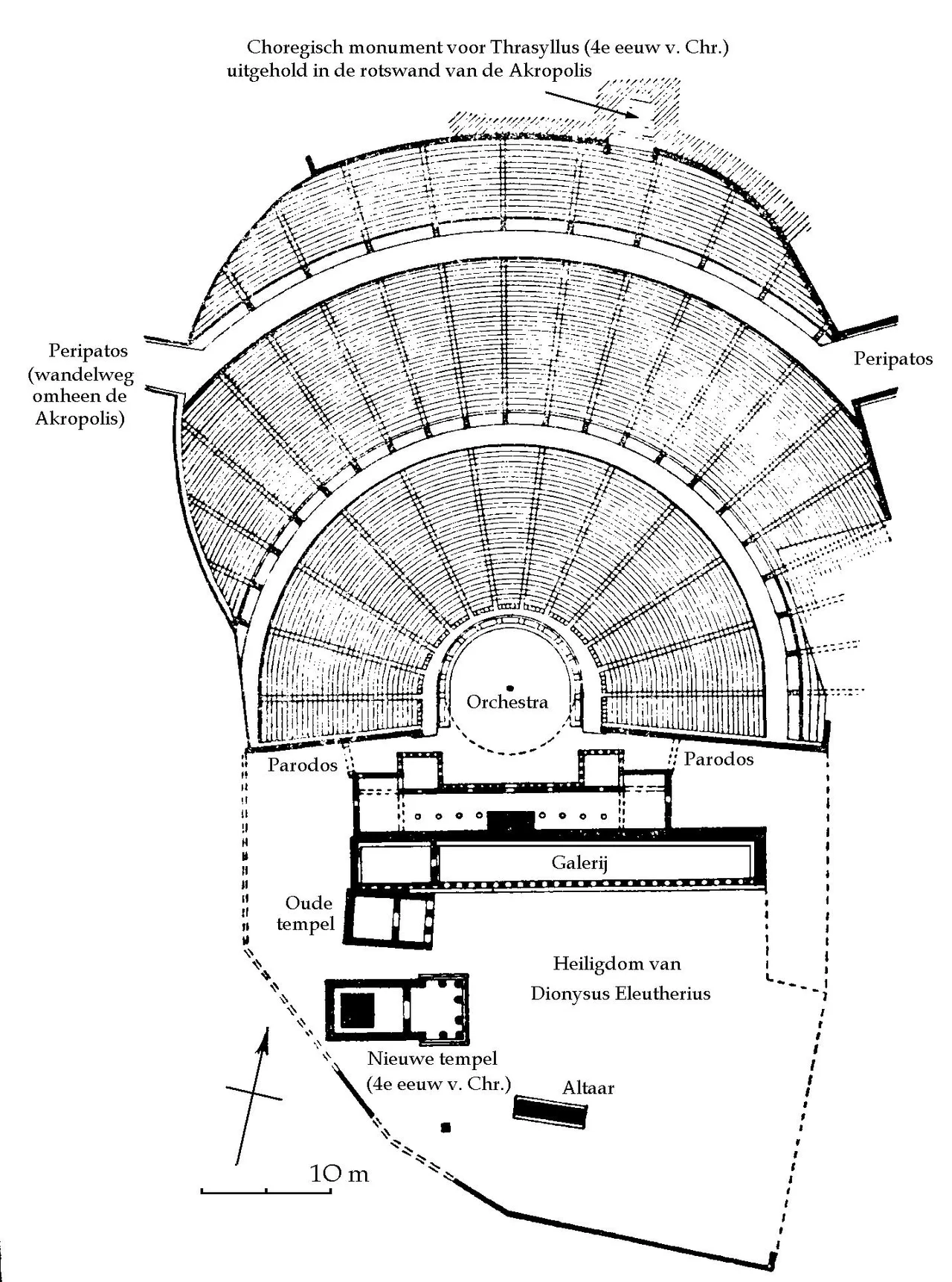
Every tragedy and comedy that survives from ancient Athens was first performed here, on a worn semicircle of stone cut into the southern flank of the Acropolis. This is where Aeschylus, Sophocles, Euripides, and Aristophanes sent their actors out before tens of thousands of spectators. The plays that still fill theatres twenty-four centuries later began as competition entries, judged in the open air on this very slope. Look at the empty curve of seats and you are looking at the cradle of Western drama.
Where the God Was Watching
The theatre was never just a stage. It grew up inside the sanctuary of Dionysus Eleuthereus, the god of wine and of theatre, and the plays were an act of worship as much as entertainment. Each spring the city held the City Dionysia, a festival that turned drama into a civic contest. Citizens packed the slope; metics, foreigners, and enslaved people attended too, while the public Theoric Fund underwrote tickets for poorer citizens. The earliest performances had taken place down in the Agora, until the wooden bleachers there collapsed under the crowd. That disaster pushed the festival up here, to the natural hollow of the Acropolis hill, where the rock itself became the first seating and the god looked on from his temple below.
The Golden Age
In the fifth century BC, the slope witnessed an explosion of genius that has rarely been matched. The Oresteia of Aeschylus needed a palace door for its entrances and exits, hinting at painted scenery and a primitive stage building. Sophocles and Euripides built on that, and Aristophanes turned his comic fire on the politicians sitting in the front rows. Audiences here were anything but quiet. Plutarch records that in 468 BC, when Sophocles competed against the older Aeschylus, the crowd grew so unruly that the general Kimon had to march in and install his fellow commanders as judges to settle the contest. Laws may even have been passed to rein in how savagely comedy could mock the powerful.
Built in Stone
For its first century the theatre was largely wood and earth, a temporary thing rebuilt each year. That changed in the fourth century BC under Lycurgus, the Athenian statesman who controlled the city's finances and rebuilt the theatre in lasting stone. The auditorium swelled to a capacity of up to 25,000, its seats divided by stairways into wedge-shaped blocks. The front rows survive best: sixty-seven marble thrones of honour, the prohedria, each later carved with the name of the priest or official who claimed it. The central throne belonged to the priest of Dionysus himself, who sat closest to the orchestra where the chorus once sang and danced.
Rome, Ruin, and Rediscovery
The Romans reshaped the theatre for their own appetites. Under Nero the orchestra was relaid in coloured marble, and a marble barrier rose around it, most likely to shield spectators during gladiatorial combats. After the fifth century AD the place was abandoned. Its orchestra became the courtyard of a Christian basilica; its seats were quarried away for building stone. For more than a thousand years the birthplace of drama lay buried and forgotten, until excavators began uncovering it in 1861. Walk the site today and you trace eight centuries of construction in a single glance: archaic foundations, classical thrones, the Roman stage of the Bema of Phaidros, all layered into one slope beneath the Parthenon.
From the Air
The Theatre of Dionysus sits at 37.9704 N, 23.7278 E on the south slope of the Acropolis in central Athens, immediately east of the Odeon of Herodes Atticus and just below the Parthenon. The Acropolis rock is an unmistakable visual anchor from the air. Athens International Airport (LGAV) lies roughly 20 nm east-southeast. Best appreciated at low altitude in clear Mediterranean light; summer haze can soften the city below.
Nearby Stories
- Great Sand Beach 5 km away
- Battle of Delium 7.7 km away
- Tower of Aliartos 9 km away
- HMHS Britannic 10 km away
- Saronic Gulf 15 km away
- Sousaki Volcano 17 km away
- Sanctuary of Apollo Maleatas 24 km away
- Skyros 66 km away