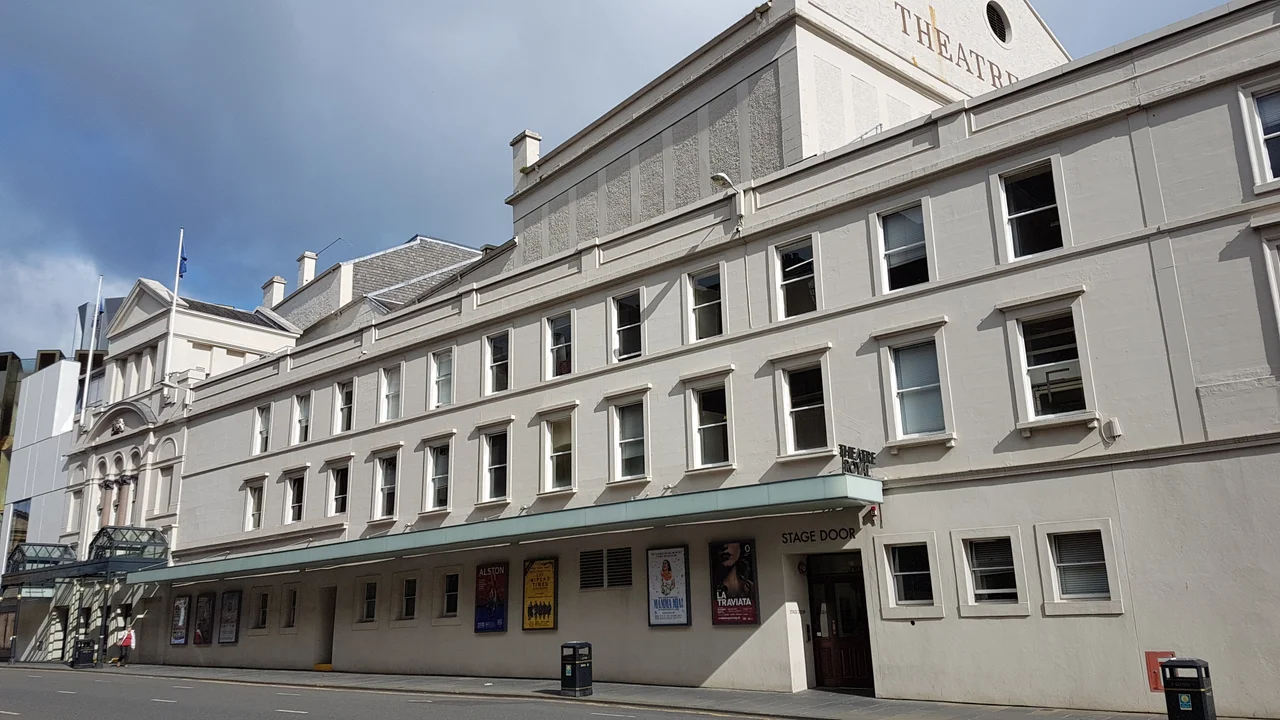

Theatre Royal, Glasgow
Fire is the recurring guest at the Theatre Royal. The auditorium burned in 1879. It burned again in 1895. It caught fire once more on 3 November 1969, and that time a fireman who climbed in to fight the blaze did not come out alive. Each time, the building was rebuilt - faster than seems possible, in plasterwork and gilt and rows of velvet seats that filled within weeks of reopening. The theatre at 282 Hope Street, Cowcaddens, has been operating since 1867, longer than any other theatre in Scotland. It is the largest surviving example of Charles J. Phipps' architecture in Britain. Today, with 1,541 seats, it is the home of Scottish Opera and Scottish Ballet, and its plasterwork is once again picked out in gold, cream and pale blue.
James Baylis Opens a Music Hall
The building opened in 1867 as the Royal Colosseum and Opera House under the management of James Baylis, who already ran the Milton Colosseum Music Hall at Cowcaddens Cross and had opened the Scotia Music Hall down on Stockwell Street. He was a Glasgow showman with multiple irons in multiple fires. Two years later he leased the new venue to Glover and Francis, who had previously run the old Theatre Royal in Dunlop Street before it was demolished to make way for St Enoch railway station. William Glover brought the name Theatre Royal with him - along with his company of actors, orchestra, and stage crew - and the building was rebranded. From its earliest years it specialized in opera, presenting many Scottish premieres of works both famous and now-forgotten.
Phipps Rebuilds in French Renaissance
The 1879 fire gave Charles J. Phipps, then the most sought-after theatre architect in Britain, the chance to rebuild the auditorium from scratch. He turned the front door away from Cowcaddens Road to face Hope Street, expanded the building into a classical French Renaissance design with three galleries instead of two, and gave it capacity for around 3,000 people in an era when audiences sat closer together than they do now. It is this auditorium - in its essentials - that still stands. When fire returned in 1895, Phipps oversaw the rebuild again, restoring his design within six months and few visible changes. The same year, the resident company became Howard and Wyndham Ltd, quoted on stock exchanges, and grew into the largest group of quality theatres in Scotland and England, with the Royal as flagship.
Pantomime and the Five Past Eight Shows
In 1888, Baillie Michael Simons arranged for two actor-managers, James Howard and Fred Wyndham, to take the theatre on. They announced an ambitious programme: plays, opera, musicals, summer revues, and above all pantomime. Their first was The Forty Thieves. Howard and Wyndham went on to produce pantomimes across Britain for nearly 80 years. From the 1930s they staged the famous Half Past Eight Shows, later rebranded as the record-breaking Five Past Eight Shows. They never operated music halls - that was Moss Empires' territory - but they built the King's Theatre across the city in 1904, designed by Frank Matcham, and kept the Theatre Royal as the centerpiece of their empire. Simons himself was a Glasgow cultural entrepreneur whose touch also lay behind Kelvingrove Art Gallery, the International Exhibitions of 1888 and 1901, and the expansion of the McLellan Galleries.
From Television to Opera
In 1957 Scottish Television leased the theatre, transmitting variety, dance and music programmes from its stage and networking them to ITV areas south of the border. STV became one of the earliest and largest sponsors of Scottish Opera, founded by Sir Alexander Gibson in 1962. The 1969 fire, in which a fireman lost his life, paused operations. STV moved most of its productions temporarily to its Edinburgh branch. In 1974, STV moved next door to custom-built premises and offered the theatre to Scottish Opera, which bought it with public support. The company turned it into Scotland's first national opera house, enlarging the orchestra pit to hold a hundred players, modernizing the dressing rooms, restoring the plasterwork to its original cream, gold, and pale blue, and hanging William Morris wallpaper on the principal walls. The reopening on 14 October 1975 was a televised gala performance of Die Fledermaus, with the Duke of Edinburgh on hand to open the building.
An Elliptical New Foyer
In 1997, lottery funding paid for new wiring and a fresh colour scheme - cherry-red walls, turquoise seats - replacing the 1975 palette. In 2005 Scottish Opera leased the management to Ambassador Theatre Group while keeping the building as its home, and Scottish Ballet's. The most dramatic recent change came in December 2014, when a 14-million-pound, largely elliptical new foyer building opened at the corner of Hope Street and Cowcaddens. Designed by Page and Park on the site of the former Alexandra Music Hall, it added entrances, bars, a cafe, hospitality and education space, a heritage exhibition, and lifts to every level including an open roof terrace - all wrapped around an open spiral staircase. Since 1977 the older theatre has been protected as a Category A listed building. It has burned three times. It has been rebuilt three times. It is still selling tickets.
From the Air
Located at 55.8662°N, 4.2562°W, at the corner of Hope Street and Cowcaddens Road in central Glasgow. The 2014 elliptical foyer is the most visible recent addition, contrasting with the older sandstone block behind it. The site sits just north of the M8 motorway. Glasgow Airport (EGPF) is 13 km west; Glasgow Prestwick (EGPK) lies roughly 50 km south-southwest. Best viewed at low altitude over the Cowcaddens district.
Nearby Stories
- Mauchline 3.6 km away
- Shotts 4.2 km away
- HMS Ulysses (1917) 7.7 km away
- Rothesay Castle 8.8 km away
- Inchcailloch 10 km away
- Strachur 14 km away
- Battle of Dollar 16 km away
- Crawford Castle 16 km away