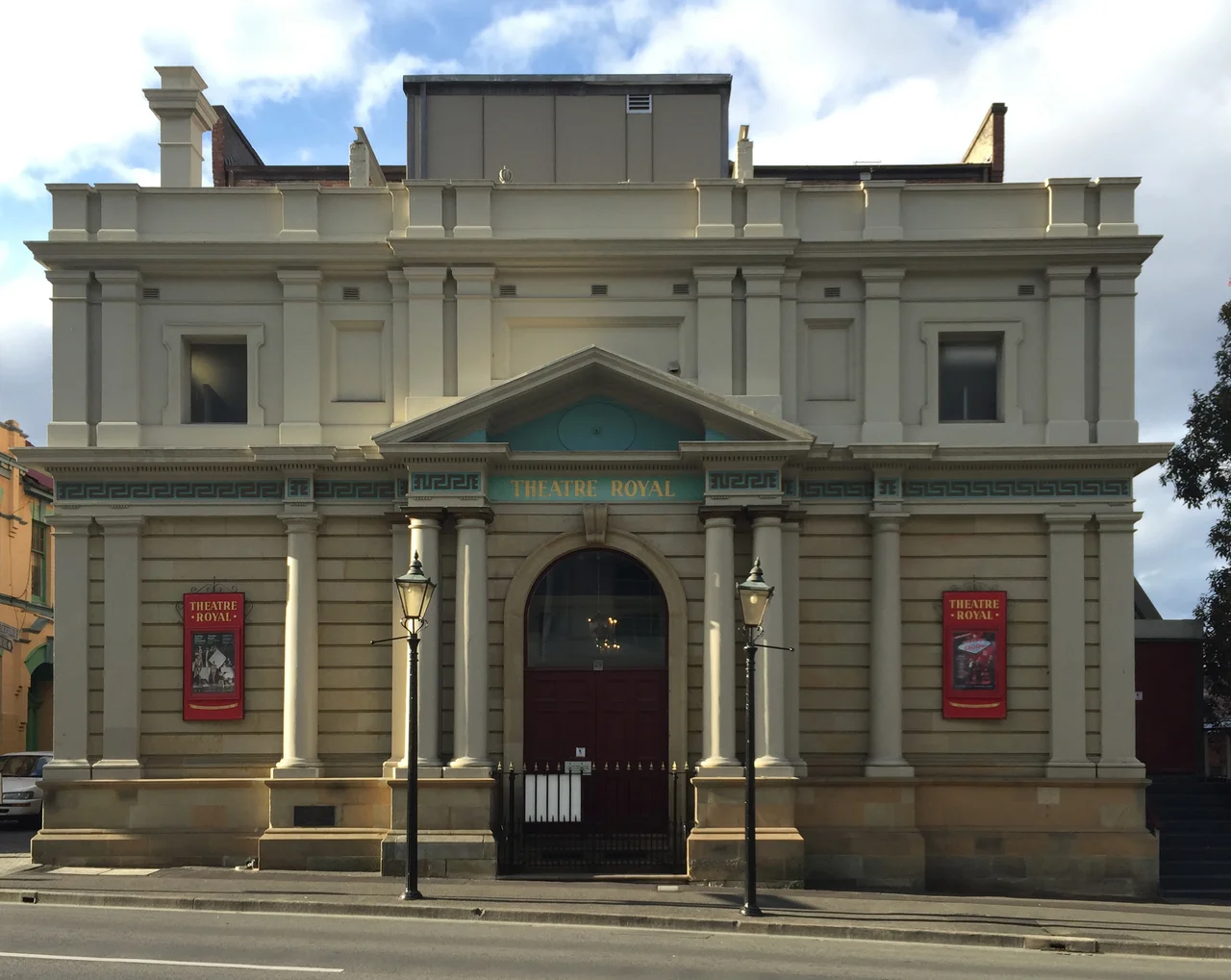

Theatre Royal, Hobart
Noel Coward called it "a dream of a theatre." The dream was built next door to a slaughterhouse. When the Theatre Royal opened in Hobart in 1837, it stood in one of the roughest, foulest-smelling corners of the town, hemmed in by an abattoir, brothels, factories and pubs. The architect made a clear-eyed peace with the neighbourhood: he cut a doorway straight from the pub next door into the cheap pit seating, a rowdy section the locals nicknamed "the Shades." The fine carriages of the gentry could come and go by the front. The sailors and labourers could drink their way in from the side. Nearly two centuries later, it is the oldest continually operating theatre in Australia, and it has survived everything the years could throw at it, including fire.
The Shades and the Cockfights
The Theatre Royal was finished by the end of 1836, built in part with convict labour, and staged its first performances in March 1837 with Thomas Morton's Speed the Plough. That June it was formally christened the Royal Victoria Theatre to mark the young Queen's coronation, though everyone soon dropped the mouthful and simply called it the Theatre Royal. In its early years the stage saw as much blood sport as drama. Hemmed in by the convict-laden Wapping district, it hosted cockfights, boxing matches and religious meetings, and the patrons of the Shades, visiting seamen and dockside workers, were notorious for heckling, drinking and brawling with the performers. Into this chaos stepped Anne Clarke, who managed the theatre from 1840 to 1847 and was credited by the press with dragging it upmarket, bringing in a better class of performer and giving a disreputable art form a respectable name.
Gilding the Old Lady
Ownership passed through hands that each tried to lift the theatre's fortunes. Peter Degraves, who had taken full control when the original investors fled an economic slump, mounted a major renovation in 1856 that did little for the bookings. After his death in 1883, Richard Lewis bought the place for 3,222 pounds and spent some forty years polishing it. The great transformation came in 1911, when the interior was gutted and rebuilt entirely. The Melbourne architect William Pitt, a specialist in theatres, replaced the unruly Shades with raked stalls and raised a steep new balcony above, dressing the whole auditorium in the ornate Louis Quatorze style still seen today: red velvet, gilded plasterwork, and a crystal chandelier hung in a domed ceiling. Yet grandeur could not stop decay. By the 1940s the performers were dodging holes in the stage, faulty wiring and cockroaches, and the building drifted close to demolition.
The Fire of 1984
In the early 1980s a million-dollar refurbishment was launched to honour the theatre's 150th year, restoring the 1911 decoration and rebuilding the backstage into a smaller second venue. The work was nearly finished when, on 18 June 1984, fire broke out backstage and pushed into the main auditorium. The roof took structural damage; smoke and water ruined almost everything else. Of all the furniture, fittings and decoration, a single painting survived. One small mercy saved the worst of it: a fire curtain dropped across the stage, almost as if by its own decision, and held back the flames. The loss was severe, but the response was immediate. Backed by insurance, a public fundraising appeal and a government guarantee, Australia's grand old lady of the theatre was sent straight back into reconstruction, though it would be years before her doors opened again.
Fred, and the Long Encore
The Theatre Royal reopened in March 1986 and quickly reclaimed its place at the centre of Hobart's social life. Today it runs a full annual program of theatre, music and dance, has offered a subscription season since 1994, and has folded into the larger Hedberg performing arts complex next door. Through all the renovations one tenant has refused to leave. The theatre's resident ghost, known as Fred, is said to be a former actor killed in a fight in the basement long ago. He made his public debut, fittingly, in 1984, when the theatre invoked him to help its restoration appeal after the fire, proof that even a theatre's ghosts know how to play to the house. To stand in the gilded auditorium now is to occupy a room that has been a cockpit, a slum entertainment, a society jewel, a ruin and a phoenix, all without ever quite going dark.
From the Air
The Theatre Royal stands in central Hobart at 42.88 degrees south, 147.33 degrees east, a few blocks back from the River Derwent waterfront on Campbell Street. As a low historic building wedged into the city grid, it is not a standout from altitude; navigate instead by the broad Derwent estuary, the Tasman Bridge just to the north, and kunanyi / Mount Wellington rising west of the city. Best appreciated on the ground, but for orientation a 1,500 to 2,500 ft pass over central Hobart places it between the waterfront and the mountain. Hobart International Airport (ICAO: YMHB) lies about 14 km east across the river; Cambridge Aerodrome (YCBG) is nearby. City air is generally clear, though winter mornings can bring haze off the harbour.
Nearby Stories
- Maria Island 20 km away
- Port Arthur Massacre Memorial 31 km away
- Mount Field National Park 34 km away
- Freycinet National Park 59 km away
- Van Diemen's Land 72 km away
- Franklin Dam Controversy 100 km away
- 2003 Fiordland Earthquake 1525 km away
- Chatham Islands 2932 km away