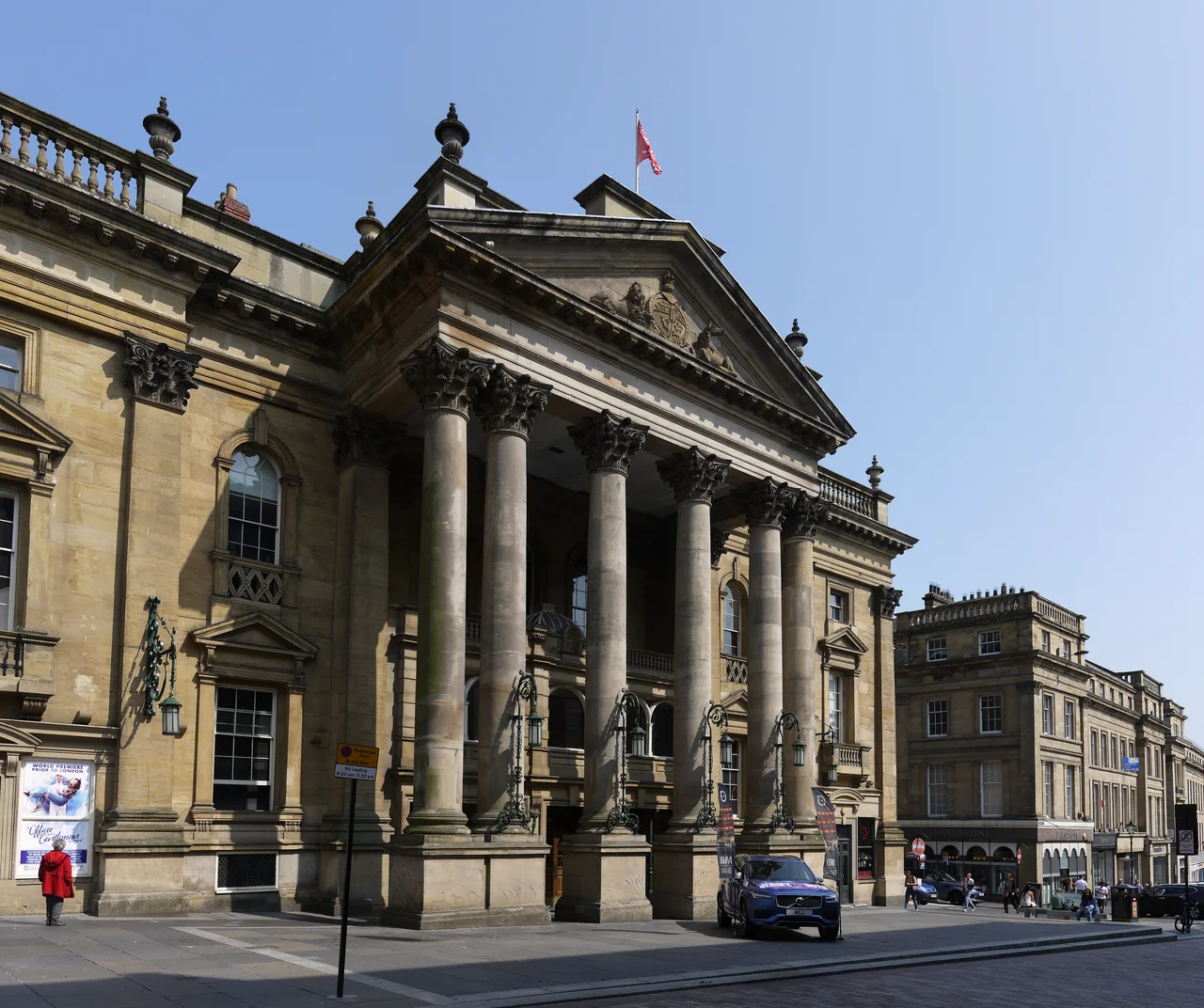

Theatre Royal, Newcastle
On 31 December 1901, the Theatre Royal on Grey Street reopened to a Newcastle audience that had been waiting more than two years. A fire after a performance of Macbeth in 1899 had gutted the interior of a theatre that had only stood for sixty years; the city had lost one of its most beloved Victorian buildings overnight. The man who rebuilt it was Frank Matcham, the most celebrated theatre architect of his era, whose other works include the London Coliseum and the Buxton Opera House. What he delivered - Edwardian gold leaf, gilded plasterwork, a five-tier auditorium - is what audiences still see today. The Theatre Royal is the rare survivor of a Newcastle that took its theatre seriously enough to spend the money twice.
The First Theatre
George III authorised the founding of a theatre in Newcastle in the 1780s. The first Theatre Royal opened on Mosley Street and, for a quarter of a century, was managed off and on by Stephen Kemble - brother of the great tragedian John Philip Kemble and the slightly more famous actress Sarah Siddons. The Kemble family was British theatrical royalty, and Stephen's tenure from 1791 to 1806 gave Newcastle a glamour disproportionate to its size. But by the 1830s, the city was being reshaped by Richard Grainger, whose grand Tyneside Classical scheme required Mosley Street to be cut through to make Grey Street. The Theatre Royal sat in the way. It was demolished in 1834.
Grey Street's Crown
The new Theatre Royal was designed by local architects John and Benjamin Green as part of Grainger's grand redesign of central Newcastle, and it opened on 20 February 1837 with a performance of The Merchant of Venice. It anchors the lower curve of Grey Street, which Sir John Betjeman would later call one of the finest streets in England. One of the first managers was Thomas Ternan, whose wife Frances Ternan acted as the leading lady - she would later be remembered as the mother of Ellen Ternan, the actress with whom Charles Dickens conducted his long, secretive relationship. The longest-running individual lessee was Edward D. Davis, from 1845 to 1870, during which architect Charles J. Phipps redesigned the interior in 1867.
Fire and Matcham
A performance of Macbeth in 1899 ended in disaster. A fire broke out after the audience had left and gutted the interior of the building. The shell on Grey Street stood, but everything inside had to be rebuilt. The Cowen family, who controlled the lessee company through MP Joseph Cowen, brought in Michael Simons of Glasgow as chairman and engaged Frank Matcham as architect. Matcham's Edwardian interior - gold leafed proscenium arch, ornate plasterwork, multi-tier auditorium with boxes near the stage and at the rear of the circles - opened on 31 December 1901. Newcastle had its theatre back, more lavish than ever.
Charlton Heston and the Modern Restoration
By the 1980s the building was tired again. A major refurbishment ran from 1986 to 1988, reopening on 11 January 1988 with A Man For All Seasons starring Charlton Heston. Heston had family connections to Tyneside and chose Newcastle deliberately. The theatre then went dark again on 14 March 2011 for a 4.75 million pound restoration that stripped the auditorium back to bare plasterwork and rebuilt it to Matcham's 1901 specifications. The amphitheatre that had been removed in earlier renovations was reinstated, gold leaf was reapplied, new frescos were commissioned for the lobby and upper circle, and wheelchair spaces were added on every level. The theatre reopened on 12 September 2011 with Alan Bennett's The Madness of George III - a fitting choice, given that George III had authorised the city's first Theatre Royal in the first place.
A Touring House
Almost everything that comes to the Theatre Royal today is a national tour - thirty to thirty-five visiting productions in a typical year. The orchestra pit seats up to sixty musicians for opera and musicals. The Royal Shakespeare Company has very close ties to Newcastle and is a recurring presence in the spring programme. The annual pantomime is one of the city's institutions, a Tyneside Christmas tradition that has run almost continuously since the building was first thrown open in 1837. Stand on Grey Street in December and look up - the building Grainger built and Matcham rebuilt is still lit for the next show.
From the Air
The Theatre Royal sits at 54.973 degrees N, 1.612 degrees W, on Grey Street in central Newcastle upon Tyne, two blocks north of Grey's Monument. Newcastle International (EGNT) is 5 nautical miles north-west. From the air, central Newcastle's Georgian street grid is visible with Grey Street curving south-east toward the Tyne. The theatre's neoclassical portico fronts Grey Street roughly 600 metres north of the Tyne Bridge. Look for the cluster of stone buildings forming Grainger Town. Best viewed at 1,500-2,500 feet AGL in clear conditions.
Nearby Stories
- Cresswell Lifeboat Station 5.2 km away
- Auckland Castle 5.7 km away
- Battle of Otterburn 7.1 km away
- Saltburn Pier 11 km away
- Hadrian's Wall Path 11 km away
- Battle of Stainmore 18 km away
- Saltburn-by-the-Sea 39 km away
- Alexander L. Kielland (Platform) 296 km away