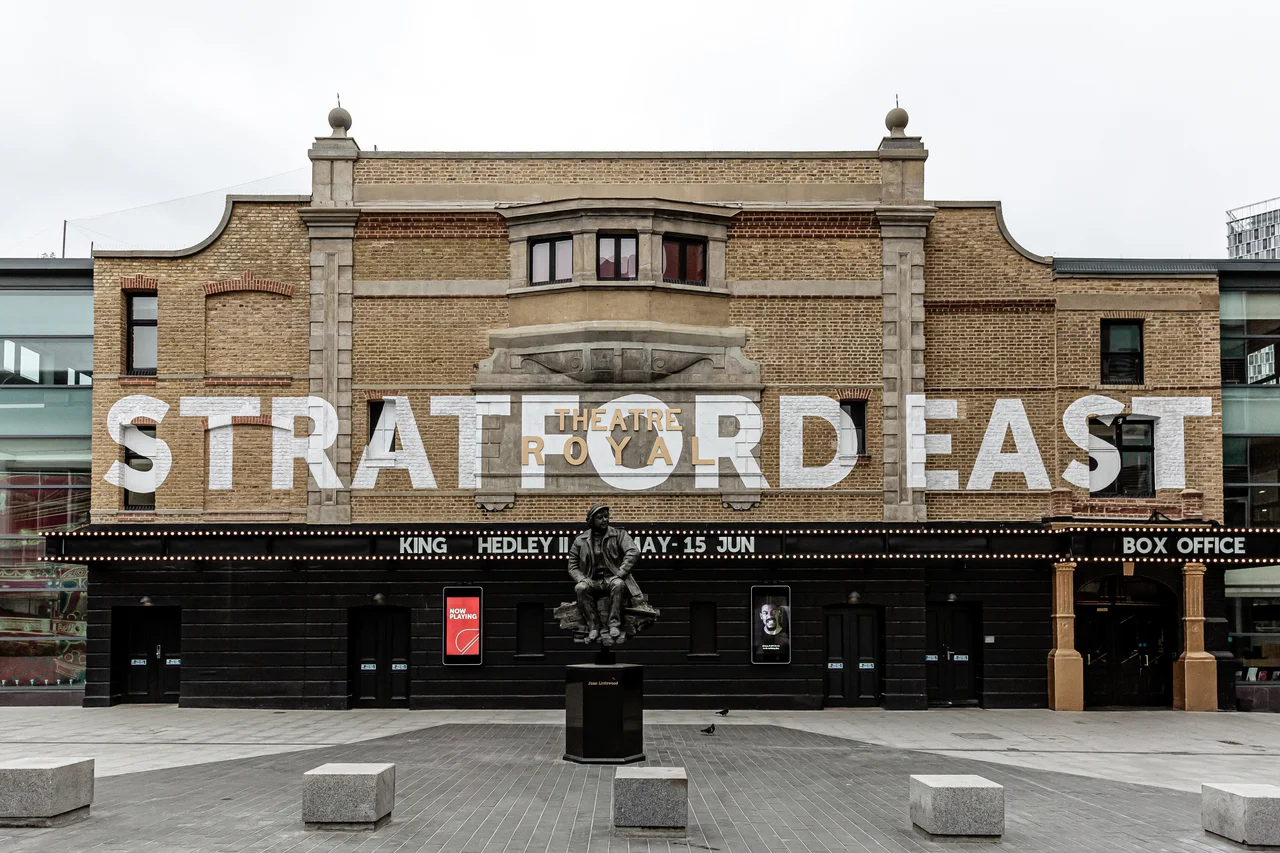

Theatre Royal Stratford East
Joan Littlewood looked at the young man auditioning in her theatre in 1956 - a tall actor with rimless spectacles and the wrong kind of ambition - and told him: "Piss off to Shaftesbury Avenue. You will only ever be a star." The young man was Michael Caine. He took the advice. The theatre was Stratford East. Outside it now stands a statue of Joan Littlewood herself, the small fierce director whose Theatre Workshop turned a struggling Victorian playhouse in east London into the most influential company in twentieth-century British theatre. The proscenium still bears the letters "FF" that nobody quite remembers the meaning of. Theatre superstition has it that if the letters are ever removed, the building will crumble.
A Theatre on a Wheelwright's Shop
James George Buckle designed only one theatre that survived. The Theatre Royal Stratford East opened on 17 December 1884, built on the site of a wheelwright's shop on Salway Road just off Angel Lane, commissioned by Charles Dillon - the adopted son of the great actor-manager Charles Dillon. The opening night was a revival of Richelieu by Edward Bulwer-Lytton, the playwright now remembered mainly for the opening line "It was a dark and stormy night." Dillon sold the theatre two years later to Albert O'Leary Fredericks, his sister's brother-in-law. The Fredericks family ran it for nearly fifty years, even surviving the August Bank Holiday fire of 1921 that destroyed the rear of the building - the safety curtain had been lowered before the audience went home, which is the only reason the Victorian auditorium still exists. The "FF" on the proscenium may stand for Frederick Fredericks, the actor husband of Charles Dillon's sister. Nobody is entirely certain. The letters stay anyway.
Joan Littlewood and the Theatre Workshop
The Theatre Workshop company arrived in 1953, led by Joan Littlewood and her partner Gerry Raffles. They had been an itinerant troupe for years, performing in church halls and improvised spaces, committed to a kind of socially engaged theatre that the British establishment did not yet have a category for. At Stratford East they found a home. Littlewood developed an improvisational, ensemble-based approach that drew on Brecht, on Stanislavski, on the music hall traditions of the East End. The actors she trained included a generation that would shape British screen comedy and drama: Barbara Windsor, Murray Melvin, Brian Murphy, Yootha Joyce, Harry H Corbett, Avis Bunnage, Victor Spinetti. The shows she produced - A Taste of Honey, Oh, What a Lovely War! - became landmarks of postwar British culture. Shelagh Delaney wrote A Taste of Honey at nineteen. Lionel Bart got his start writing music for Theatre Workshop before Oliver! made him rich. In 1975 Gerry Raffles died of diabetes, aged 51. Littlewood, devastated, moved to France in 1979 and never directed again.
The Theatre That Refused to Die
The 1970s nearly killed the building. The construction of the Stratford shopping centre threatened to demolish it. A public campaign saved it. English Heritage gave it Grade II* listing in June 1972. Money was always short. Gerry Raffles managed redecoration as cash allowed; later managers stretched every grant; the 2001 Heritage Lottery Fund bid finally paid for a proper refurbishment as part of the Stratford Cultural Quarter that grew around what would become the Olympic Park. Philip Hedley, artistic director from 1979 to 2004, continued Littlewood's project of putting East London on stage - traditional music hall variety on Sunday evenings, new work that reflected the changing local demographic, then the Musical Theatre Initiatives scheme that he launched in 1999 to develop new British musicals. In 1990 Five Guys Named Moe transferred from Stratford East to the West End and won the Olivier Award for Best Entertainment, then went to Broadway, then to the world. In 2004 The Big Life became the first Black British musical to transfer to the West End. The year after, The Harder They Come - the stage adaptation of the cult Jamaican film, with its reggae soundtrack - did the same.
New Communities, New Stages
Kerry Michael took over in 2004 with a stated mission to bring London's newer communities to the stage. His debut as artistic director was The Battle of Green Lanes by Cosh Omar, set in London's Cypriot community. Under Michael, the theatre won Olivier Awards for Pied Piper in 2007 and Cora Bissett's Roadkill in 2011. In 2016 the theatre rebranded simply as Stratford East and opened Gerry's - a café and 80-seat studio space named for Gerry Raffles. Nadia Fall arrived as artistic director in 2017 and ran the building until 2025, opening her first season with The Village, an adaptation of Lope de Vega's Fuenteovejuna featuring Anya Chalotra and Art Malik. Her revival of Equus, directed by Ned Bennett, transferred to the West End in 2019 and won three Off-West End Awards. King Hedley II starred Lenny Henry. The community opera Noye's Fludde, co-produced with English National Opera, featured children's groups and schools from across Newham. Lisa Spirling succeeds Fall in 2025.
What FF Could Still Stand For
The proscenium letters still wait, in their faded gilt, for someone to be certain of their meaning. Theatre superstition holds that the building falls if the letters are removed. The auditorium - oval, intimate, the gilt and red velvet of late-Victorian playhouse design preserved through fire and threatened demolition and rolling neglect - is one of the most beautiful small theatre interiors in London. Standing in it now, you can see why Joan Littlewood made her stand here. The room itself argues for the kind of theatre she wanted: the audience close to the stage, the actors close to the audience, no possibility of pretension because the space will not allow it. Two thousand twenty-three brought controversy with a series of performances designated for Black audiences only, a programme widely criticised and widely defended, with the cabinet office eventually confirming that the policy was legal under the 2010 Equality Act. The argument outside reached the national papers. The work inside continued. That, in the end, is what Stratford East has always done.
From the Air
Theatre Royal Stratford East sits at 51.54°N, 0.00°E in the London Borough of Newham, on Gerry Raffles Square just north of Stratford station. The theatre is a small Victorian building set against the much larger structures of the Westfield Stratford City development, the former Olympic Park to the north, and the towers of central Stratford. London City Airport (EGLC) is 3 miles to the south; London Heathrow (EGLL) is 18 miles west. Best viewed from 1,500-2,500 feet to read the theatre's footprint against the modern surroundings.
Nearby Stories
- Waytemore Castle 2 km away
- Prittlewell Royal Anglo-Saxon Burial 4.2 km away
- Sevenoaks 5.6 km away
- Central line (London Underground) 6.4 km away
- River Lea 9.7 km away
- Surrey 11 km away
- Mercury Theatre, Colchester 14 km away
- Faversham Munitions Explosion Memorial 14 km away