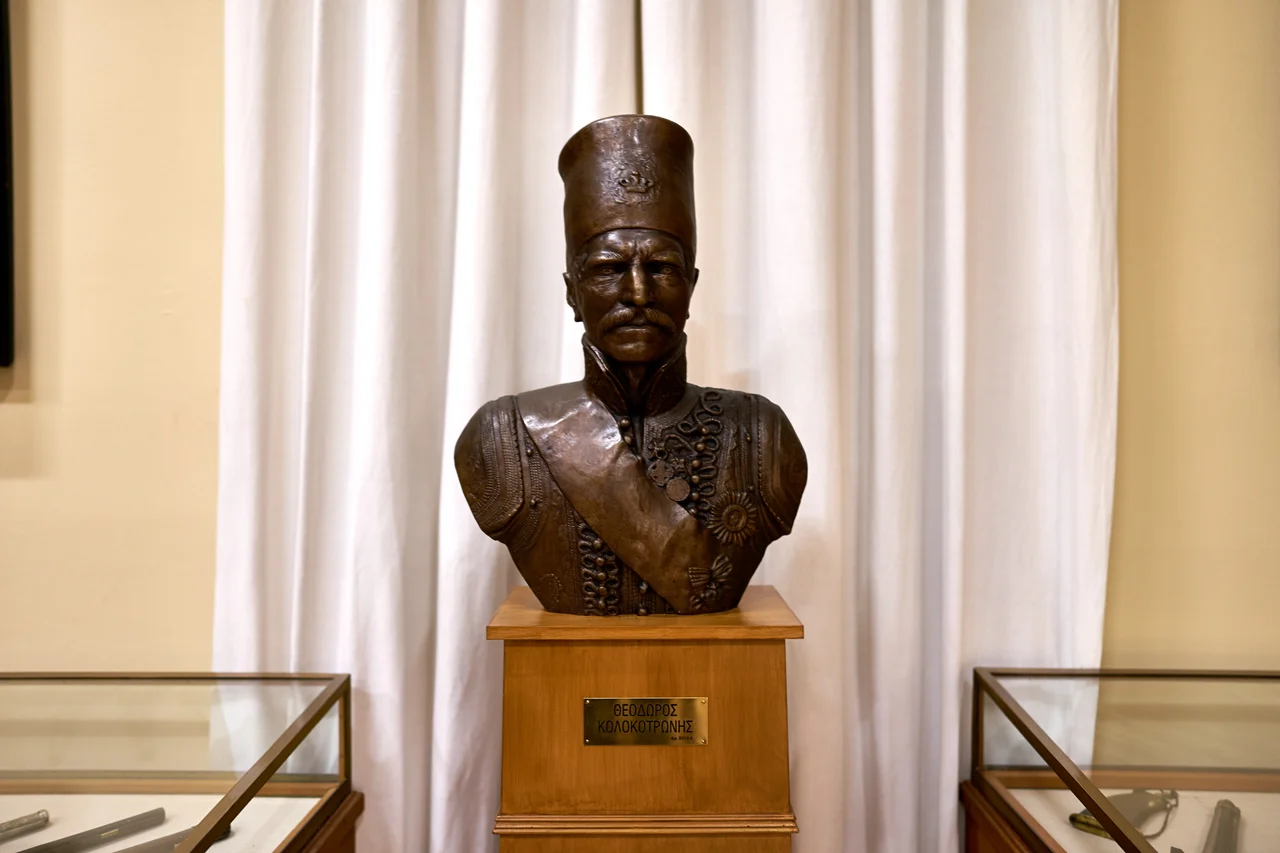

Theodoros Kolokotronis
The statue stands in the forecourt of the Old Parliament building on Stadiou Street, near Syntagma Square: a man on horseback, wearing a plumed helmet and the pseudo-classical uniform he was known to favour. Theodoros Kolokotronis looks as commanding in bronze as contemporary portraits suggest he was in life. He was 50 years old when the Greek War of Independence broke out on 25 March 1821 — already, by the standards of guerrilla warfare in the mountains of the Peloponnese, an old man. The sobriquet stuck: *O Geros tou Morea*, the Elder of Morea. What it obscured was how much of his life had been a preparation for what came next.
The Klepht Who Became a General
Before 1821, Kolokotronis was a klepht — one of the armed mountain men who operated outside Ottoman authority in the highlands of the Peloponnese, sometimes as bandits, sometimes as unofficial protectors of Greek communities, often as both simultaneously. He had spent time in the Ionian Islands, then under British protection, where he gained some exposure to organised military thinking. When he returned to the mainland just before the outbreak of the war, he carried that experience with him. He formed a confederation of irregular Moreot klepht bands and tried to train and organise them into something resembling a modern army — a task that tested anyone's patience, given what the sources describe as the notoriously quarrelsome nature of the klephtic bands. In May 1821 he was named archistrategos, commander-in-chief. He was already the oldest man in the room.
The Pass at Dervenakia
The moment that defined Kolokotronis came in August 1822. The Ottoman army commanded by Mahmud Dramali Pasha had swept south from Corinth to the plain of Argos, aiming to crush the Greek uprising. Dramali's force was large and well-equipped, but it carried a vulnerability: the Greeks had pursued a scorched earth policy, and the Ottomans were burning through their food supplies in a landscape that offered nothing to replace them. The Greek fleet under Admiral Andreas Miaoulis blocked the supply ships at Nafplio. Dramali had no choice but to retreat toward Corinth through the same pass he had come through — the Dervenaki. Kolokotronis had been hoping for exactly this. His faster-moving guerrilla forces had already positioned themselves in the heights. When the Ottoman column entered the pass, it was trapped. The Battle of Dervenakia destroyed Dramali's army. Sultan Mahmud II, devastated, was forced to turn to Muhammad Ali of Egypt for help — and the war entered a new, grimmer phase. But the pass at Dervenakia had shown that the Greeks could fight and win.
Jailed by the Country He Had Fought For
Victory did not bring peace, and not only because of the Egyptian forces that Ibrahim Pasha led through the Peloponnese from 1825. The independent Greece that Kolokotronis had helped create was riven by faction from the start. Between December 1823 and February 1825, the young Greek state descended into civil war among its competing power centres. When Kolokotronis's faction was defeated, he was jailed on the island of Hydra in March 1825. He was released only when Ibrahim's invasion made his military experience urgently necessary again. The pattern would repeat. After the war ended, he supported Count Ioannis Kapodistrias and then Prince Otto of Bavaria as king. But he fell afoul of the Bavarian-dominated regency that governed in Otto's name. On 7 June 1834, he was charged with treason and sentenced to death. He was 63 years old and had spent his adult life fighting for the Greek state. He was pardoned in 1835. The arrest and near-execution were not incidental to his story: they were part of it. A man who had fought a revolutionary war discovered, as many such men do, that the state he had won was not the one he had imagined.
The Memoirs He Learned to Write
Kolokotronis died in Athens in 1843, the day after his son Konstantinos's wedding, following a feast at the Royal Palace in the presence of King Otto. He was buried in the First Cemetery of Athens, where he remained until 1930, when Prime Minister Eleftherios Venizelos had his bones exhumed and transported to Tripoli. They rest today at the base of his statue in Areos Square. In the twilight of his life, Kolokotronis had taught himself to write in order to complete his memoirs — a testament to a man who had started life as an illiterate mountain fighter. Those memoirs are now considered the second most important account of the Greek War of Independence after the memoirs of Yannis Makriyannis. His helmet, weapons, and armour are in the National Historical Museum in Athens. A portrait of him appeared on the Greek 5,000-drachma banknote from 1984 to 2002. The Old Man of the Morea, in other words, has not gone anywhere.
From the Air
Theodoros Kolokotronis is most closely associated with Athens and the Peloponnese. The equestrian statue that most defines his public memory stands at approximately 37.963°N, 23.738°E, in the forecourt of the Old Parliament building on Stadiou Street in central Athens, a short walk from Syntagma Square. From the air approaching Athens from the southwest over the Saronic Gulf, the grid of the historic centre is clearly visible, with the Acropolis rock rising prominently to the south. Athens Eleftherios Venizelos International Airport (LGAV) lies approximately 26 km to the east-northeast. Recommended viewing altitude: 2,000–4,000 ft AGL for the city overview, with clear-weather views extending to the Peloponnese hills to the southwest where Kolokotronis fought.
Nearby Stories
- Parnitha 3.4 km away
- Kea (island) 7.3 km away
- Sanctuary of Apollo Maleatas 11 km away
- Sousaki Volcano 12 km away
- Battle of Leuctra 14 km away
- Great Sand Beach 18 km away
- Agios Georgios (island) 23 km away
- Skyros 84 km away